







Two operators. Six hours. And the loading dock still isn’t dry before the next truck arrives. In large facilities, that’s the gap a ride-on floor scrubber is designed to close—not through brute force, but through a fundamentally different approach to covering ground.
That said, a ride-on in the wrong environment is an expensive machine that turns and idles rather than cleans. This guide focuses on what most buying guides skip: the conditions that make a ride-on the right call, the conditions that make it the wrong one, and the specs that separate a good purchase from a costly mismatch.
What Is a Ride-On Floor Scrubber?
A ride-on floor scrubber is a powered cleaning machine operated from a seated position. In a single pass, it dispenses cleaning solution, scrubs the surface with a rotating brush deck, and vacuums up the dirty water through a rear squeegee—leaving the floor clean and nearly dry.
Five components do the work:
- Solution tank — holds clean water and detergent
- Brush deck — scrubs with disc or cylindrical brushes
- Recovery tank — collects dirty water
- Squeegee — channels wastewater toward the vacuum inlet
- Traction system — drives and steers the machine
The key difference between a ride-on and a walk-behind isn’t just size. It’s a different operating model. A walk-behind sets a hard ceiling on how much one person can clean per shift—the operator has to walk every meter. A ride-on removes that ceiling. Fatigue and walking distance are no longer the constraints. That shift matters most in warehouses, distribution centers, manufacturing plants, and airports where cleaning routes run long and straight.
Does Your Facility Actually Need a Ride-On?
Before looking at any spec sheet, answer these four questions. They’ll tell you more than any brochure.
- How much open, unobstructed floor do you actually clean per shift?
Not total building area—actual cleanable routes. A 20,000 m² warehouse packed with racking might yield only 6,000 m² of usable floor space. That number determines the machine’s size. - How wide are your narrowest cleaning aisles?
A ride-on needs room to move and turn. If your tightest routes force constant three-point turns, the machine spends more time maneuvering than cleaning, and the productivity advantage shrinks fast. - Can one operator realistically walk the full cleaning route each shift?
When that’s not physically feasible, a ride-on solves a problem a walk-behind never will. When feasible, a walk-behind often completes the job faster with less setup. - How often do you clean?
Ride-on machines earn back their cost through repeated use. Daily cleaning across a large floor makes the labor math work. Two or three times a week rarely does.
If these questions don’t point clearly toward a ride-on, a walk-behind floor scrubber is likely the better investment—not a compromise, but a better fit.
The Real Advantages of a Ride-On Scrubber
These benefits are genuine. But they only show up when the facility conditions support them.
Higher Productivity on Large Open Floors
Ride-on scrubbers clean up to 5,500 m²/h. Walk-behind models top out around 3,000 m²/h. On a large floor cleaned daily, that gap compounds across a full year.
The number that matters, though, isn’t the spec-sheet figure. It’s real throughput in your building:
Practical productivity = cleanable area ÷ total shift time
(Total shift time includes turns, refills, tank dumps, and travel between zones.)
From there, the labor savings are straightforward to estimate:
Annual savings = (manual hours − ride-on hours) × hourly labor cost × annual cleaning frequency
Facilities running five days a week often recover a significant portion of the machine’s purchase cost through labor savings alone within two years.
More Consistent Cleaning Results
Manual cleaning varies with the operator’s energy and pace. A ride-on doesn’t. Brush pressure, solution flow, and travel speed remain constant from the first aisle to the last—so the cleaning result doesn’t degrade as the shift progresses.
Brush selection matters here. Disc brushes work well on smooth, flat surfaces like sealed concrete and epoxy. Cylindrical brushes handle textured safety flooring better and can sweep fine debris while scrubbing—useful in manufacturing environments where particles are always present. Scrub pressure is adjustable up to 99 kg to handle ground-in industrial grime; lower settings protect coated floors from surface damage.
The squeegee is easy to underestimate. A well-maintained, correctly fitted squeegee leaves the floor nearly dry in a single pass. A worn or misaligned blade leaves water behind—both a slip hazard and a reason to come back.

Fewer Interruptions on Long Cleaning Runs
Every stop to refill or dump is time not cleaning. Ride-on machines carry solution tanks up to 150 L and recovery tanks up to 180 L, which reduces how often the operator has to leave the floor.
Battery choice shapes how much of that capacity you actually use:
- Lead-acid costs less upfront but charges slowly, requires maintenance, and wears out faster
- Lithium-ion costs more initially but charges quickly, lasts significantly longer, and handles multi-shift use better
- ECO mode (available on LeadV models) extends runtime by roughly 20% without a meaningful drop in cleaning performance
One detail that often gets overlooked is that cold environments reduce battery capacity. A pack rated for a full shift under normal conditions may fall noticeably short in a refrigerated warehouse or cold storage area. Size the battery for actual operating temperature, not ideal conditions. LeadV’s guide on choosing the right floor scrubber battery covers this in depth.
When a Ride-On Is the Wrong Tool
Most buying guides skip this part. It’s the most useful section in a guide like this.
Narrow or heavily racked aisles. A wide machine in a tight layout turns more than it cleans. Turning time is dead time—the machine isn’t covering the floor, and the operator is repositioning rather than cleaning.
Infrequent cleaning. The labor savings that justify a ride-on require frequency. A facility that cleans twice a week rarely generates enough saved hours to make the investment pay back within a reasonable timeframe.
No dedicated storage or charging space. Ride-on machines are large. They need a dedicated spot to park, charge, and have tanks serviced. Without that space, the machine creates a logistics problem before it ever becomes a cleaning solution.
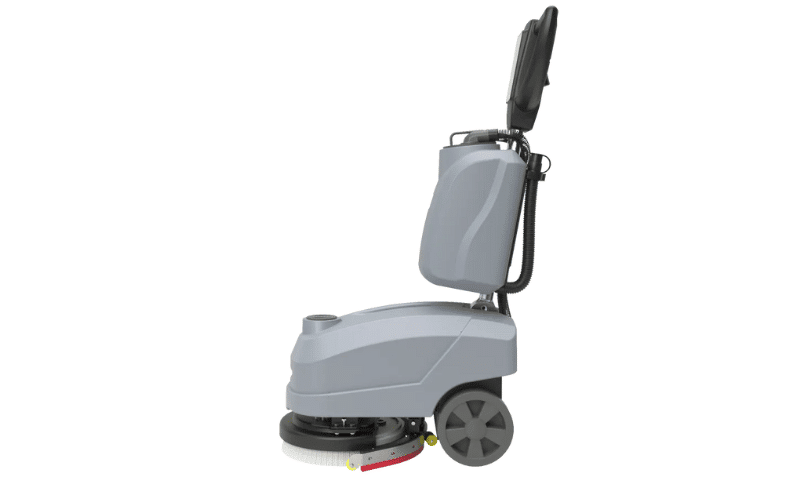
Small spaces or fragmented layouts. Lots of furniture, equipment, or short, disconnected cleaning zones favor maneuverability over raw speed. A walk-behind or a small floor scrubber will clean those environments faster than a ride-on can.
A practical rule: if most of your cleaning routes require constant direction changes and you rarely drive more than 20–30 meters in a straight line, the ride-on’s main advantage disappears.
Ride-On or Walk-Behind? Choosing by Facility Type
|
Factor |
Ride-On |
Walk-Behind |
|---|---|---|
|
Operator position |
Seated, drives the machine |
Standing, walks behind |
|
Best floor area |
Open areas of 2,000 m²+ |
Small to medium spaces |
|
Cleaning rate |
Up to 5,500 m²/h |
Up to 3,000 m²/h |
|
Tank capacity |
Up to 150 L / 180 L recovery |
45–60 L |
|
Storage needed |
Large; dedicated space |
Compact |
|
Maneuverability |
Best in open layouts |
Strong in tight spaces |
|
Upfront cost |
Higher |
Lower |
|
Typical environments |
Warehouses, terminals, large retail |
Offices, clinics, aisles, schools |
How this plays out in practice:
- Warehouses and industrial facilities: Ride-on for open floor areas and loading zones; walk-behind for tightly racked sections or areas the ride-on can’t navigate cleanly. See warehouse and industrial solutions.
- Retail and supermarkets: Walk-behind for customer aisles where noise and tight turns are daily constraints; ride-on for open back-of-house areas where speed matters more. See retail and supermarket solutions.
- Healthcare and education: Noise level, operating around people, and maneuverability in corridors are typically the dominant requirements—walk-behind machines handle these better. See healthcare and educational solutions.
- Airports and transport hubs: Ride-on for long, open concourses; walk-behind for gate areas, restrooms, and tight service corridors.
Many large facilities run both. A ride-on covers the open floor efficiently; a walk-behind handles the sections the ride-on can’t reach.
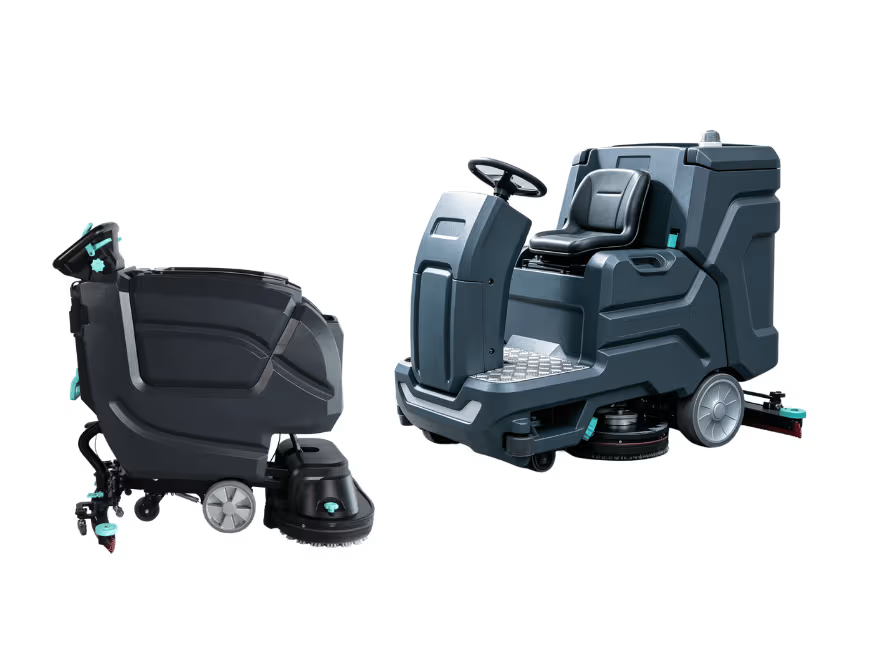
Matching Machine Setup to Your Floor Type
Buying the right machine type is only part of the decision. How the machine is configured—brush type, scrub pressure, pad selection—determines whether it actually cleans effectively without damaging the surface.
- Sealed concrete: Aggressive brushes and higher scrub pressure to break loose embedded grime from a coarser surface
- Epoxy-coated floors: Medium pressure with softer pads; epoxy scratches under high-pressure disc brushes
- Tile and vinyl: Gentle pads and lower pressure to protect the surface finish
- Textured safety flooring: Cylindrical brushes, which reach into the texture rather than sliding over it
Before committing a machine to a new floor type, test on a small, low-traffic area. A five-minute check can prevent a coating from being damaged across an entire facility.
The Specs That Drive the Decision
When shortlisting specific models, compare them in this order:
- Productivity (m²/h) — Use this as the primary filter, not price. A machine that cleans 20% slower than an alternative will cost more in labor over its working life, even if it’s cheaper to buy.
- Cleaning width — Match it to your widest practical route, but verify it against your narrowest aisle. Both ends of the range matter.
- Tank capacity — Size solution and recovery tanks to your actual shift length. If the recovery tank fills before the shift ends, you’ve bought the wrong configuration.
- Brush pressure range — Match it to your floor type and worst-case contamination.
- Battery type and runtime — Compare against your actual shift length and operating temperature, not the spec sheet’s ideal conditions.
- Noise level — In retail, healthcare, or any occupied space, this governs when the machine can run. Some LeadV models operate at 60 dB(A), which allows cleaning during business hours without disruption.
- Turning radius — Measure your tightest aisle before committing. This number can rule a model in or out faster than any other spec.
- Warranty — LeadV backs its larger ride-on floor scrubber models with up to 2 years or 2,000 hours of coverage.
What a Ride-On Actually Costs Over Its Life
The purchase price gets the most attention. It’s rarely the number that matters most over the machine’s working life.
Ownership costs that add up over time:
- Consumables — brushes, pads, and squeegee blades wear at predictable rates and need to be budgeted from the start
- Battery replacement — lithium-ion packs outlast lead-acid significantly; that difference often more than offsets the higher initial battery cost over several years
- Training and maintenance — an untrained operator shortens machine life and produces inconsistent results; neither is avoidable
A straightforward payback calculation:
Payback period = total acquisition cost ÷ annual net labor savings
For daily facility cleaning, payback typically occurs within 1 to 3 years. For lighter use—a few times per week—it can stretch to five or more times per week. When the cleaning schedule doesn’t support buying outright, leasing spreads the cost without tying up capital in a machine that sits idle. LeadV’s breakdown on renting vs. buying a floor scrubber walks through where those lines fall.
Buying Mistakes Worth Knowing About
Sizing to total building square footage instead of actual cleaning routes. A 25,000 m² warehouse with dense racking may have only 7,000 m² of open, cleanable floor. Buying for the building number gets you a machine too large for the spaces it needs to navigate.
Choosing a cleaning width that doesn’t fit the narrowest aisle. A machine that clears your widest corridor but can’t turn in standard storage aisles will spend a disproportionate amount of time getting repositioned.
Trusting battery ratings without cold-weather adjustment. Spec-sheet runtime assumes controlled temperatures. Cold storage and refrigerated facilities regularly see 20–30% less usable capacity. Plan for actual conditions.
No operator training or maintenance plan. Tanks left dirty between shifts, worn squeegees not caught, brushes run past their effective life—these degrade cleaning quality and shorten machine life faster than heavy use alone. Build maintenance into the routine before the machine arrives, not after it starts underperforming.
Skipping an on-site demo. A machine performs differently on your actual surfaces, in your actual aisles, against your actual contamination than it does in a showroom. A demo on your own floor is still the most reliable pre-purchase test available.
Before You Talk to a Supplier
Before requesting a quote, confirm:
- Cleanable floor area measured by actual routes, not total building size
- Narrowest aisle width and tightest turning zone recorded
- Shift length and cleaning frequency defined
- Floor type and typical contamination identified
- Operating temperature noted if cold storage is involved
- Storage and charging space confirmed
- Shortlist built by productivity (m²/h) first, price second
Then ask for an on-site demo. Watching the machine work on your floor, in your aisles, against your contamination is still the most reliable confirmation of a purchase decision.

Frequently Asked Questions
Is a ride-on floor scrubber worth the investment?
For facilities with large open floors that are cleaned daily, the labor savings typically justify the cost within 1 to 3 years. For smaller or less frequently cleaned spaces, the payback period is significantly longer, and a walk-behind often makes more financial sense.
What facility size actually benefits from a ride-on?
The relevant figure isn’t total building size—it’s open, drivable floor area per shift. Facilities with 2,000 m² or more of that tend to see a clear benefit. Below that threshold, or in layouts with many obstacles and short cleaning runs, a walk-behind typically performs just as well at a lower cost.
How do I decide between a ride-on and a walk-behind?
Ride-on when: large open areas, long straight routes, daily cleaning, and aisle widths that allow driving and turning without constant repositioning. Walk-behind when: tight spaces, frequent obstacles, noise constraints, lower cleaning frequency, or limited storage.
Can a ride-on scrubber handle different floor types?
Yes—sealed concrete, epoxy, tile, vinyl, and textured safety flooring are all compatible. Brush type and scrub pressure need to match the surface. High pressure and aggressive brushes on epoxy will damage the coating; soft pads on rough warehouse concrete won’t clean effectively. Match the setup to the floor and test on a small area when switching surfaces.
How long does a commercial ride-on scrubber typically last?
A well-maintained machine operates reliably for many years. Longevity depends heavily on consistent maintenance—rinsing tanks after each use, inspecting and replacing squeegees, and changing brushes before they affect performance. LeadV’s larger ride-on models carry a warranty of up to 2 years or 2,000 hours.
Lead-acid or lithium-ion: which battery should I choose?
Lithium-ion is the better choice for daily or multi-shift operations, cold environments, and facilities where downtime matters. Lead-acid is acceptable for lighter use where upfront cost is the primary concern. For cold storage specifically, size up the battery regardless of chemistry—cold weather noticeably reduces usable capacity.
Choosing the Right Machine
Ride-on scrubbers are effective tools—but only in facilities that are well-suited to them. The model that dramatically reduces labor cost in a distribution center can become an expensive inconvenience in a congested retail backroom.
The decision narrows quickly when you start from your facility rather than from a catalog. Measure your cleanable routes. Record your aisle widths. Define your shift length and cleaning frequency. Then compare shortlisted machines by productivity, not sticker price—and see the machine run on your own floor before committing.
If your facility supports a ride-on, LeadV’s ride-on floor scrubber range covers models from compact commercial units to heavy-duty industrial machines. Match cleaning rate and tank capacity to your shift requirements, and request a demo to confirm the fit before you buy.