







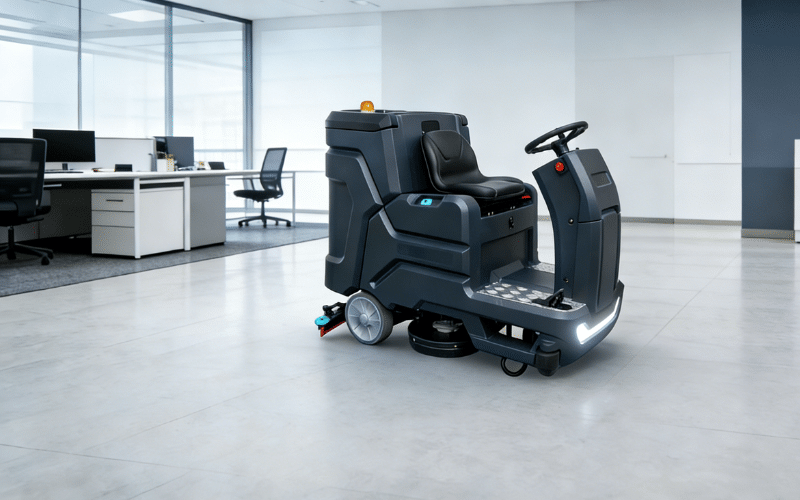
Buying a commercial floor scrubber makes financial sense for operations running 1,200 or more annual hours — most buyers break even around the 14-month mark. Renting delivers better value below 800 annual hours. According to the 2024 Cleaning Equipment Trends Report, 61% of businesses ultimately adopt a hybrid model that combines both strategies.
Facility managers and cleaning professionals constantly face this question: Is it smarter to rent a floor scrubber as needed or to commit to owning one outright? The answer isn’t the same for every operation — and getting it wrong means either overspending on a machine that sits idle or paying rental fees that quietly exceed what ownership would have cost.
This guide cuts through the noise. You’ll find a direct cost comparison, a clear breakdown of what ownership actually entails, a five-factor decision framework, and scenario-based recommendations tailored to specific facility types. By the end, you’ll have a defensible answer for your operation — not just a general rule of thumb.
Rent vs. Buy: Side-by-Side Comparison
Before diving into the details, here’s how the two options stack up across the dimensions that matter most to facility managers and cleaning professionals.
|
Factor |
Renting |
Buying |
|---|---|---|
|
Upfront cost |
Low (deposit only) |
$3,000–$25,000+ |
|
Daily rate (walk-behind) |
$185–$220/day |
N/A |
|
Monthly rate (walk-behind) |
$1,465–$2,025/month |
N/A |
|
Daily rate (ride-on) |
$275–$595/day |
N/A |
|
Purchase price (ride-on) |
N/A |
$10,000–$25,000+ |
|
Maintenance responsibility |
Rental company |
Owner |
|
Equipment availability |
Not guaranteed |
Always on hand |
|
Flexibility |
High |
Low |
|
Long-term cost (high usage) |
High |
Low |
|
Asset value |
None |
Depreciates 18–22%/year |
How Do the Costs Actually Compare?
The numbers tell a clear story — once you factor in the total cost of ownership rather than just the sticker price.
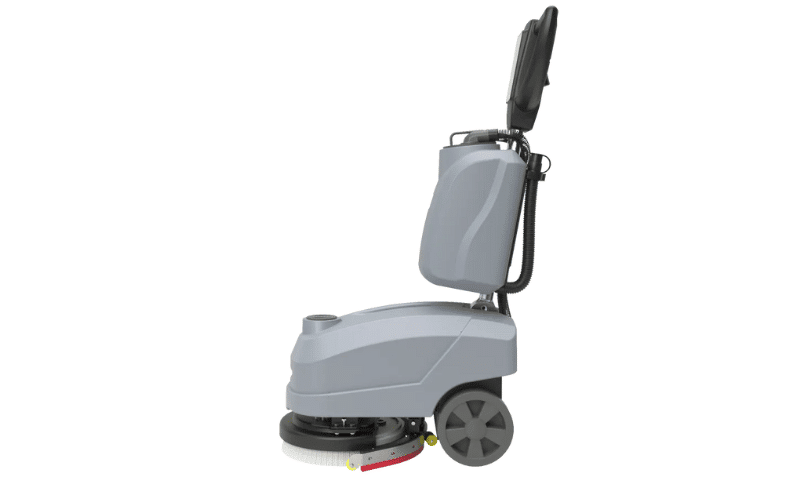
A walk-behind floor scrubber purchased from Leadv Cleaning Solutions typically ranges from $3,000 to $12,000, depending on deck size and features. Ride-on models run $10,000 to $25,000 or more. Those figures look significant upfront. But consider the rental alternative: a walk-behind unit rents for approximately $185–$220 per day or $1,465–$2,025 per month. A ride-on costs $275–$595 per day to rent.
Run the math on a walk-behind at $1,700/month in rental fees, and you’ve paid the equivalent of a mid-range purchase price within eight to nine months — with nothing to show for it. Most buyers hit their breakeven point at around 14 months, after which every operating hour represents money saved compared to renting.
The threshold to watch: operations running fewer than 800 hours per year generally spend less by renting. At 1,200 or more annual hours, purchasing becomes the more cost-effective path. Between 800 and 1,200 hours, the decision depends on other factors explored below.
Annual maintenance costs for an owned machine run approximately $2,400 per year — a real expense, but one that should be weighed against the cumulative rental fees for comparable machine time.
How Does Asset Ownership and Depreciation Factor Into the Decision?
Owning a floor scrubber means owning a depreciating asset. Commercial floor scrubbers depreciate at 18–22% per year and have a working lifespan of 5–10 years, or 2,000–5,000 operating hours, depending on how well they’re maintained.
That depreciation isn’t just an accounting abstraction. It represents the real decline in resale value if you ever need to offload the machine. A $10,000 ride-on scrubber purchased today may be worth $5,000–$6,000 after three years of use.
That said, ownership does build equity in a business asset. For established cleaning contractors and facility management companies, equipment on the books carries tangible value — both for operations and for financing conversations with lenders. Renting, by contrast, builds no equity. Every rental dollar is a pure operating expense.
For operations where the machine will see consistent use over multiple years, the depreciation curve typically works in the buyer’s favor — especially when Leadv Cleaning Solutions’ support team helps you maintain the machine to its full rated lifespan.
Where Does Renting Have a Clear Edge on Flexibility and Scalability?
Rental makes sense precisely where ownership creates problems: variable demand, short-term projects, and operational uncertainty.
Retail facilities, for example, show a rental penetration rate of 68% — reflecting seasonal traffic swings and the cost of owning equipment that sits idle during slower periods. Event venues push that even higher, with 81% relying on rentals for their floor care needs, according to the 2024 Cleaning Equipment Trends Report.
For a cleaning contractor bidding on a three-month post-construction project, renting the right machine for that job is almost always cheaper than buying one. For a facility manager dealing with an unexpected equipment breakdown mid-contract, renting provides a quick operational fix while the primary machine is repaired.
Renting also allows organizations to test different models before committing to a purchase. If you’re evaluating whether a ride-on machine would meaningfully reduce labor time in your facility, renting one for a month produces real data — not a vendor’s estimate.
Will Renting Give You Access to Better Technology?
This is a reasonable question, and the honest answer is: sometimes, but not reliably.
Rental companies don’t always stock the latest models. Fleet turnover schedules vary, and rental inventory is often maintained until it’s no longer serviceable rather than upgraded on a fixed cycle. You may have access to newer equipment through a rental company, or you may get older machines that rental companies are working to recoup the cost on.
Purchasing from Leadv Cleaning Solutions, on the other hand, means specifying the exact model, deck type, and battery configuration that fit your facility. You’re not choosing from available inventory. You’re choosing what’s right for the job.
The concern about technology obsolescence is more relevant for operations with long replacement cycles. If you’re buying a scrubber and expecting to run it for 10 years in a facility where cleaning requirements stay consistent, technology change is unlikely to be a meaningful issue. If your facility type or floor area is likely to evolve significantly, that’s worth factoring into the rent vs. buy analysis.
Maintenance and Liability: Who Is Responsible for What?
This is one of the most practically significant differences between renting and owning — and one of the most frequently underestimated.
With a rental, maintenance and repair responsibilities fall on the rental company. When a squeegee blade wears out, or a vacuum motor fails, you make a call, not a repair appointment. That operational simplicity has real value, particularly for facilities without dedicated maintenance staff.
With ownership, your team handles maintenance — or you budget for service contracts with a vendor like Leadv Cleaning Solutions. The annual maintenance cost of approximately $2,400 covers routine consumables (pads, squeegee blades, brushes) and periodic service. Skip that maintenance, and you’ll likely see that cost show up in premature equipment failure instead.
One underappreciated advantage of ownership: a well-maintained machine on a consistent schedule performs more predictably than rental equipment with an unknown maintenance history. For operations where floor cleanliness directly affects safety compliance — healthcare facilities, food processing environments, or regulated manufacturing floors — equipment reliability is non-negotiable.
Decision Framework: When Should You Rent vs. Buy a Floor Scrubber?
Use these five factors to evaluate your specific situation:
1. Annual operating hours
The clearest quantitative signal. Below 800 hours/year: rent. Above 1,200 hours/year: buy. Between 800–1,200: weigh the other factors below.
2. Duration of need
Short-term contracts, one-time projects, or seasonal demand spikes favor renting. Ongoing, year-round cleaning operations favor ownership.
3. Facility type and floor area
Large, consistent floor areas with uniform cleaning requirements — such as warehouses, distribution centers, and large commercial facilities — support purchase decisions. Facilities with highly variable floor areas or mixed surface types may benefit from rental flexibility.
4. Maintenance capacity
Do you have staff who can handle post-use maintenance, routine inspections, and minor repairs? If yes, ownership becomes more viable. If your team lacks the technical capacity for equipment maintenance, a rental arrangement shifts that responsibility to someone else.
5. Capital availability and cash flow
Purchasing ties up capital. If that capital is needed for staffing, consumables, or contract startup costs, renting preserves cash flow — even if the total cost over time is higher. Equipment financing can bridge this gap for purchases, but cash flow constraints are a legitimate reason some operations rent longer than the math strictly requires.
The Hybrid Strategy: The Best of Both Worlds
The binary framing of rent vs. buy doesn’t capture how most successful operations actually manage their equipment. According to the 2024 Cleaning Equipment Trends Report, 61% of businesses use a hybrid model — owning core machines for regular use and renting supplemental equipment when demand spikes or specialized jobs arise.
This approach makes practical sense. A cleaning contractor might own two walk-behind scrubbers for their regular contract portfolio, then rent a ride-on for a large-format job that doesn’t justify a permanent purchase. A facility management company might own equipment for its anchor facility and rent it for satellite locations serviced less frequently.
The hybrid model also provides a hedge against equipment downtime. If your owned machine requires extended repair, a rental keeps operations running without disrupting service commitments.
Leadv Cleaning Solutions works with facility managers and cleaning professionals to structure equipment strategies across both owned and supplemental needs — not just as a one-time sale, but as an ongoing partnership.
Scenario-Based Recommendations
Small Retail Store (under 10,000 sq ft, moderate traffic)
With 68% rental penetration in retail, many small operations rent — and for good reason. A compact walk-behind scrubber used three to four times per week may not clear 800 annual operating hours. Renting or short-term leasing is likely the better fit unless floor cleaning volume is consistently high year-round.
Warehouse or Distribution Center (40,000+ sq ft, daily use)
High-frequency, large-format operations almost always justify ownership. Daily scrubbing on a 40,000+ sq ft floor quickly surpasses the 1,200-hour annual threshold, and the labor savings from a ride-on scrubber compound over time. Purchasing a ride-on unit is typically the right call, with the 14-month breakeven point arriving ahead of schedule on high-usage floors.
Property Management Company (multiple facilities, variable schedules)
A hybrid strategy fits best here. Own one or two walk-behind units for properties with consistent cleaning schedules, and maintain a rental relationship for properties serviced irregularly or for temporary coverage during maintenance windows. Evaluate each property’s annual hours separately rather than applying a blanket approach.
Commercial Cleaning Contractor (contract-based work, variable clients)
The right approach depends heavily on contract duration and size. Long-term, large-facility contracts justify dedicated ownership. Short-term or project-based work — post-construction cleaning, event cleanup, seasonal contracts — favors rental. Most contractors land on a hybrid model as their portfolios mature, owning core equipment and renting equipment for contracts that fall outside their standard scope.
Frequently Asked Questions
Is renting a floor scrubber cheaper than buying?
Renting is cheaper in the short term and for low-usage operations (under 800 annual hours). For operations running 1,200 or more annual hours, purchasing delivers a lower total cost of ownership. Breakeven typically occurs around 14 months after purchase.
What is the average cost to rent a floor scrubber per day?
Walk-behind floor scrubbers are typically rented for $185–$220 per day or $1,465–$2,025 per month. Ride-on models cost $275–$595 per day, depending on machine size and rental provider.
How much does it cost to buy a commercial floor scrubber?
Walk-behind floor scrubbers range from $3,000 to $12,000. Ride-on models range from $10,000 to $25,000 or more, depending on deck width, battery type, and machine configuration.
How long does a commercial floor scrubber last?
A well-maintained commercial floor scrubber lasts 5–10 years, or 2,000–5,000 operating hours. Annual maintenance costs of approximately $2,400 cover routine consumables and service, and consistent upkeep is the primary driver of machine longevity.
What is the best floor scrubber for a warehouse?
Large warehouses and distribution centers generally require a ride-on scrubber with a 26″–36″ cleaning path to clean efficiently. Leadv Cleaning Solutions offers ride-on models suited to high-volume industrial environments — the right choice depends on floor area, surface type, and operating hours.
Should a cleaning contractor rent or buy floor scrubbers?
Most cleaning contractors benefit from a hybrid approach — owning core equipment for regular contracts and renting supplemental machines for short-term or specialized jobs. The 2024 Cleaning Equipment Trends Report found that 61% of businesses use this mixed strategy.
What happens if a rented floor scrubber breaks down?
With rental equipment, responsibility for repair and replacement falls on the rental company. This is one of the rental’s primary operational advantages — equipment failure doesn’t translate into out-of-pocket repair costs or extended downtime while parts are sourced.
Find the Right Floor Scrubber for Your Operation
The rent-vs.-buy decision comes down to three things: how many hours per year you’re cleaning, how long you’ll need the machine, and what your capital situation allows. Operations above 1,200 annual hours will almost always come out ahead by owning. Those with fewer than 800 hours are usually better served by renting. And for everyone in between, the details of your facility, your team, and your contracts determine the answer.
Leadv Cleaning Solutions helps facility managers, cleaning contractors, and business owners work through exactly this kind of analysis — matching the right machine to the right operation, from compact walk-behind scrubbers to industrial ride-on models. The team can walk you through total cost-of-ownership figures, help you identify the specifications your facility actually needs, and support you with parts, maintenance, and service over the life of the machine.
Request a quote from Leadv Cleaning Solutions and get a recommendation built around your specific floor area, usage patterns, and budget — not a one-size-fits-all answer.