




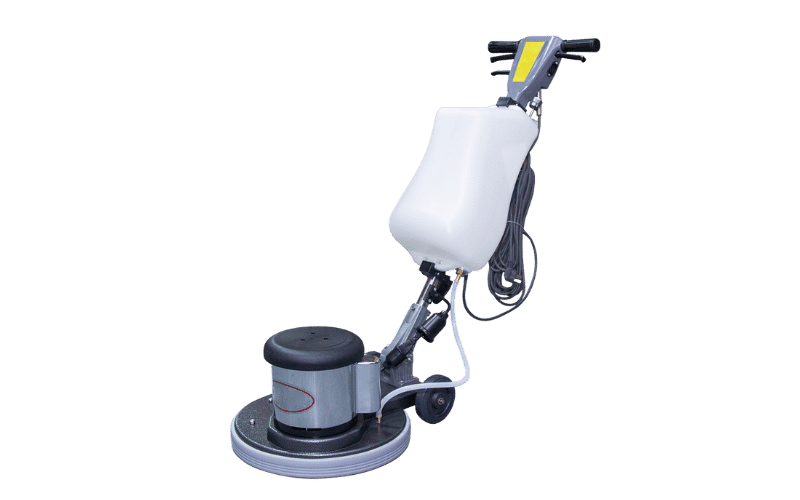



That tacky film on a warehouse floor after a shift of forklift traffic. The streaks a mop leaves across retail tile, still catching the light an hour later. Anyone who has dragged a mop and bucket across a large space knows the reality—you’re not really cleaning; you’re just moving dirty water from one place to another.
Floor scrubbers solve that. They lay down cleaning solution, scrub the surface, and recover the dirty water in a single pass, leaving the floor clean and nearly dry. For any space larger than a few hundred square feet, a scrubber significantly reduces labor hours and delivers far better results than manual mopping.
The trouble starts at the buying stage. Cleaning widths, brush pressures, battery chemistries, tank capacities—the spec sheets pile up fast, and it’s easy to buy the wrong machine for reasons that sounded sensible at the time. This guide focuses on the decisions that actually matter: how to read your facility, how to match it to the right machine type, and which specs are worth scrutinizing versus which ones are just noise.
What is a floor scrubber—and how is it different from a mop or sweeper?
A floor scrubber is a powered machine that cleans hard floors in a single continuous motion. Rather than smearing water around, it cleans and dries the floor simultaneously.
The differences between tools are more significant than they first appear. A mop drags dirty water across a surface and leaves it to air-dry. A floor sweeper collects loose dry debris—dust, crumbs, gravel—but doesn’t wash anything. A scrubber does the wet work: it applies a solution, loosens grime with brushes or pads, and vacuums the dirty liquid back up so the floor is walkable almost immediately.
Every scrubber shares the same core components:
- Solution tank — holds the clean water and detergent mix
- Brushes or pads — scrub and lift dirt off the floor
- Squeegee — a rubber blade that channels dirty water into the vacuum path
- Recovery tank — collects the dirty water pulled from the floor
- Drive system — moves the machine, either operator-pushed or motor-powered
As the machine moves forward, it dispenses solution, the brushes scrub, and the trailing squeegee vacuums everything up behind it. One pass, clean floor. You’ll find scrubbers in warehouses, supermarkets, hospitals, schools, factories, and hotel lobbies—anywhere hard floors are cleaned daily to a standard. LeadV’s floor scrubber lineup covers every category discussed below.

Start with your facility, not the spec sheet
Most people start shopping by browsing machines. They compare prices, look at tank sizes, and try to decide between walk-behind and ride-on. What they should do first is look at their floor.
Your facility answers the only questions that actually drive the right purchase. Work through these before you open a single catalog:
- How much floor do you actually clean per shift? Not the total square footage on the lease—the cleanable routes. A 30,000-square-foot warehouse packed with racking might have only 8,000 square feet of open, walkable floor. The cleanable area determines the machine’s size.
- What type of surface are you cleaning? Rough, sealed concrete in a warehouse needs aggressive scrubbing pressure. Polished tile or marble in a hotel lobby needs a gentle touch—push too hard, and you’ll dull the finish or scratch the surface. Floor type is the biggest driver of brush selection and scrub pressure.
- Is the layout open or obstacle-heavy? Wide, clear aisles and a compact ride-on are a natural match. Shelving racks, display tables, columns, and tight doorways quickly shrink your options. The narrowest point in your route caps the cleaning width you can realistically use.
- How long must the machine run without stopping? Tank capacity and battery runtime determine how often the operator stops to refill, dump, and recharge. If a scrubber dies at hour two of a three-hour shift, you’ve bought the wrong machine.
- Are you cleaning while the building is in use? In retail stores, hospitals, and schools, a loud scrubber running during business hours is a real problem. Noise level isn’t a secondary concern in those environments—it’s a primary one.
Answer these five, and the spec sheet starts to make sense.
Walk-behind, ride-on, or compact: choosing by scenario
There are three main types of scrubbers, and the choice almost always comes down to floor area and layout constraints rather than preference.
Walk-behind: the right tool for medium spaces
The operator walks behind and steers, much like a lawnmower. Walk-behind scrubbers cover up to 3,000 m²/h, carry 60 L tanks, and operate with cleaning widths of 460 to 660 mm.
Choose a walk-behind floor scrubber when you’re cleaning medium spaces of roughly 20,000 square feet or less with a mix of open floor areas and aisles—retail stores, clinics, and schools fit this profile well. Walk-behind machines are also easier to maneuver through doorways, around display fixtures, and in spaces where a larger machine would constantly bump into things.

The common mistake is assuming walk-behind means underpowered. It doesn’t. A dual-brush walk-behind on a clean concrete floor is efficient, fast, and leaves a genuinely good result.
Ride-on: the machine for large-scale operations
The operator sits and drives. Ride-on scrubbers reach up to 5,500 m²/h, carry tanks up to 180L, and deliver brush pressure up to 99 kg—enough to pull ground-in grime off warehouse concrete.
A ride-on floor scrubber is the right choice for warehouses, distribution centers, and manufacturing plants where an operator would otherwise walk several miles per shift. At those scales, the productivity difference is not marginal—it’s the difference between one person cleaning an entire facility and the same person covering half of it. The labor savings often pay for the machine in under a year.
Ride-on machines also need room to operate. If your layout is heavily racked or has many narrow corridors, a ride-on will spend a lot of time maneuvering rather than cleaning.

Compact and small: built for the spaces larger machines can’t reach
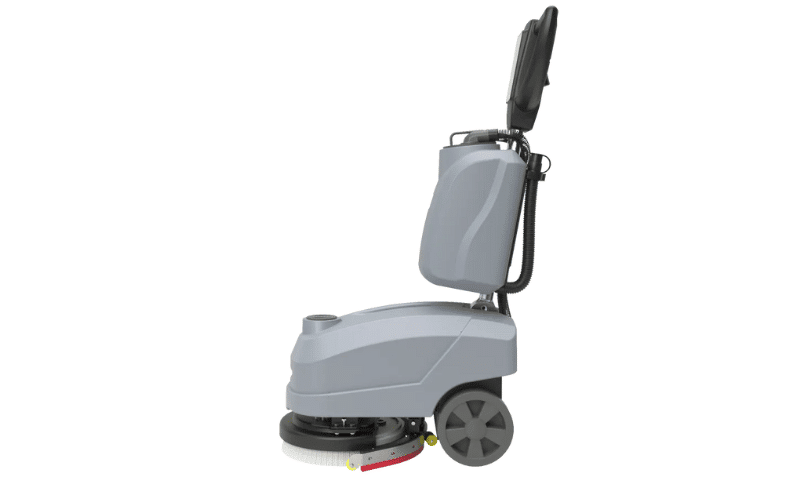
Small scrubbers give up tank size and productivity in exchange for tight turning radius and light weight. LeadV compact models deliver up to 1,500 m²/h with tanks ranging from 4L to 45L—well-suited for restaurant kitchens, convenience store aisles, office pantries, and small retail spaces.
A small floor scrubber is also a good tool for quick daily touch-ups in spaces that get a deeper clean less frequently. Think of it as the right machine for jobs where a larger scrubber would need to be disassembled to fit through the door.
The specs that actually change your result
Most spec sheets list a dozen or more figures. A handful of them genuinely drive cleaning performance and operating cost. The rest are secondary.
Productivity (m²/hour) is the one number worth putting at the top of your comparison. It bundles cleaning width, travel speed, and efficiency into a single figure you can compare across machines from completely different categories. When you’re shortlisting, rank by productivity first, then price.
Cleaning width determines how many passes you need. Wider is faster on open floors but becomes a liability in tight aisles. The right cleaning width matches your narrowest route, not your widest.
Brush type and scrub pressure are where most mismatches happen. Disc brushes suit flat, smooth floors. Cylindrical brushes handle uneven surfaces and can sweep light debris as they scrub—useful in manufacturing settings where fine particles are always present. Scrub pressure is adjustable on most machines, but the range matters. High-pressure attacks ground-in grime on rough concrete; low-pressure protects polished surfaces. Buying a high-pressure machine for a polished marble lobby, or a gentle pad scrubber for a heavily soiled factory floor, is an expensive mistake that shows up fast.
Tank capacity governs how often the operator stops. Large tanks reduce interruptions, but they also add weight and bulk. On a compact machine navigating tight quarters, a smaller tank that empties and refills faster is often the better operating choice.
Squeegee performance is easy to underestimate. A high-quality squeegee leaves the floor nearly dry. A worn or poorly fitted one leaves wet streaks—a slip hazard in any facility and a compliance issue in healthcare or food environments. Check squeegee width relative to cleaning path and confirm it lifts cleanly when the machine reverses.
Noise level determines scheduling flexibility. LeadV walk-behind scrubbers run as low as 60 dB(A), and compact units around 65 dB(A)—quiet enough to operate alongside customers, patients, or students. A machine rated at 75 dB(A) or higher gets pushed to off-hours by default.
Lead-acid vs. lithium-ion: which battery is right for your operation
Battery chemistry is one of the most consequential choices buyers make and one of the most frequently glossed-over.
Lead-acid batteries cost less upfront. They’re heavier, charge more slowly, and wear out sooner. In cold environments, they lose capacity fast. For a light-use operation where the machine runs a few times a week, and budget matters more than long-term cost, lead-acid is defensible.
Lithium-ion batteries cost more to buy, but they charge faster, last significantly longer, handle cold temperatures better, and require less maintenance. For operations that clean daily or run multiple shifts, the lifetime math strongly favors lithium-ion. LeadV’s ECO mode extends battery runtime by around 20% across chemistries—useful when a shift runs long.
One practical rule: the battery should cover your longest cleaning shift with buffer. If your shift is three hours, a two-hour battery rating is not enough, and it will be even less on an older battery or in a cold building. Size up and plan accordingly. For a closer look at the trade-offs, LeadV’s guide to choosing the best battery for floor-cleaning machines covers the specifics.

Matching machine to facility: four real scenarios
Warehouses and industrial plants
The main challenges here are scale and soil. Warehouse floors tend to be rough sealed concrete with heavy traffic, wide aisles but long routes, and soil loads that include oil, fine dust, and debris tracked in from loading docks.
Ride-on scrubbers are the standard answer. High productivity (up to 5,500 m²/h), large solution and recovery tanks (up to 180L), high brush pressure (up to 99 kg), and a lithium-ion battery for multi-shift runtime are the specs that matter most. If your facility has narrower interior aisles within a larger open footprint, a dual-brush walk-behind can supplement the ride-on for those sections. LeadV’s warehouse and industrial solutions are built for this environment.
Retail and supermarkets
The challenge in retail isn’t soil load—it’s timing and maneuverability. Scrubbing needs to happen while the store is open, which means noise becomes a hard constraint rather than a preference. Display racks, end caps, and checkout lanes create tight turns that a wide machine can’t navigate without constant repositioning.
Walk-behind scrubbers are the default here, with compact machines for the tightest sections. Low noise (60–65 dB(A)), moderate cleaning width, and a squeegee that leaves floors genuinely dry are the specs to verify. Wet floors in retail are both a safety liability and a customer experience issue. See retail and supermarket solutions.
Healthcare and educational facilities
Hygiene standards and operating hours drive everything in healthcare. Floors need to be genuinely clean, not just visually acceptable, and cleaning often has to happen while the facility is occupied. Schools face similar constraints—cleaning during class hours or between periods requires a machine that won’t disrupt.
Walk-behind scrubbers for corridors and larger spaces, compact machines for rooms and confined areas. The squeegee needs to be streak-free, not just functional. Solution changes are frequent in hygiene-critical settings, so easy-to-empty tanks that can be rinsed and refilled quickly matter more here than in industrial settings. LeadV’s healthcare and educational solutions address these requirements.
Offices and commercial spaces
Office environments tend to have mixed flooring—hard tile in lobbies, possibly carpet in working areas, and a layout full of furniture and narrow passages. Daily cleaning is common, but the soil load is light.
Compact or small scrubbers are typically the right fit. Small tanks are easier to handle when the cleaning job is short. Low weight matters when the machine moves between floors or buildings. Quiet operation keeps morning cleaning from disrupting early arrivals. Explore commercial and office solutions.
Common buying mistakes worth knowing about
Measuring total square footage instead of actual cleaning routes. A warehouse listed as 30,000 square feet may have only 8,000 square feet of cleanable floor once you account for racking, equipment, and staging areas. Buying a machine sized for the full building gets you something too large for the aisles and more expensive than necessary.
Mismatching brush pressure to floor type. High pressure on polished marble dulls the finish and quickly burns through pads. Low pressure on sealed industrial concrete leaves grime behind. This mismatch shows up within the first few cleanings and gets expensive fast.
Trusting spec-sheet battery ratings without adjustment. Battery capacity drops in cold environments, on older batteries, and under heavy loads. A two-hour rating in a temperature-controlled testing environment may be a 90-minute reality in a cold storage area. Always size up and test under real conditions.
Skipping operator training and maintenance planning. A scrubber that isn’t properly maintained—tanks not rinsed, squeegees not checked, brushes not inspected—produces worse results and wears out faster. Build a maintenance routine before the machine arrives, not after it starts to underperform.
Not requesting an on-site demo. A spec sheet describes a machine in general. A demo shows you how it behaves on your specific floor, in your specific aisles, against your specific type of soil. It’s the most reliable test available and still the most commonly skipped step.
Before you talk to a supplier
Before requesting a quote or demo, run through these:
- Measure your cleanable routes—not the total floor area, but the sections you actually scrub each shift
- Note your floor type—concrete, tile, vinyl, epoxy, polished stone
- Record the width of your narrowest aisle—this caps your cleaning width and turning radius options
- Define your required runtime per shift and identify whether cold temperatures are a factor
- Decide whether you need to clean during operating hours—if yes, noise level becomes a filtering criterion from the start
- Compare machines on productivity (m²/hour) rather than leading with price
Then ask the supplier for an on-site demo before committing.

Frequently asked questions
Walk-behind vs. ride-on: how do I decide?
Floor area and daily walking distance are the deciding factors. Walk-behind scrubbers suit spaces of roughly 20,000 square feet or less—retail, clinics, schools, and mid-size commercial facilities. Ride-on scrubbers are the right tool for operators covering long distances per shift and for cleaning routes that are wide and open. If your facility has long straight runs through a warehouse, the ride-on’s productivity advantage pays for itself. If your layout has frequent turns and tight passages, a walk-behind gives you more control without sacrificing much speed.
Can a floor scrubber be used on any type of flooring?
Most hard floors—concrete, tile, vinyl, sealed stone, and epoxy—work well with a scrubber. The key is selecting the right brush type and scrub pressure for the surface. Rough concrete needs aggressive brushes and higher pressure. Polished marble or tile needs soft pads and lower pressure to protect the finish. Scrubbers aren’t suited for carpet or surfaces with heavy loose debris that should be swept first.
Battery-powered or corded: which is the better choice?
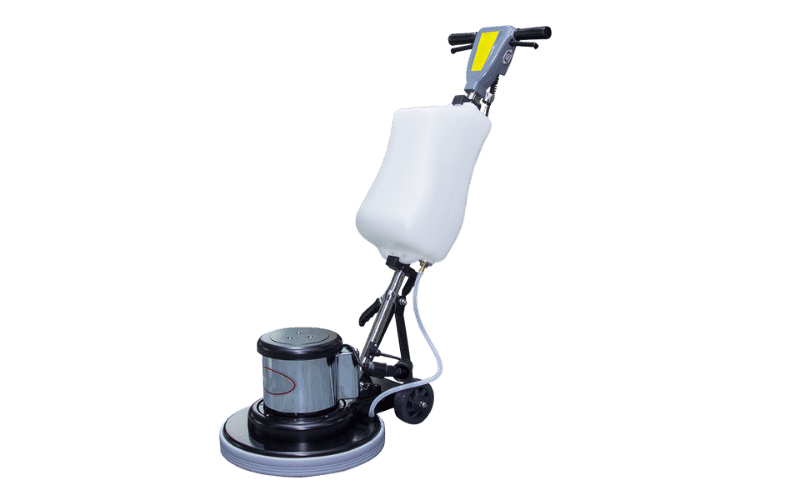
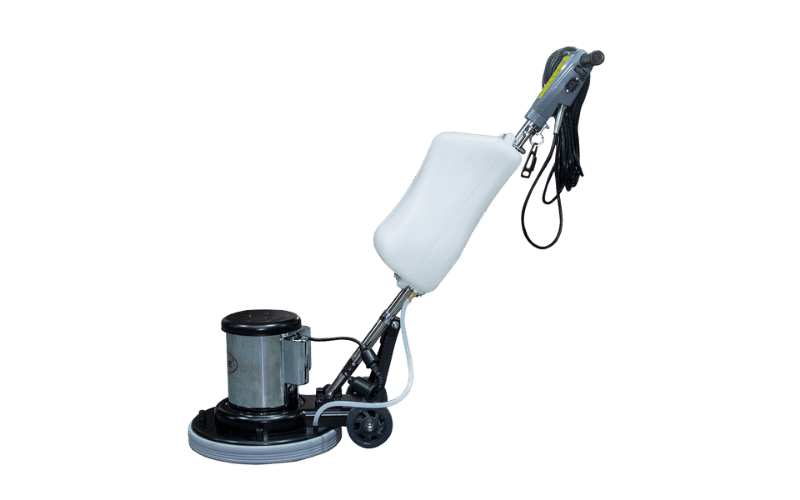
Corded scrubbers offer unlimited runtime but limit your range to the length of the cord and proximity of an outlet. They’re practical for small, contained areas. Battery machines move freely and suit larger spaces where trailing a cord would be impractical or unsafe. Among battery types, lithium-ion costs more upfront but charges faster, lasts longer, and performs better in cold conditions—making it the stronger choice for daily or high-frequency use. Lead-acid is an acceptable option for light or occasional cleaning where upfront cost is the main concern.
What’s the real difference between a floor scrubber and a floor sweeper?
A sweeper collects dry, loose debris—dust, dirt, and litter—without washing the floor. A scrubber applies water and detergent, agitates the surface to release bonded grime, and recovers the dirty solution, leaving the floor genuinely clean and nearly dry. In facilities with both loose debris and embedded grime, many operations run a sweeper first, then follow with a scrubber.
How fast can a floor scrubber clean a large warehouse?
Ride-on models built for industrial use reach up to 5,500 m²/h. At that rate, a single operator can cover more than 5,000 square meters in an hour. The same area, cleaned by a mop-and-bucket crew, would take most of a day. Actual productivity in practice depends on layout complexity, floor condition, and how often the operator needs to stop for refills.
How long will a commercial floor scrubber last?
With consistent maintenance, most commercial scrubbers run for 7 to 10 years. The frame and motor tend to outlast multiple sets of consumables and one or more battery replacements. Lifespan depends significantly on usage intensity and how well daily maintenance is handled—rinsing tanks after use, keeping the squeegee clean, and replacing brushes before they wear out. LeadV backs its larger models with up to 2 years or 2,000 hours of warranty coverage, and compact models with up to 1 year or 2,000 hours.
Is it better to rent or buy a scrubber?
Buying makes sense when the machine will be used frequently enough that the labor savings pay back the purchase cost—often within a year for large facilities. Renting is a reasonable option for seasonal operations, one-time projects, or facilities with light, irregular cleaning needs. LeadV’s breakdown on renting vs. buying a floor scrubber walks through the numbers if you need to make the case internally.
Closing thoughts
The biggest mistake in buying a floor scrubber isn’t choosing the wrong brand—it’s choosing the wrong machine type for the facility or basing the decision on total square footage rather than actual cleaning routes. The right machine is the one that fits your layout, handles your floor type at the right pressure, runs long enough to finish the job, and can be used when you actually need it.
Measure your cleanable routes. Know your floor material. Identify your narrowest aisle and your longest shift. Then compare machines on productivity rather than sticker price—and request a demo before you finalize anything. A few hours of upfront work tends to prevent years of frustration with a machine that was bought for the wrong job.