



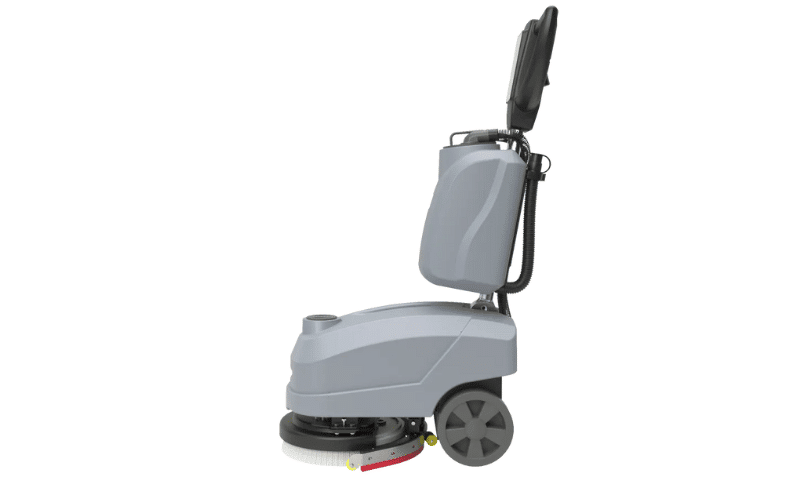

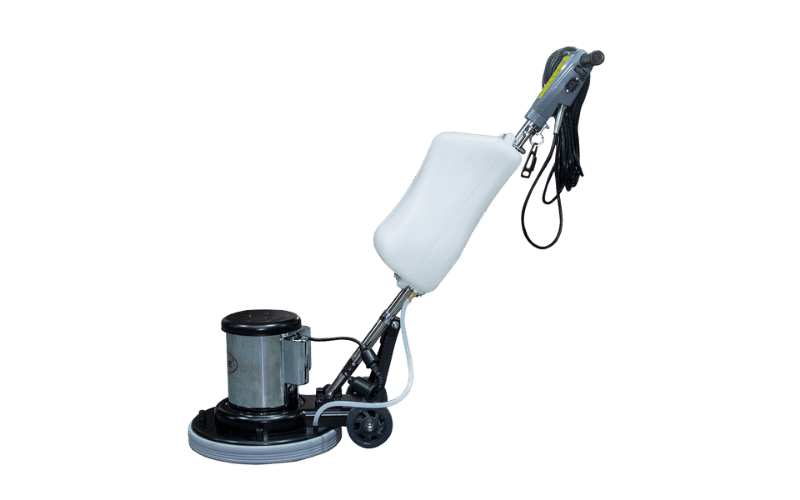
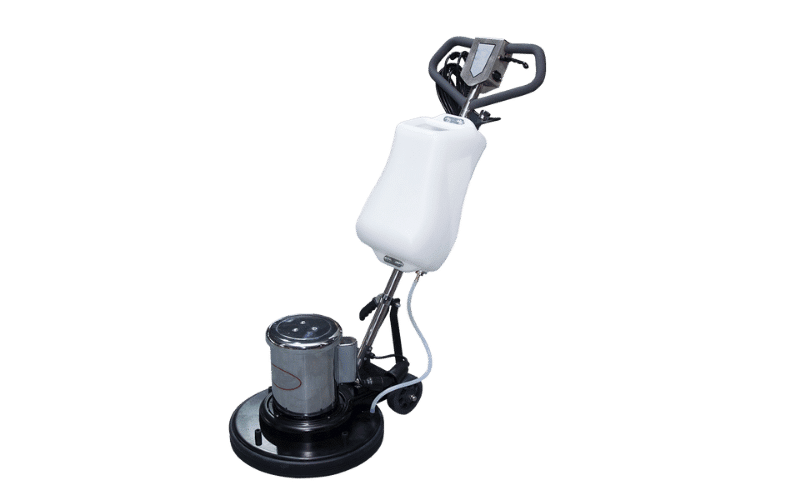
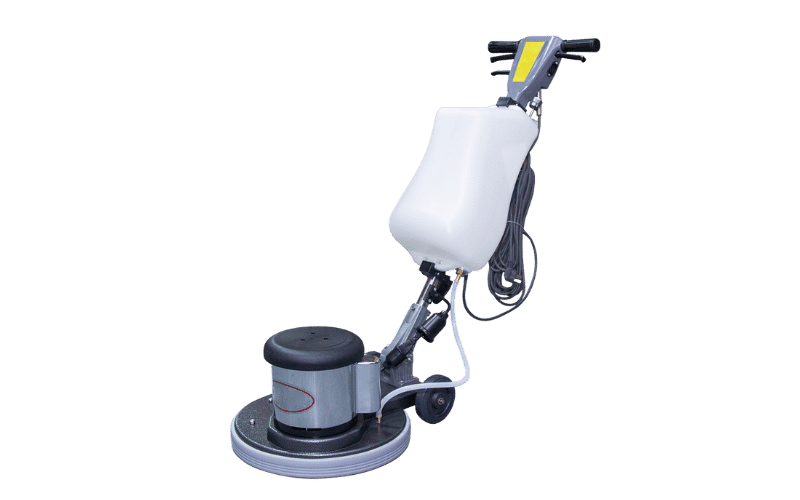



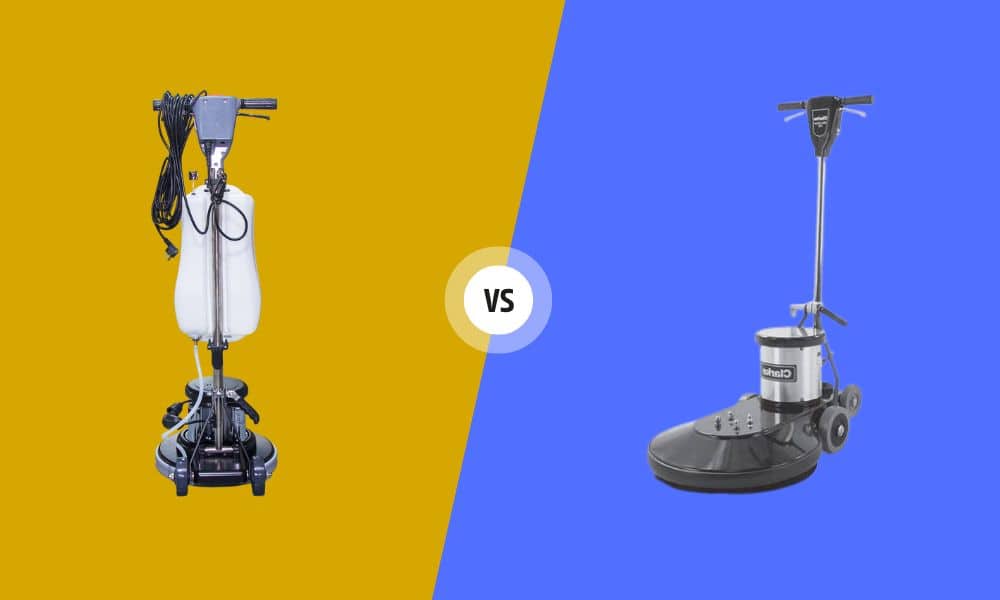
If you manage floor care for a commercial facility, you’ve likely faced the buffer-versus-burnisher question. The two machines look nearly identical from across the room — round pad, upright handle, motor on top — but they do very different jobs. Using the wrong one wastes time, money, and effort.
The core difference is that a floor buffer runs at low speed to clean, strip, and prep floors, while a burnisher runs at high speed to restore a high-gloss shine on floors that are already finished.
This guide explains how each machine works, where each performs best, and how to decide which one belongs in your facility — including whether you need both.
What Is a Floor Buffer?
A floor buffer — also called a swing machine or low-speed floor machine — is the versatile workhorse of hard floor care. It runs at a slow rotational speed, typically between 175 and 350 RPM. That lower speed generates high torque, providing the buffer with the mechanical force it needs for heavy cleaning work.
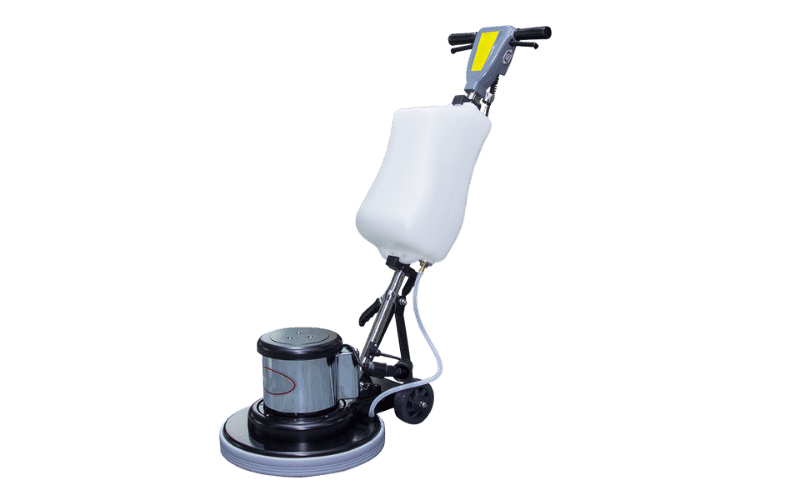
Buffers handle a wide range of tasks:
- Scrubbing ground-in dirt and grime from the surface
- Stripping old wax or floor finish, with the right pad and stripping solution
- Restorative work, such as removing deep scuffs and preparing floors for refinishing
- Light polishing on certain floor types
Flexibility is the buffer’s biggest advantage. Swap the pad, and the same machine shifts from stripping old wax to gently polishing a surface. It also works across many floor types — tile, vinyl, concrete, and wood — making it a practical choice for facilities with mixed flooring.
The trade-off is control. A buffer’s rotating pad pulls the machine side to side, so operators need some practice before they can guide it smoothly. The weight helps maintain consistent pressure but increases the learning curve for new users.
What Is a Floor Burnisher?
A burnisher is built for one purpose: a brilliant, high-gloss finish. These machines spin at much higher speeds, typically between 1,000 and 3,000 RPM, with some propane-powered models reaching even higher speeds.
That speed is what makes the result possible. As the pad moves rapidly across the floor, it generates friction and mild heat that smooths and hardens the existing finish into a tight, reflective layer — the deep “wet look” gloss common in polished retail stores and hospital corridors.
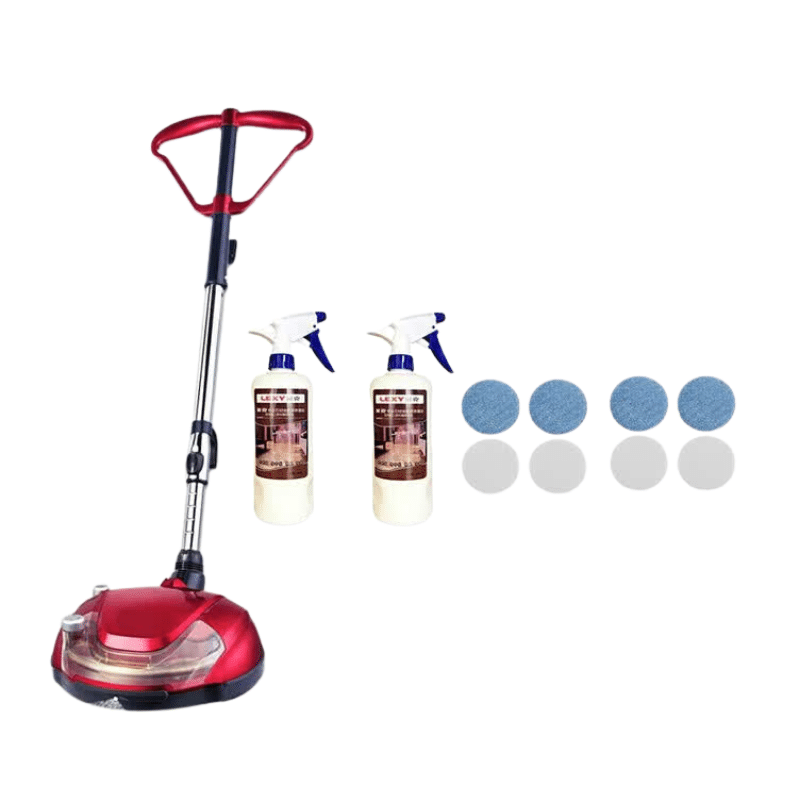
Burnishers are the right tool when you need to:
- Restore gloss to finished floors dulled by daily foot traffic
- Maintain shine between strip-and-wax cycles
- Smooth minor surface scratches in an existing floor coating
One key limitation: a burnisher only works on floors that already carry a finish or sealer. It refines what’s there — it doesn’t clean deeply or strip anything away. Running a burnisher on a bare or dirty floor yields poor results and quickly wears out pads.
On the operational side, burnishers move in a straight line rather than swinging side to side. That makes them easier to guide down long corridors and considerably faster across large, open floor areas.
Buffer vs. Burnisher: Side-by-Side Comparison
| Feature | Floor Buffer | Burnisher |
|---|---|---|
| RPM range | 175–350 RPM (low speed) | 1,000–3,000+ RPM (high speed) |
| Primary purpose | Scrub, strip, deep clean, prep | Restore and maintain high gloss |
| Floor finish required? | No — works on bare or finished floors | Yes — requires an existing finish or sealer |
| Best environments | Mixed-flooring facilities, restoration work | Large, open, high-traffic finished floors |
| Operator skill level | Moderate — takes practice to control swing | Lower — straightforward straight-line motion |
| Versatility | High — handles many tasks with pad changes | Low — specialized for gloss maintenance |
| Movement | Swings side to side | Moves straight back and forth |
| Typical surfaces | Tile, vinyl, concrete, wood | Finished VCT, sealed stone, polished surfaces |
Which One Should You Choose?
The right machine depends on what your floors actually need. Here’s how the decision typically breaks down.
Choose a floor buffer if you:
- Manage mixed flooring and need one machine for multiple tasks
- Regularly scrub, strip, or prep floors before applying a new finish
- Are building a floor care program from the ground up
- Need flexibility more than a high-gloss result
A buffer is the stronger foundational investment. It handles the heavy, practical work that keeps floors clean and ready across a wider range of surfaces and conditions.
Choose a burnisher if you:
- Maintain large areas of finished flooring in retail, healthcare, schools, or similar settings
- Need a consistently high-gloss appearance as part of your daily or weekly routine
- Already run a strip-and-wax program and want to preserve the shine between refinishes
- Cover a significant square footage and need a machine that moves efficiently
A burnisher earns its place when appearance is a priority, and the floors already carry a finish worth protecting.
Can One Replace the Other?
In most situations, no. These machines serve different stages of floor care and rarely substitute for each other.
- A buffer cannot replicate a burnisher’s gloss. Even with a polishing pad, a low-speed buffer won’t generate the heat needed to produce a deep, hardened, mirror-like finish.
- A burnisher cannot clean, scrub, or strip. It refines an existing finish — it cannot prep a bare floor or remove old wax.
Many facilities use both as part of the same floor care cycle. A common sequence: a buffer or autoscrubber strips and deep-cleans the floor, a fresh finish is applied, and a burnisher maintains the gloss between refinishing jobs. The two machines complement each other rather than compete.
If budget limits you to one machine right now, start with a buffer. Its versatility covers more ground. Add a burnisher when your finished-floor maintenance demands grow.
Frequently Asked Questions
Can a burnisher strip floors?
No. A burnisher polishes an existing coating — it cannot strip wax or finish. For stripping, you need a low-speed buffer or an autoscrubber, paired with a stripping pad and the appropriate solution. Using a burnisher on a bare or dirty floor produces poor results and wears out pads quickly.
Is a floor buffer the same as a polisher?
Not exactly, though the terms overlap. “Buffer” typically refers to a low-speed machine designed for scrubbing, stripping, and general floor maintenance. “Polisher” is a broader term that can refer to a buffer used with a polishing pad or to high-speed machines designed for shine. When comparing equipment, RPM range and intended task are more reliable guides than the name alone.
Which machine is better for VCT floors?
It depends on what the floor needs. VCT is typically stripped, scrubbed, and refinished using a low-speed buffer, then kept glossy with a burnisher between refinishes. Both machines have a role: the buffer handles prep and deep cleaning, and the burnisher maintains the high-gloss finish.
Can a buffer create a high-gloss finish?
Only to a limited degree. A buffer with a polishing pad can improve surface shine, but it cannot match the depth or durability of a high-speed burnished finish. For a true mirror-like result, a burnisher is the right tool.
Do I really need both machines?
Many commercial facilities do, particularly those running a regular strip-and-wax program. The buffer handles cleaning, stripping, and prep; the burnisher maintains the shine between cycles. If you’re just getting started, a single buffer offers more flexibility and is usually the smarter first investment.
What pads should I use with each machine?
Match the pad to the machine’s speed rating and the task. Buffers use more aggressive pads built for low-speed, high-torque work. Burnishers use softer pads engineered for high-speed polishing. Always verify that a pad is rated for your machine’s RPM — the wrong pad at high speed can be ineffective or damage the floor finish.
The Bottom Line
Floor buffers and burnishers are not competing tools — they’re designed for different stages of the same job. A buffer does the heavy lifting: cleaning, stripping, and prepping floors across a wide range of surfaces. A burnisher steps in at the finish line, restoring and protecting the high-gloss shine on floors that are already coated and ready.
To choose well, start with what your floors actually need. If the priority is cleaning, stripping, and versatility, a buffer is your foundation. If you maintain large areas of finished flooring where daily appearance consistency matters, a burnisher belongs in your equipment room. And if your program covers both deep cleaning and gloss maintenance, the two machines work best as a pair.
Match the machine to the job, and your floors — and your crew — will be better for it.