







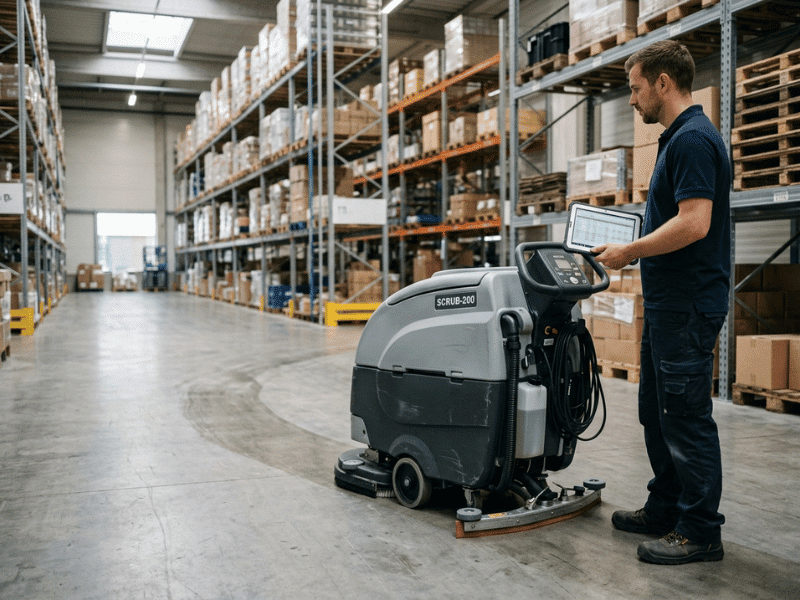
Floor scrubber total cost of ownership (TCO) is the full amount you spend to buy, run, maintain, and retire a machine over its working life. For most commercial facilities, that total is many times the purchase price. A $12,000 walk-behind scrubber that cleans 50,000 square feet five nights a week can cost close to $200,000 to own over five years. Operator labor makes up most of that figure.
This guide is for facility managers, cleaning company owners, and operations leads who need a realistic five-year budget, not just a quote. It covers:
- The five cost categories that make up floor scrubber TCO
- Typical price ranges for machines, batteries, consumables, and repairs
- A worked five-year TCO example for a 50,000 sq ft facility
- A four-step method and formulas you can reuse with your own numbers
All prices in this guide are typical market estimates. Actual figures vary by region, dealer, configuration, and order volume. Use them as benchmarks, then replace them with your own quotes.
Key takeaways:
- Labor is the largest cost. It often makes up 60–85% of five-year TCO.
- Battery replacement is the biggest mid-life expense. It is also the cost most often left out of the budget.
- Downtime is the cost buyers forget. Each day without the machine can add hundreds of dollars in backup labor.
- The cheaper machine to buy is often the more expensive one to own.
What Floor Scrubber TCO Includes
Many scrubber purchases come down to one question: which machine costs less today? That approach feels careful, but it often leads to budget surprises in year two or three. A battery set fails early, consumables cost more than planned, or a breakdown sends the team back to mops for a week.
TCO asks a more useful question: What will this scrubber cost per year, and per square foot cleaned, until we replace it?
To answer it, you need to account for five cost categories:
|
Cost Category |
What It Includes |
Typical Share of 5-Year TCO |
|---|---|---|
|
1. Acquisition |
Purchase or lease, charger, freight, setup, training, accessories |
5–20% |
|
2. Operating |
Operator labor, water, chemicals, consumables, energy |
65–90% |
|
3. Maintenance |
Preventive service, repairs, battery replacement |
3–10% |
|
4. Downtime |
Backup cleaning labor, rental machines, lost cleaning coverage |
2–6% |
|
5. End-of-life |
Disposal and recycling, offset by resale or trade-in value |
Usually a net credit |
The shares shift with machine class and cleaning hours. Even so, the pattern holds for most facilities: the invoice is a small slice, and the labor needed to run the machine is the largest.
Service life benchmark. Most commercial floor scrubbers stay in service for 5 to 10 years. Compact walk-behind units in daily use tend to last 5 to 7 years. Well-maintained ride-on machines often reach 7 to 10 years or more. Run hours, floor conditions, operator care, and parts availability decide where a machine lands in that range.
Your numbers will also depend on facility type, square footage, floor surface, and cleaning frequency. A hospital cleaning around the clock and a retail store cleaning once a night will see very different TCO from the same machine.
The sections below walk through each category in order, starting with the cost you see first.
Acquisition Costs: What You Pay Up Front
Acquisition is the most visible cost and, for most facilities, one of the smallest shares of TCO. It still matters. It shapes your cash flow and sets the baseline for depreciation and resale.
Purchase Price by Machine Type
|
Machine Type |
Typical Use |
Approximate New Price |
|---|---|---|
|
Compact walk-behind (13–20 in) |
Restrooms, small retail, offices, tight spaces |
$3,000 – $8,000 |
|
Standard walk-behind (20–34 in) |
Retail, schools, healthcare, light industrial |
$8,000 – $20,000 |
|
Small ride-on (24–32 in) |
Mid-size retail, warehouses, large schools |
$15,000 – $30,000 |
|
Mid-size ride-on (32–40 in) |
Warehouses, manufacturing, distribution |
$30,000 – $60,000 |
|
Large ride-on (40 in+) |
Large distribution centers, factories |
$60,000 – $150,000+ |
|
Autonomous / robotic |
Large open areas with repeatable routes |
$35,000 – $80,000+, or subscription pricing |
Power type also changes the acquisition number:
- Battery-powered models dominate commercial cleaning. Lithium-ion configurations usually add a clear premium over lead-acid.
- Corded models cost less but are limited to small areas near outlets.
- Propane machines are less common and mostly used in large industrial or outdoor areas with proper ventilation.
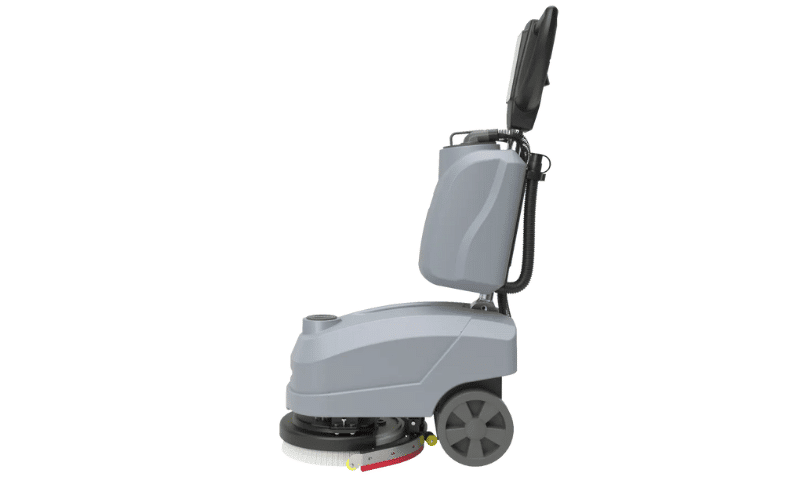
Machine class matters more than price within a class. For narrow aisles and small rooms, compact floor scrubbers keep acquisition low without forcing staff back to mops. For larger areas, compare walk-behind floor scrubbers and ride-on floor scrubbers on five-year cost, not purchase price. The sample calculation later in this guide shows why the more expensive machine often wins.
New vs. Used vs. Lease vs. Rent
Each path changes how much you pay over time:
- Buy new. Highest upfront cost, full warranty, known history, and the strongest resale value. Best for long-term, steady use.
- Buy used or refurbished. Often 30–60% below new. The trade-offs are a short or missing warranty, unknown maintenance history, and a battery that may be near replacement.
- Lease. Spreads cost into monthly payments, often with maintenance bundled. Over five years, total payments usually exceed the purchase price, but cash flow stays predictable.
- Rent. Highest cost per month, with no long-term commitment. Fits short contracts, seasonal peaks, or temporary coverage during repairs.
Financing adds to the real acquisition cost. An equipment loan or lease-to-own agreement includes interest, so a $20,000 machine financed over five years can cost $23,000 or more in total payments. Tax treatment can also differ between leasing and buying, so confirm depreciation and deduction rules with your accountant.
Delivery, Setup, Training, and Accessories
Quotes don’t always include the costs that come before the first cleaning pass. Budget for:
- Freight and delivery: $150–$1,500, depending on machine size and distance
- Setup and commissioning: Often included, sometimes $100–$500
- Initial operator training: Often included at delivery; extra sessions may be billed hourly
- Charger: Sometimes sold separately, especially with lithium-ion configurations
- Spare accessories: Extra brushes, pads, pad drivers, and a backup squeegee blade set, typically $200–$1,000
Acquisition cost = machine price + charger + freight + setup + training + initial accessories + financing interest
Once the machine arrives, the recurring costs begin, and they grow much faster than the invoice.
Operating Costs: The Recurring Expenses That Add Up
Operating costs repeat every shift. Over a scrubber’s life, they almost always exceed the purchase price. Cleaning schedule drives them more than anything else. A machine running five hours a night, six nights a week, uses labor, chemicals, and pads far faster than one used twice a week.
Labor: The Largest Line Item
For most facilities, operator labor is the single biggest cost of owning a floor scrubber, often 60–85% of five-year TCO. You pay for the machine once. You pay for labor every time it runs.
The real labor cost includes:
- Wages plus benefits. A fully loaded labor rate includes payroll taxes, insurance, and benefits, often 25–40% above the base wage.
- Non-cleaning time. Filling the solution tank, draining and rinsing the recovery tank, cleaning the squeegee, and connecting the charger can add 20–40 minutes per shift.
- Turnover. Every new operator needs training time and usually works more slowly in the first few weeks.
This is why cleaning productivity matters so much. Say a ride-on scrubber finishes a route in 3 hours instead of 4.5. That saves 1.5 labor hours per shift.
Annual labor savings = hours saved per shift × loaded hourly rate × cleaning days per year
1.5 × $28 × 260 = $10,920 per year, or about $54,600 over five years
That figure alone can cover the price gap between a walk-behind and a small ride-on.
Autonomous scrubbers push labor savings further on repeatable routes. The trade-offs are a higher acquisition cost, route mapping, and the need for staff to handle setup, emptying, and exceptions. They make the most financial sense in large, open areas cleaned daily.
Water, Chemicals, and Consumables
Water is inexpensive in most regions. Walk-behind scrubbers typically hold 10–25 gallons of solution, and ride-on machines 25–60 gallons or more. Detergent and wear parts cost more.
Chemicals. Spend varies by facility type and soil load:
- Retail and offices: Neutral cleaners, usually the lowest spend
- Healthcare: Disinfectant or specialty products, higher cost per gallon
- Warehouses and manufacturing: Degreasers for oil and tire marks at higher concentrations
- Food service: Heavy degreasers and frequent cleaning, often the highest spend
Overdosing is common when operators mix by eye. Onboard dosing systems or adjustable solution flow can cut chemical use and reduce the residue that leaves floors dull or slippery.
Consumables. These wear parts follow a predictable schedule:
|
Consumable |
Typical Replacement Interval |
Approximate Cost |
|---|---|---|
|
Floor pads |
Every 1–4 weeks with daily use |
$5 – $25 each |
|
Scrub brushes |
Every 6–18 months |
$80 – $400 each |
|
Squeegee blades |
Every 3–6 months (longer if flipped to use all edges) |
$30 – $150 per set |
|
Filters |
Clean weekly; replace every 3–12 months |
$20 – $100 |
|
Hoses |
As needed, often every 2–3 years |
$30 – $150 |
For one machine in daily use, consumables and chemicals together often run $1,000–$3,000 per year.
Energy and Charging Costs
Charging a battery scrubber costs less than most buyers expect. A typical walk-behind uses about 5–8 kWh per full charge, and a mid-size ride-on about 10–15 kWh. At $0.15 per kWh, that’s roughly $1–$2 per charge, or a few hundred dollars per year with daily use.
The charging setup can cost more than the electricity:
- Dedicated circuits or outlets near the charging area
- Ventilated charging space for flooded lead-acid batteries, which release hydrogen while charging
- Charging bays for multi-machine fleets
If your utility charges demand fees, schedule charging after the cleaning shift or overnight. Lithium-ion batteries also allow opportunity charging during breaks, which can remove the need for a second battery set on long routes.
Operating costs are steady and predictable. Maintenance costs are less predictable, and they rise as the machine ages.
Maintenance, Repairs, and Battery Replacement
Maintenance falls into two groups: scheduled maintenance, which you can plan, and unexpected repairs, which you can only estimate. A practical rule of thumb is to budget 5–10% of the purchase price per year for both combined. Expect the lower end in years one and two and the higher end as wear parts age.
Preventive Maintenance Schedule and Costs
|
Interval |
Tasks |
Who Usually Does It |
|---|---|---|
|
Daily |
Drain and rinse tanks, clean squeegee, check brushes or pads, charge battery |
Operator |
|
Weekly |
Clean filters and float shut-off, inspect hoses, check battery water (lead-acid) |
Operator or supervisor |
|
Monthly |
Inspect squeegee blades and brush wear, check drive and vacuum performance |
In-house maintenance |
|
Every 250–500 hours |
Full inspection, motor carbon brushes, electrical connections, adjustments |
Technician |
Routine technician visits typically cost $150–$400 plus parts. A service contract fixes these costs in advance and usually includes priority response. In-house maintenance costs less per visit but requires trained staff and stocked parts.
Skipping preventive maintenance saves money for a few months, then costs more. A worn squeegee blade leaves water behind and forces extra passes. A clogged filter strains the vacuum motor. Unwatered lead-acid batteries can lose years of life. Each shortcut moves cost from the maintenance budget to the repair budget, usually at a higher price.
Common Repairs and Their Price Ranges
|
Component |
Common Issue |
Approximate Cost per Repair |
|---|---|---|
|
Squeegee assembly |
Bent frame, damaged casters, worn blades |
$50 – $500 |
|
Brush deck |
Worn bearings, damaged skirts, actuator failure |
$200 – $1,200 |
|
Vacuum motor |
Worn carbon brushes, water damage |
$300 – $900 |
|
Solution pump or valve |
Clogging, solenoid failure |
$150 – $600 |
|
Drive motor (traction models) |
Wear, overheating |
$600 – $2,000 |
|
Control board and wiring |
Electrical faults, water intrusion |
$500 – $2,500 |
|
Tanks and hoses |
Cracks, leaks, collapsed hoses |
$50 – $800 |
Technician labor typically runs $90–$150 per hour, often with a trip charge for on-site visits. Repair frequency usually climbs after year three, when original wear parts reach the end of their life.
Battery Replacement: The Biggest Mid-Life Expense
For battery-powered scrubbers, battery replacement is usually the largest single mid-life cost, and the one most often missing from the original budget.
|
Battery Type |
Typical Lifespan |
Walk-Behind Set |
Ride-On Set |
|---|---|---|---|
|
Flooded lead-acid |
1,000–1,500 cycles (about 3–5 years) |
$800 – $1,800 |
$1,800 – $4,000 |
|
AGM / gel |
500–1,000 cycles (about 2–4 years) |
$1,000 – $2,200 |
$2,200 – $4,500 |
|
Lithium-ion |
2,000–3,000+ cycles (often 5–8+ years) |
$2,500 – $5,000 |
$5,000 – $12,000 |
Lithium-ion costs more upfront but often needs fewer replacements, requires no watering, and supports opportunity charging. On multi-shift routes, those benefits can offset the price difference within five years. On single-shift routes with light use, lead-acid often remains the lower-cost choice.
Charging habits change battery life:
- Lead-acid lasts longest when fully charged after each use, watered correctly, and never left discharged.
- Repeated partial charging shortens lead-acid life.
- Lithium-ion handles partial charging well but needs a compatible charger and protection from extreme heat.
Repair or replace? When a new battery set costs more than about 40–50% of the machine’s current resale value, and repair bills are also rising, replacing the whole scrubber often makes more financial sense.
Downtime and Hidden Costs
Downtime is the cost buyers forget. It rarely appears in a purchase proposal, yet it can hit the budget harder than any single repair. When a scrubber stops, the floors still need cleaning.
How Long Repairs Take
- Minor repairs with parts in stock: same day to 2 days
- Repairs that need ordered parts: 3–10 days
- Major components from a distant warehouse: 2–4 weeks
During that time, your team either cleans manually or skips scheduled cleaning. Both carry a cost.
How to Estimate Downtime Cost
Daily downtime cost = (manual cleaning hours − machine cleaning hours) × loaded hourly rate
Example: A 50,000 sq ft floor takes about 4.5 hours with a walk-behind scrubber. Mopping at roughly 2,500 sq ft per hour takes about 20 labor hours. That’s 15.5 extra hours per day. At $28 per hour, each day without the machine costs about $434 in extra labor.
Multiply that by your expected downtime days per year. Your dealer’s parts stock and service response time have a direct effect on this number.
Backup and Rental Costs
When manual cleaning isn’t practical, you’ll need a rental:
- Walk-behind scrubber: $150–$350 per day, or $500–$1,200 per week
- Ride-on scrubber: $300–$700 per day, or $1,000–$2,500 per week
Some service contracts include loaner machines, which can bring this cost to zero. Check before you budget.
Skipped cleaning has its own price: dull floors in customer areas, higher slip risk, and lower scores in health, safety, or food-safety inspections.
Operator Training and Error
Poor operator habits quietly raise TCO:
- Running brushes in one spot too long, damaging floor finish
- Using excess down pressure, which wears pads and brushes faster
- Driving over drains, thresholds, or debris that damage the squeegee
- Leaving dirty water in the recovery tank, causing odors and clogged hoses
- Charging incorrectly, shortening battery life
Training at delivery and refresher sessions for new hires cost little compared with the wear they prevent. In high-turnover facilities, plan for retraining several times a year. Wastewater disposal and chemical handling may also be regulated locally, so include any compliance costs in your budget.
Resale Value and End-of-Life Costs
Resale value is the only TCO line that reduces your total, so it belongs in every cost model.
Typical Resale Values
For well-maintained commercial scrubbers, approximate resale value as a share of the original price:
|
Age |
Approximate Resale Value |
|---|---|
|
3 years |
40% – 55% |
|
5 years |
25% – 40% |
|
7 years |
10% – 25% |
What pushes resale value up or down:
- Service records. Documented maintenance builds buyer confidence.
- Battery condition. A recently replaced battery raises the price.
- Operating hours. Lower hours mean higher value.
- Physical condition. Clean tanks, intact squeegees, and working controls matter.
- Parts availability. Machines with ongoing parts support hold value better.
Disposal, Recycling, and Trade-Ins
End-of-life costs are usually modest. Lead-acid batteries are widely recycled, and many recyclers accept them free or pay a small credit. Lithium-ion batteries may carry a recycling fee depending on location. Frames and tanks may involve a small haul-away charge if the machine has no resale value.
Many dealers offer trade-in credit toward a new machine. A trade-in may return less than a private sale, but it saves time, avoids disposal costs, and lines up replacement with your budget cycle. Ask for trade-in value in writing when you compare replacement quotes.
With every cost category covered, the next question is which ownership path keeps the total lowest for your facility.
Comparing Ownership Models
The right model depends on how long you need the machine, how much cash you want to commit upfront, and how much repair risk you’re willing to carry.
Buy New vs. Buy Used vs. Lease vs. Rent
|
Factor |
Buy New |
Buy Used |
Lease |
Rent |
|---|---|---|---|---|
|
Upfront cost |
High |
Medium |
Low |
Very low |
|
5-year total outlay |
Moderate |
Lowest to moderate |
Moderate to high |
Highest |
|
Warranty coverage |
Full |
Limited or none |
Often included |
Included |
|
Repair risk |
Low early, rising later |
Higher, less predictable |
Low if maintenance bundled |
Carried by rental company |
|
Residual value |
Yours to keep |
Yours, but lower |
Usually none unless bought out |
None |
|
Best fit |
Long-term, steady use |
Tight budgets, light use |
Cash-flow priority |
Short contracts, peaks, backup |
By facility profile:
- Small retail and offices: A new or quality used compact walk-behind often delivers the lowest TCO.
- Large warehouses and distribution centers: Buying new usually wins over five years, especially with ride-on machines and strong resale value.
- Healthcare: Buying new, or leasing with bundled maintenance, keeps reliability high and downtime low.
- Hospitality and contract cleaning: Leasing or a mixed fleet can match equipment to changing contracts.
Battery-Electric vs. Propane vs. Corded
- Battery-electric: The standard for indoor commercial cleaning. Low energy cost, quiet, no emissions. Main cost risk: battery replacement.
- Propane: Mainly for large industrial or outdoor areas. Long runtime and fast refueling, but higher fuel cost per hour, engine maintenance, and ventilation requirements.
- Corded: Lowest purchase price and no battery to replace, but the cord limits range and slows operators. Best for small areas near outlets.
Manual Mopping vs. Floor Scrubber
Mopping looks cheap because the equipment costs almost nothing. Labor tells a different story. Cleaning 50,000 sq ft at about 2,500 sq ft per hour takes roughly 20 labor hours per day. At $28 per hour over 260 days, that’s about $145,600 per year, or $728,000 over five years. A scrubber covering the same floor costs a fraction of that, machine included.
Manual cleaning still makes sense for very small areas, spaces no machine can reach, spot cleaning, and floors cleaned only occasionally.
How to Calculate Floor Scrubber TCO for Your Facility
You don’t need special software. A spreadsheet, four steps, and three formulas will give you a number you can defend in a budget meeting.
TCO Formulas at a Glance
|
Metric |
Formula |
What It Tells You |
|---|---|---|
|
5-Year TCO |
Acquisition + Operating + Maintenance + Downtime + End-of-life − Resale value |
Full cost of ownership over the period |
|
Annualized TCO |
5-Year TCO ÷ 5 |
Yearly budget figure |
|
Cost per 1,000 sq ft cleaned |
Annualized TCO ÷ (sq ft cleaned per year ÷ 1,000) |
Fair comparison across machine sizes and options |
Square feet cleaned per year = floor area × cleaning days per year.
Step 1: Gather Your Facility Data
- Total cleanable square footage and floor types
- Cleaning frequency and shift schedule
- Fully loaded labor rate and current hours spent on floor care
- Local electricity and water rates
- Doorway, aisle, and elevator dimensions
- Existing charging locations and power supply
Step 2: List Every Cost Category
- Acquisition: Purchase or lease, delivery, setup, training, accessories
- Operating: Labor, water, chemicals, consumables, energy
- Maintenance: Preventive service, repairs, battery replacement
- Downtime: Extra labor during repairs, rental machines
- End-of-life: Disposal and recycling, minus resale or trade-in value
Step 3: Project Five-Year Costs
- Apply a modest annual increase to labor and energy, such as 3% per year
- Place battery replacement in the year you expect it, not spread evenly
- Raise repair estimates for years four and five
- Subtract a realistic resale value at the end of year five
Step 4: Compare Alternatives
Run the same model for at least one alternative: a different machine class, lease vs. buy, or your current manual method. Compare cost per 1,000 sq ft cleaned, not just the five-year total. Then weigh what a spreadsheet can’t fully capture, such as cleaning quality, operator comfort, and safety compliance.
TCO only works if you compare the right machines. Our guide on how to evaluate floor scrubber brands beyond rankings covers machine fit, parts support, and dealer quality. To build an initial longlist, start with our top 50 floor scrubber brands guide.
Sample 5-Year TCO: 50,000 sq ft Facility
This worked example compares a standard walk-behind with a small ride-on in the same building. It’s illustrative, so swap in your own quotes and rates.
Assumptions
|
Input |
Value |
|---|---|
|
Floor area |
50,000 sq ft, sealed concrete and VCT |
|
Cleaning schedule |
5 nights per week (260 days per year) |
|
Loaded labor rate |
$28 per hour |
|
Route time |
Walk-behind 4.5 hrs; ride-on 3 hrs |
|
Battery type |
Lead-acid, one replacement set in five years |
|
Electricity |
$0.15 per kWh |
|
Downtime |
About 4 days per year of manual backup cleaning |
|
Inflation |
Not applied, to keep the math simple |
Results
|
Cost Line |
Walk-Behind (28 in) |
Small Ride-On (32 in) |
|---|---|---|
|
Acquisition (machine, charger, delivery, training) |
$12,000 |
$32,000 |
|
Labor |
$163,800 |
$109,200 |
|
Consumables, chemicals, water |
$8,000 |
$11,000 |
|
Energy |
$1,350 |
$2,550 |
|
Preventive service and repairs |
$4,500 |
$9,000 |
|
Battery replacement (one set) |
$1,200 |
$2,500 |
|
Downtime (backup labor) |
$9,000 |
$9,600 |
|
Disposal and recycling |
$100 |
$100 |
|
Resale value at year 5 |
−$3,000 |
−$9,000 |
|
5-Year TCO |
$196,950 |
$166,950 |
|
Annualized TCO |
$39,390 |
$33,390 |
|
Cost per 1,000 sq ft cleaned |
$3.03 |
$2.57 |
What the Numbers Show
- The ride-on costs $20,000 more to buy but about $30,000 less to own. Labor savings drive almost the entire difference.
- Acquisition is a small share of TCO: about 6% for the walk-behind and 19% for the ride-on.
- Labor dominates: roughly 83% of the walk-behind’s TCO and 65% of the ride-on’s.
- Downtime outweighs repairs for the walk-behind: $9,000 in backup labor vs. $4,500 in service and repairs.
How the Numbers Shift at 200,000 sq ft
At four times the floor area, labor becomes even more dominant. One walk-behind can no longer finish the route in a single shift, so the comparison usually moves to mid-size or large ride-on machines, or a mix of ride-on and autonomous units. Acquisition rises, but cost per 1,000 sq ft cleaned often falls, because wider cleaning paths and faster travel spread labor across far more area. At this scale, one extra labor hour per shift adds about $36,400 over five years.
Common Mistakes That Inflate TCO
These mistakes appear in scrubber budgets again and again. Each has a direct fix.
1. Buying on upfront price alone
Impact: As the sample shows, the cheaper machine can cost tens of thousands more over five years in labor.
Fix: Compare five-year TCO and cost per 1,000 sq ft cleaned for every option.
2. Skipping preventive maintenance
Impact: Short-term savings turn into motor failures, shorter battery life, and longer downtime.
Fix: Set a written schedule with daily operator tasks and technician visits every 250–500 hours.
3. Choosing the wrong machine size
Impact: An undersized machine adds labor every shift. An oversized one struggles in tight spaces and costs more to buy and maintain.
Fix: Match cleaning width and machine class to square footage, aisle widths, and route length.
4. Leaving battery replacement out of the budget
Impact: A $800–$12,000 surprise in year three or four.
Fix: Add battery replacement as a dated line item in your projection.
5. Training operators poorly
Impact: Faster wear on pads, brushes, and squeegees, damaged floors, and early battery failure.
Fix: Train every operator at delivery, retrain new hires, and post a daily checklist on the machine.
6. Ignoring downtime and resale value
Impact: An aging, unreliable machine looks free to keep while backup labor piles up. Skipping resale also makes better-built machines look more expensive than they are.
Fix: Track downtime days and repair spend each year, and include resale value in every comparison.
FAQs
How much does a floor scrubber cost to own over five years?
It depends mostly on labor and machine type. For one machine in daily use, five-year TCO can range from about $50,000 in a small facility to around $200,000 in a 50,000 sq ft building, with operator labor making up most of the total.
What’s the biggest hidden cost of owning a floor scrubber?
Downtime. Manual backup cleaning can take several times longer than machine cleaning, and rentals add $150–$700 per day. Most purchase proposals leave this cost out.
How long does a floor scrubber battery last, and what does replacement cost?
Flooded lead-acid batteries typically last 3–5 years and cost about $800–$4,000 per set, depending on machine size. Lithium-ion often lasts 5–8 years or more and costs about $2,500–$12,000 per set.
Is it cheaper to lease or buy a floor scrubber?
Buying is usually cheaper over five years or more, especially once you include resale value. Leasing makes sense for short contracts, seasonal demand, or when preserving cash matters more than total cost.
How much does maintenance cost per year for a ride-on scrubber?
A common estimate is 5–10% of the purchase price per year. For a $32,000 ride-on, that’s about $1,600–$3,200 per year, rising as the machine ages.
Do autonomous floor scrubbers have a lower total cost of ownership?
They can in large, open facilities cleaned daily, because they cut operator hours. In smaller or cluttered spaces, the higher purchase price and setup work may outweigh the labor savings.
How do I calculate TCO for a floor scrubber in my facility?
Add acquisition, operating, maintenance, downtime, and end-of-life costs over five years, then subtract resale value. Divide by five for an annual figure, then divide by thousands of square feet cleaned per year to compare options fairly.
What’s the resale value of a used floor scrubber after three years?
A well-maintained commercial scrubber often resells for about 40–55% of its original price after three years. Service records, battery condition, and operating hours have the biggest effect.
How does floor scrubber TCO compare to manual mopping?
For areas larger than a few thousand square feet, scrubbers usually cost far less. In a 50,000 sq ft facility, daily mopping can cost several times more in labor over five years than owning a scrubber.
What maintenance tasks can I do in-house to lower TCO?
Operators can drain and rinse tanks, clean squeegees and filters, flip squeegee blades, check brush wear, water lead-acid batteries, and charge correctly. These daily habits prevent many common repairs.
Conclusion: The Cheapest Machine to Buy Is Rarely the Cheapest to Own
A floor scrubber’s purchase price is a small part of what it costs over its working life. Labor takes the largest share, battery replacement brings the biggest mid-life bill, and downtime adds costs that seldom appear in a proposal.
The four-step method gives you a repeatable way to see the full picture:
- Gather your facility data
- List every cost category
- Project costs over five years
- Compare alternatives on cost per 1,000 sq ft cleaned
Before you commit, run the numbers for at least two options, such as walk-behind vs. ride-on, or buy vs. lease. The gap is often larger than expected, and it usually favors the machine that saves labor hours over the one with the lowest invoice.
To fill in your model with real configurations, review our walk-behind floor scrubbers for mid-size areas, ride-on floor scrubbers for large, open floors, and compact floor scrubbers for tight spaces. The Leadv team can share specifications, battery options, consumable part references, and warranty terms so each line of your TCO estimate rests on documented figures rather than assumptions.