







I’ve spent years around floor scrubbers and the gear that goes with them, and one tool gets overlooked all the time: the air mover. People reach for a box fan to dry a wet floor and wonder why it takes forever. The answer is simple. A fan and an air mover are built for two completely different jobs.
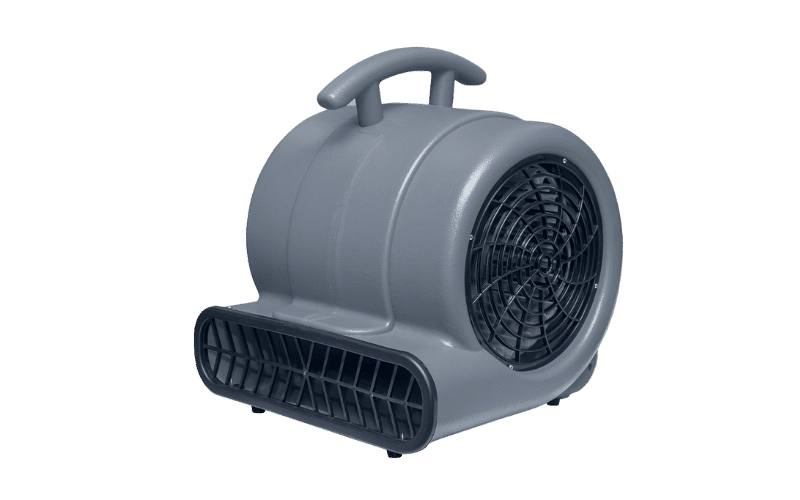
A standard fan moves a soft, wide breeze meant to keep people comfortable. An air mover is a high-velocity machine built to dry surfaces and shove large volumes of air exactly where you want it.
Once you’ve used a real air mover on a wet floor, you won’t go back to a fan. Here’s why they’re worth the upgrade, whether you run a facility or just want to dry a room at home.
Faster Drying Times for Floors and Carpets
This is the big one. After a floor scrubber pass, a mopping job, or a spill, you want that floor dry fast. An air mover gets you there in a fraction of the time a fan would.
The trick is how the air moves. A good air mover is built for laminar flow, which means it pushes a focused, low-velocity stream of air that hugs the ground and travels across the surface rather than just stirring the room.
That low, fast airflow does something important. Wet surfaces hold a thin film of saturated, humid air right above them, called the boundary layer. As long as that damp layer sits there, the surface dries slowly. An air mover strips that layer away and replaces it with dry air, so evaporation speeds up.
That focused stream pays off across plenty of surfaces:
- Hardwood floors dry before moisture has a chance to soak in
- Tile and grout lines dry evenly, with no lingering damp seams
- Thick carpet dries down into the fibers, not just on top
Set up a few air movers around a room, and you’ll dry the whole space in a fraction of the time it takes natural airflow. Pros stage them in a pattern so the air sweeps around the room in one direction, almost like a current.
Here’s a real scenario. Say a pipe lets go under a sink and water spreads across a tile floor. Mop it up and leave a fan running, and moisture can still creep into the grout and down into the subfloor. That’s how you end up with warped boards and hidden mold weeks later. Get two air movers on it right away, and you pull the water out before it ever reaches the subflooring. Quick drying isn’t just convenient. It prevents expensive damage.
Effective Mold and Mildew Prevention
Mold needs two things to grow: moisture and time. Air movers take away both.
Stagnant, damp air is a breeding ground. Let a wet spot sit in still air, and spores settle in and start growing, sometimes within a day or two. Keep that surface dry, and the air moving, and mold never gets the chance.
Air movers are great at reaching the spots where moisture loves to hide. Their tight, directed airflow gets into corners, along baseboards, under cabinets, and into crawlspaces and wall cavities that a wide-fan breeze can’t reach.
The speed is what matters. By driving rapid evaporation, an air mover dries a surface before mold can complete its life cycle and take hold. You’re not just drying the floor. You’re cutting the growth off before it starts.
This matters even more in humid climates or after heavy rain. When the outside air is already damp, surfaces dry painfully slowly on their own. An air mover forces the issue.
And here’s a pro move: pair air movers with a dehumidifier. The air movers lift moisture off surfaces and push that damp air toward the dehumidifier’s intake. The dehumidifier removes moisture from the air, and the drier air returns to circulation. Together, they dry a space far faster than either tool alone.
Heavy-Duty Durability for Tough Environments
Most household fans are thin plastic. Knock one over on a job site, and it cracks. Air movers are built to take a beating because they’re made for places that dish it out.
Look at the housing. Quality air movers use rotomolded plastic or metal casings that protect the motor inside. You can stack them, bump them, and drag them across rough floors without worrying about them falling apart.
They’re also built to run. A good air mover can run for 24 hours or longer without overheating, which is exactly what you need when you’re drying a floor overnight or over the course of a multi-day job. A box fan isn’t designed for that kind of duty.
They’re made to move, too. Most have built-in handles and cord wraps, so you can carry one in each hand and set up a room quickly. No tangled cords, no awkward grip.
And the motors are a different class. Industrial-grade motors shrug off the dust, drywall grit, and debris that would choke a consumer fan’s electronics. On a construction site or in a busy workshop, that toughness is the difference between a tool that lasts years and one you replace every season.
Versatility Across Multiple Applications
People think air movers are just for water damage. They do far more than that. Once you own one, you’ll find uses for it all year.
Here’s where they earn their keep beyond drying:
- Cooling big spaces. Point an air mover across a hot garage or workshop, and it moves serious air, keeping you comfortable where a small fan can’t keep up.
- Clearing fumes and odors. Painting a room or working with strong cleaners? An air mover quickly flushes the fumes out, making the job safer and the air breathable again.
- Circulating heat. In winter, rooms with high ceilings trap warm air up top. An air mover pushes that heat back down to where people actually are, so your heating works smarter.
- Inflatables and effects. They’re handy for inflatable decorations, and the steady, strong airflow is great for creating wind effects in photography and video shoots.
That range is what makes an air mover worth owning. It’s not a single-task tool that sits in a closet 11 months a year.
Energy Efficiency and Targeted Performance
Here’s something that surprises people. Air movers usually move more air while drawing less power than big industrial blade fans.
The number to watch is CFM, or cubic feet of air per minute. A good air mover delivers high CFM with low amperage draw. Compared to a traditional high-velocity blade fan that hogs power, a low-amp air mover gives you more airflow for less electricity.
That efficiency has a real practical benefit. Because each unit draws so little, you can often run several air movers on a single household circuit without tripping a breaker. Try that with several high-amp fans and you’ll be flipping breakers all day.
Many models also support daisy-chaining, where you plug one unit into the next instead of hunting for more outlets. That saves outlet space and keeps your setup clean on a big job.
You also waste less air. Most air movers have adjustable positions, often at 0, 45, and 90 degrees. You aim the airflow exactly where it’s needed, whether that’s straight across a floor or angled up a wall. No energy wasted blowing air at nothing.
A quick note on design. Standard fans are usually axial, meaning the air flows straight through the blades. Many air movers use a centrifugal design, in which a blower wheel throws air outward and builds up pressure. That extra pressure is what gives an air mover its focused, hard-hitting stream instead of a soft breeze.
Frequently Asked Questions
How long should I run an air mover to dry a wet carpet?
Most wet carpets dry in 12 to 24 hours with proper airflow, though it depends on how soaked the carpet is and the room’s humidity. Set up multiple air movers and pair them with a dehumidifier to speed things up. Check the padding underneath, too, since it holds water longer than the surface.
Can I leave an air mover running overnight safely?
Yes. Air movers are built for long, continuous runtimes, and running one overnight is common practice for drying jobs. Just place it on a stable, dry surface, keep the cord clear of walkways, and use a properly rated outlet or circuit. Never cover the intake while it runs.
What is the difference between a centrifugal air mover and an axial fan?
A centrifugal air mover uses a blower wheel to fling air outward, building higher pressure and a focused, hard-hitting stream that’s ideal for drying surfaces. An axial fan pushes air straight through its blades, moving a larger volume in a softer, wider flow. Centrifugal for targeted drying, axial for general air movement.
How many air movers do I need for a standard-sized room?
For a typical room, two to three air movers usually do the job well. Place them so the airflow circulates in one direction around the room. For larger spaces or heavy water damage, you’ll want more units; roughly one for every 10 to 16 feet of wall space is a common rule of thumb.
Do air movers help with cooling a room as much as an air conditioner?
No. An air mover doesn’t lower the air temperature the way an AC does. It moves a strong stream of air that helps you feel cooler through evaporation off your skin, much like a fan but stronger. For real temperature drops, you still need air conditioning.
Will an air mover significantly increase my electricity bill?
Not much. Most air movers are low-amp and energy-efficient, drawing less power than many large fans while moving more air. Running one for a drying job adds little to your bill. Running several units around the clock for days will show up, but for typical use, the cost is minor.
Choosing the Right Air Mover for Your Needs
The right air mover comes down to the job at hand.
For general home use, like drying a mopped floor, freshening a damp basement, or clearing paint fumes, a compact, low-amp model is plenty. It gives you strong airflow, sips power, and tucks away easily when you’re done.
For professional work or serious water issues, go bigger. Look for units with high CFM ratings to move real volume, and for stackable designs so you can store and transport several at once. Pros often run multiple high-output units together, so daisy-chaining and rugged housings matter more.
A few quick things to weigh before you buy:
- CFM rating for how much air it moves
- Amp draw, so you know how many you can run on one circuit
- Build quality, rotomolded or metal for tough environments
- Adjustable angles for aiming airflow where you need it
- Portability, handles, and cord wraps for moving between rooms
Use these tools correctly, and you protect your space from water damage and mold while keeping floors dry and air fresh. For anyone who regularly manages moisture and airflow, a quality air mover isn’t a luxury. It’s the tool that does the job a fan only pretends to.
Your next step: match the CFM and amp draw to your typical job, then start with one solid unit. You’ll find ten more uses for it within a month.