



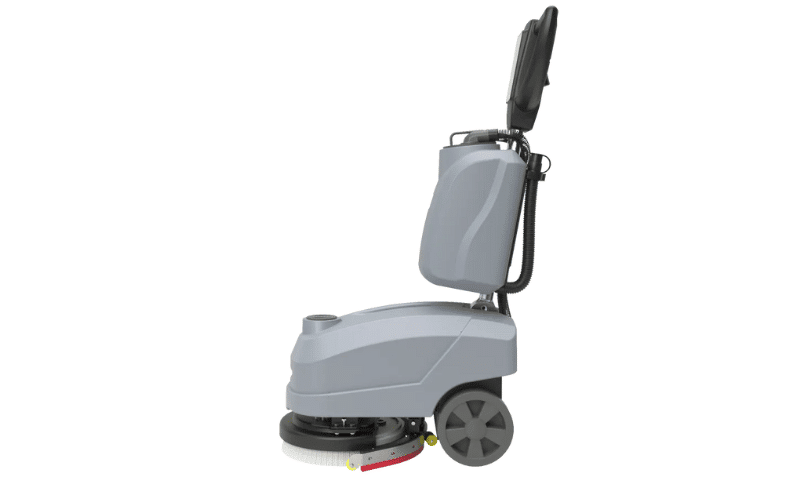

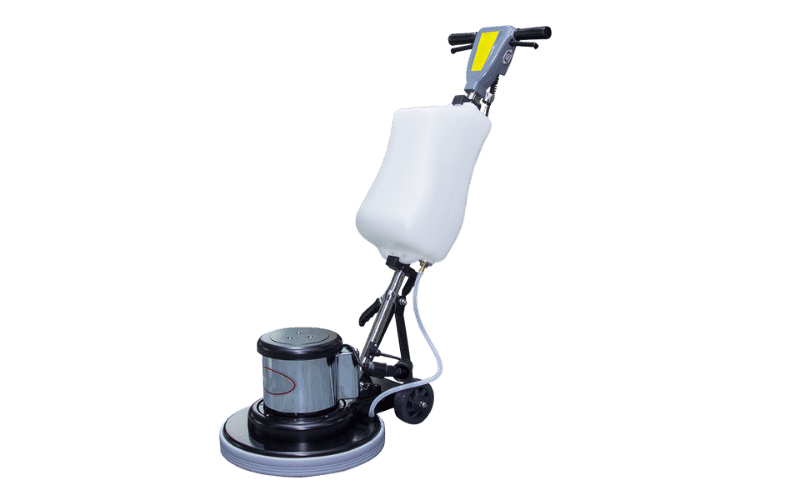
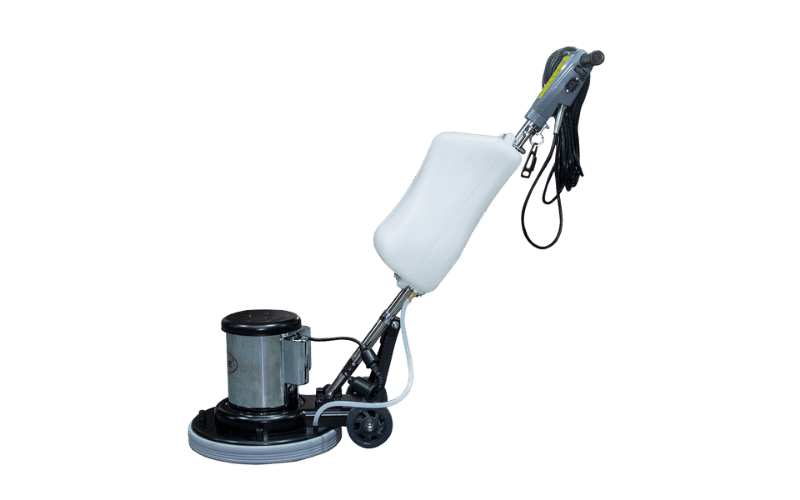
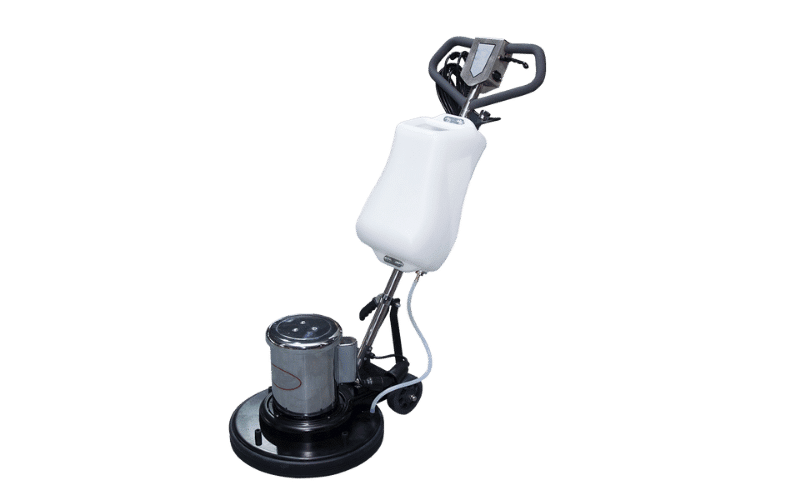
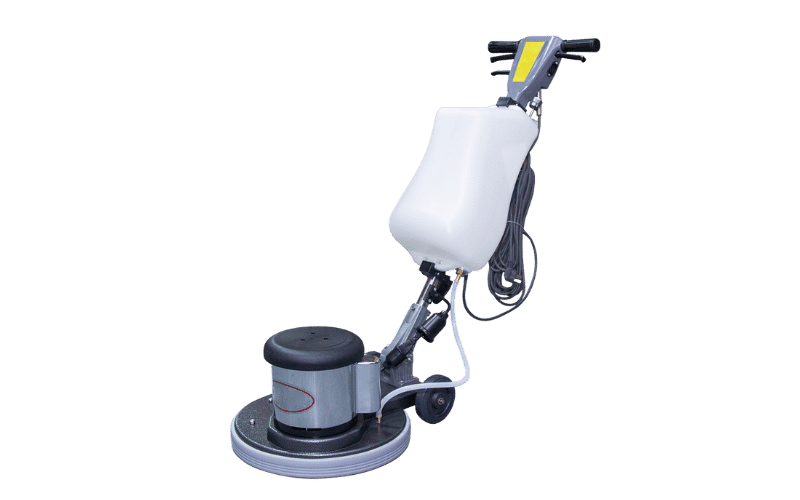



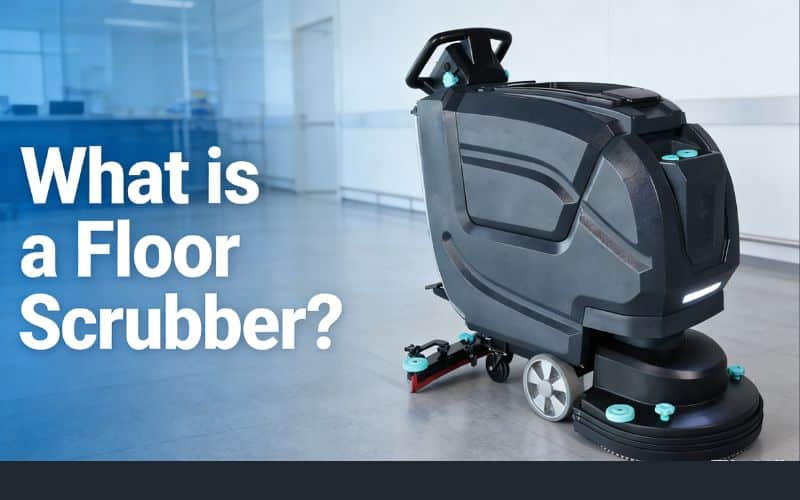
A floor scrubber is a powered cleaning machine that applies a cleaning solution, mechanically agitates the floor surface, and vacuums up the dirty water in a single pass. Floor scrubbers come in walk-behind and ride-on models, with disc, cylindrical, or orbital brush decks suited to different floor types and facility sizes.
Mops have their place, but in a commercial or industrial setting, they often create more problems than they solve. According to the ISSA 612 cleaning times and tasks study, a cleaning operator using a 16-ounce mop head covers roughly 1,700 square feet per hour. That same operator, with a 20-inch walk-behind floor scrubber, can clean up to 16,000 square feet per hour—nine times more floor in the same amount of time.
That productivity gap is why floor scrubbers have become standard equipment in warehouses, hospitals, food processing plants, retail stores, and schools. But not every scrubber works for every facility. The differences between machine types, brush configurations, and power sources matter significantly when it comes to cleaning results, total cost of ownership, and how well a machine fits your space.
This guide breaks down everything a facility manager, procurement specialist, or cleaning professional needs to know—from the basics to a practical buying framework.
What Is a Floor Scrubber?
A floor scrubber is a mechanized cleaning machine designed to deep-clean hard floor surfaces. It combines water, a cleaning detergent, and rotating brushes or pads to break down dirt, grease, and grime, then removes the resulting slurry with a built-in vacuum and squeegee system.
The key difference between a scrubber and a mop is containment. A mop repeatedly dips back into the same bucket, redistributing bacteria and soil across the floor. A floor scrubber keeps clean solution and dirty water in separate tanks at all times, meaning the floor gets progressively cleaner with each pass—not just rearranged.
Floor scrubbers are used on a wide range of hard floor surfaces, including sealed concrete, vinyl composition tile (VCT), ceramic tile, epoxy, terrazzo, and polished stone. They can be compact enough to navigate restaurant kitchens or large enough to clean hundreds of thousands of square feet in a single shift.
How Does a Floor Scrubber Work?
All floor scrubbers—regardless of size or brand—operate on the same three-stage cleaning process.
Stage 1: Solution Application
Clean water mixed with a diluted cleaning detergent is released from the machine’s solution tank onto the floor ahead of the brush deck. The flow rate is adjustable on most models, allowing operators to match water usage to the soil level and floor type.
Stage 2: Mechanical Agitation
Rotating brushes or pads, mounted on the scrub deck, work the cleaning solution into the floor surface. The brush type, RPM, and downward pressure all affect how aggressively the machine cleans. This stage is where the real cleaning happens—breaking down oil, food residue, scuff marks, and embedded grime.
Stage 3: Dirty Water Recovery
A rear-mounted squeegee blade channels the dirty water into a narrow path, where a vacuum motor lifts it into a separate recovery tank. The floor is left clean and nearly dry immediately after the pass. Compare that to a mop, which leaves surfaces wet for 15 to 30 minutes and creates ongoing slip-and-fall risk during that window.
Key Components of a Floor Scrubber
Understanding the main parts helps when evaluating specifications and comparing models:
- Solution tank – Holds the pre-diluted cleaning solution. Larger tanks mean fewer refill stops during a shift.
- Recovery tank – Collects dirty water and debris. Matched in capacity to the solution tank on most models.
- Brush deck – Houses the rotating brushes or pad drivers. Disc, cylindrical, and orbital configurations each serve different applications (covered in detail below).
- Squeegee assembly – Channels water to the vacuum inlet. The condition of the squeegee blade directly affects floor dry time.
- Vacuum motor – Generates the suction that lifts dirty water into the recovery tank.
- Drive system – Walk-behind models are operator-propelled or self-propelled; ride-on models have a traction motor.
- Power source – Battery pack or power cord. Batteries are the most common in commercial environments.
- Control panel – Manages brush pressure, solution flow, and drive speed.
Types of Floor Scrubbers
Scrubbers are categorized in four overlapping ways: by how the operator interacts with the machine, by power source, by application scale, and by brush deck type. Knowing where each category matters helps narrow the options quickly.
By Operation: Walk-Behind vs. Ride-On
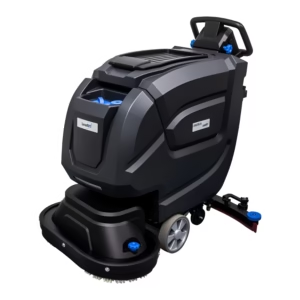
Walk-behind floor scrubbers are guided by an operator walking behind or alongside the machine. They are the standard choice for facilities up to roughly 20,000 square feet and for any layout with tight aisles, doorways, or obstacles. Schools, retail stores, clinics, and medium-sized warehouses are typical environments. Walk-behind scrubbers are easy to train staff on and generally start under $1,500 for entry-level models.
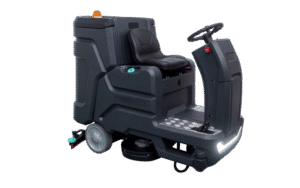
Ride-on floor scrubbers carry the operator and function like small vehicles. They cover significantly more floor per hour than walk-behind units and reduce operator fatigue during long shifts. Ride-on models are the appropriate choice when cleaning areas exceed 20,000 square feet and layouts are relatively open. Large warehouses, distribution centers, and manufacturing plants are common applications. Ride-on scrubbers range from approximately $10,000 to $30,000, depending on tank size, scrub path width, and technology.
A third category, sometimes called chariot-style or stand-on scrubbers, splits the difference. The operator stands on a rear platform, gaining the comfort and speed advantages of a ride-on machine while retaining the maneuverability of a walk-behind machine for medium-to-large facilities with moderate obstacles.
By Power Source: Battery vs. Corded
Battery-powered scrubbers are by far the most common choice in commercial and industrial settings. They offer cord-free operation throughout the facility and eliminate the hazard of trailing cables. Battery runtime varies by model and capacity, typically ranging from 2 hours on compact units to a full shift on larger machines. Matching battery capacity to shift length—with a reasonable buffer—is a critical spec check during procurement.
Corded scrubbers connect to a standard power outlet and run continuously without recharging. They work well in smaller, defined areas where cord length is not a constraint, such as a break room or server area. For larger spaces, cords become a trip hazard and a practical limitation.
By Application Scale: Compact, Commercial, and Industrial
Compact scrubbers are designed for congested spaces—restaurant kitchens, restrooms, narrow retail back-of-house areas, and anywhere that a standard walk-behind cannot maneuver effectively. They are smaller, lighter, and easier to store.
Commercial scrubbers cover the broad middle ground: retail floors, school hallways, healthcare corridors, and offices. Walk-behind models with 17- to 28-inch scrub paths dominate this category.
Industrial scrubbers are built for heavy-duty use in demanding environments—manufacturing plants, food processing facilities, parking structures, and logistics centers. They handle heavier soils, longer shifts, and rougher floor surfaces. Ride-on models with wide scrub paths and high-capacity tanks are common in this segment.
By Brush/Deck Type: Disc, Cylindrical, and Orbital
This is where many buyers make their first mistake. The brush configuration determines which surface types the scrubber can handle effectively and whether pre-sweeping is required.
Disc scrubbers use a flat, circular brush or pad driver that rotates at relatively low RPM but applies significant downward pressure. That pressure makes disc machines effective at breaking up tough stains and hard-to-remove soils on smooth floors. They work well on VCT, sheet vinyl, polished concrete, and similar surfaces. The important caveat: disc scrubbers are not designed to pick up loose debris, so the floor must be swept before scrubbing. Disc machines are the standard choice for retail, healthcare, and education environments with clean, smooth floors.
Cylindrical scrubbers use a pair of long, tubular brushes that spin in opposite directions at 600 to 800 RPM. The high-speed rotation flicks debris away from the floor rather than pushing it, and a small debris hopper captures solid material before the vacuum system engages. This means cylindrical scrubbers can sweep and scrub in a single pass—no pre-sweeping required. They also perform well on uneven surfaces, textured floors, and tiles with grout lines. Industrial plants, food and beverage processing facilities, manufacturing floors, and parking structures are the typical applications.
Orbital scrubbers use a rectangular scrub head that moves in a random orbital pattern rather than rotating. The design provides high downward pressure, excellent edge-cleaning along walls and into corners, and the ability to strip floor finish without chemicals when fitted with the appropriate pad. Orbital machines are highly versatile—switching pad types transforms the same machine from daily maintenance to deep scrubbing to surface preparation before recoating.
Floor Scrubber vs. Other Cleaning Equipment
Floor Scrubber vs. Mop
The productivity gap is substantial. A mop covers roughly 1,700 square feet per hour; a 20-inch walk-behind scrubber handles up to 16,000 square feet in the same time, according to the ISSA 612 study. Beyond speed, the cleanliness outcome differs fundamentally. A mop redistributes dirty water across the floor with each pass. A scrubber applies a fresh solution, agitates it, and removes the slurry cleanly—all in one pass. The immediate dry time also eliminates the extended slip risk associated with mop use.
Floor Scrubber vs. Buffer/Polisher
These machines serve different purposes and are not interchangeable. A floor buffer—also called a burnisher or polisher—is designed to restore shine to a floor’s finish by polishing the surface at high speed. It does not clean. Buffers are used after scrubbing, on smooth finished surfaces like marble, VCT, or hardwood, where maintaining a high-gloss appearance matters. In hospitality, showroom, and high-end retail environments, both machines often work in sequence: the scrubber cleans first, then the buffer restores the shine.
Floor Scrubber vs. Sweeper
A floor sweeper removes dry debris—dust, grit, packaging fragments—using brushes and a hopper or vacuum system. It does not wet-clean or sanitize. A floor scrubber wet-cleans but struggles with heavy debris loads. For facilities with both dry debris and surface contamination, a sweeper-scrubber combines both functions in a single machine, eliminating an entire step in the cleaning cycle.
Uses by Industry
- Warehouses and distribution centers benefit from ride-on or cylindrical scrubbers that can quickly cover large, open floors. Dust, pallet debris, and rubber-tire marks are common soil challenges.
- Food and beverage processing facilities deal with grease, food residue, standing liquid, and strict sanitation requirements. Cylindrical scrubbers are often preferred here because they handle uneven drains, floor texture, and heavy soil without pre-sweeping.
- Healthcare facilities prioritize infection control and safety. Floor scrubbers reduce the risk of cross-contamination compared to mops, and their near-instant dry time shortens the window during which floors pose a slip hazard. Disc scrubbers are standard in clinical corridors and patient areas.
- Retail environments need consistent, presentable floors with minimal operational disruption. Walk-behind disc scrubbers with moderate scrub paths handle these requirements efficiently during off-peak hours.
- Educational facilities share characteristics with retail: smooth floors, moderate traffic, and the need for efficient overnight cleaning. Walk-behind disc scrubbers are the workhorses in school hallways and gymnasiums.
- Parking structures combine textured concrete, tire marks, oil stains, and outdoor debris. Cylindrical scrubbers with aggressive brush filaments perform well in this environment.
How to Choose the Right Floor Scrubber: A 6-Step Framework
Step 1: Measure Your Facility
Calculate your largest continuous cleaning area, not just the total square footage. Under 20,000 square feet, a walk-behind is typically sufficient. Above that threshold, a ride-on scrubber will clean faster with less operator fatigue.
Step 2: Assess Your Floor Type and Soil Level
Smooth, sealed floors with light soil are suited to disc scrubbers. Rough, textured, or grouted floors and environments with heavy debris or grease are better served by cylindrical scrubbers. Facilities needing floor finish maintenance alongside daily cleaning should consider an orbital machine.
Step 3: Decide on Brush Deck Type
Match the disc, cylindrical, or orbital based on your floor-type assessment from Step 2. If your floors vary significantly across zones, some facilities use different machines for different areas.
Step 4: Select Walk-Behind or Ride-On
Factor in your square footage (Step 1), floor layout, and staff availability. A ride-on covers more floor per labor hour and reduces fatigue on long shifts. A walk-behind is more maneuverable in tight layouts and has a lower entry cost.
Step 5: Confirm Power Source and Run Time
Battery models work for most commercial and industrial environments. Match the battery’s rated run time to your cleaning shift length, allowing a buffer for tank refills and unexpected cleaning needs. For very large facilities running continuous shifts, explore high-capacity battery options or corded alternatives in zoned areas.
Step 6: Determine Your Budget and Procurement Model
Walk-behind scrubbers start under $1,500; industrial ride-on models can reach $30,000 or more. For short-term projects or seasonal needs, renting avoids capital expenditure and storage costs. Certified used equipment is another option for facilities that need industrial performance at reduced cost. When evaluating the total cost of ownership, factor in brush replacement, battery maintenance, and service availability.
Frequently Asked Questions
What is the difference between a floor scrubber and a floor buffer?
A floor scrubber deep-cleans by applying solution, scrubbing, and vacuuming up dirty water in one pass. A floor buffer polishes the floor’s surface finish to restore shine—it does not clean. Buffers are used after scrubbing on smooth, finished floor surfaces like VCT, marble, or hardwood.
Do I need to sweep before using a floor scrubber?
It depends on the brush deck type. Disc scrubbers require pre-sweeping because they are not designed to handle loose debris. Cylindrical scrubbers can pick up debris during scrubbing and do not require a separate sweep, which makes them more efficient for facilities with ongoing debris accumulation.
What size floor scrubber do I need for a warehouse?
For warehouses under 20,000 square feet with moderate layouts, a walk-behind scrubber is usually sufficient. For larger, open warehouse floors, a ride-on scrubber will clean faster and reduce operator fatigue. Match the scrub path width to your aisle width—wider paths clean faster, but the machine must fit your space.
How long does a floor scrubber battery last?
Battery run time varies by model and battery capacity, typically ranging from two to four hours on walk-behind units and longer on larger ride-on models. The key is matching the rated run time to your actual cleaning shift length. Lithium-ion batteries, increasingly available on newer models, offer faster charging and a longer service life than traditional lead-acid batteries.
Is a floor scrubber worth the investment over a mop?
For facilities that regularly clean more than a few hundred square feet, the productivity gain typically justifies the cost. According to the ISSA 612 study, a walk-behind scrubber cleans 9 times as much floor per hour as a mop. For facilities where floor care occupies a significant portion of cleaning staff time—which can reach 80% in some facilities, according to industry data—the labor savings alone can offset the equipment cost relatively quickly.
Can floor scrubbers be used on outdoor surfaces?
Yes. Many floor scrubbers, particularly those with cylindrical brush decks, are designed to handle outdoor concrete, textured pavement, and parking structures. Confirm that the model you are considering is rated for outdoor use and that the brush filament is appropriate for the surface texture.
Find the Right Fit for Your Facility
Choosing a floor scrubber comes down to matching the machine’s capabilities to the facility’s reality. The correct brush deck, operation type, and tank size can dramatically reduce cleaning time, lower labor costs, and produce consistently cleaner, safer floors. The wrong choice means lower productivity, higher ownership costs, and a machine that frustrates your team instead of supporting them.
At Leadv Cleaning Solutions, we help facility managers and procurement teams cut through the complexity and identify the right equipment for their specific environment—whether that’s a compact walk-behind for a single floor or a fleet of industrial ride-on units for a multi-site operation. Contact our team today to discuss your requirements and get a recommendation tailored to your facility.