







The most expensive mistake in commercial floor care isn’t choosing the wrong brand. It’s choosing the wrong type of machine. A ride-on scrubber in a cramped clinic ends up parked in a corner. A walk-behind grinder silently burns through your labor budget, shift after shift, in a million-square-foot warehouse.
The right choice comes down to fit: matching the machine to your space, floors, cleaning window, and team. This guide is built for facility managers, operations leads, and B2B buyers who want a clear, objective comparison—not a sales pitch.
Key takeaways:
- Facility size and floor layout matter more than price when choosing a machine.
- Walk-behinds are the stronger fit for tight, segmented, or budget-sensitive spaces.
- Ride-ons deliver better returns on large, open floors where labor savings outweigh the higher upfront cost.
- Total cost of ownership over five years is a more reliable metric than purchase price alone.
Here’s what this guide covers: how to assess your facility before you shop; the real strengths of each machine type; a side-by-side specification comparison; seven factors that drive the decision; a practical “choose this if” framework; environment-specific recommendations; and answers to the questions buyers ask most.
Assess Your Facility Before You Shop
Before you look at a single spec sheet, look at your floors. The machine should fit the building, not the other way around.
- Start with total square footage. Measure every area that needs regular cleaning—not just open floor space. This number drives everything else, especially when comparing productivity figures later.
- Walk the operator’s route. Identify narrow spots: doorways, tight hallways, and cramped storage areas. A 30-inch ride-on won’t help you if it can’t clear a 32-inch doorway with enough room to maneuver.
- Map your obstacles. Pallets, machinery, display racks, and furniture all force frequent turning and repositioning. High-obstacle environments favor a smaller, more agile machine.
- Check your floor surface. Polished concrete, sealed tile, epoxy, and rubber all respond differently to brushes and pads. A grit pad used to restore concrete can scratch finished tile. Know your surface before you select a scrub deck.
Practical tip: a 20-minute floor walk with a tape measure tells you more than any product brochure.
Walk-Behind vs Ride-On: The Core Difference
Both machine types automate scrubbing, solution distribution, and water recovery in a single pass. The difference lies in how the operator works and how much ground the machine covers per shift.
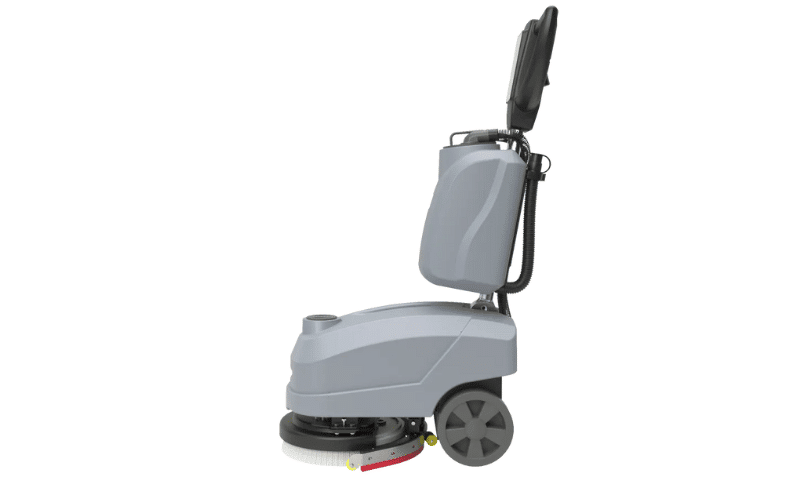
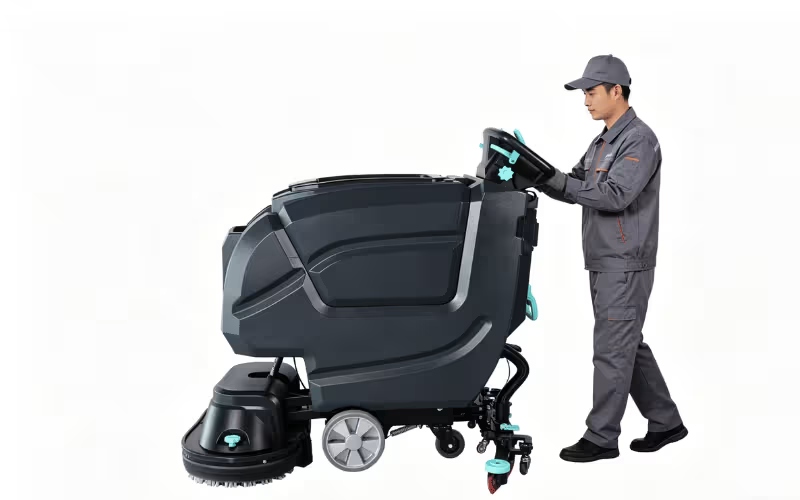
- A walk-behind floor scrubber is operated on foot. The operator steers from the rear while the machine handles propulsion and scrubbing. These units are compact and built for tight, congested spaces.
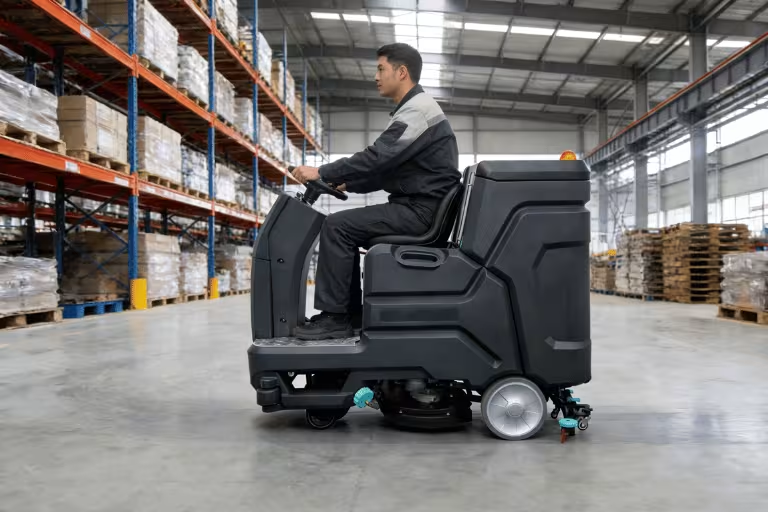
- A ride-on floor scrubber seats the operator, who steers with a wheel and controls speed with foot pedals. These machines carry larger tanks, wider scrub decks, and longer runtimes—built to cover large, open floors efficiently.
The core trade-off: walk-behinds prioritize maneuverability; ride-ons prioritize throughput.
Two Types of Walk-Behind Scrubbers
Walk-behind scrubbers come in two propulsion types, and the difference affects how they perform on your specific floor.
- Pad-assist (brush-propelled) models use the rotation of the scrub brush or pad to help pull the machine forward. The operator guides direction with minimal pushing effort. These are well-suited to smaller spaces and shorter cleaning sessions.
- Traction-drive models use a dedicated drive motor to power the wheels independently of the brush. When the operator engages the throttle, the motor propels the unit forward. This reduces physical effort on longer runs and accommodates heavier machine configurations.
Side-by-Side Comparison
The table below outlines how the two machine types compare across the most important purchasing criteria. Specific figures vary by model and manufacturer.
|
Factor |
Walk-Behind Scrubber |
Ride-On Scrubber |
|---|---|---|
|
Cleaning width |
14–28 inches |
26–50+ inches |
|
Tank capacity |
5–25 gallons |
25–80+ gallons |
|
Cleaning speed |
Up to ~3 mph |
Up to ~5–6 mph |
|
Productivity (per hour) |
~10,000–25,000 sq ft |
~40,000–100,000+ sq ft |
|
Turning radius |
Tight suits narrow aisles |
Wide; requires open space |
|
Battery runtime |
~2–3.5 hours |
~3–5+ hours |
|
Upfront cost |
~$2,000–$8,000 |
~$8,000–$40,000+ |
|
Maintenance complexity |
Lower; fewer components |
Higher; more systems to service |
|
Storage footprint |
Compact; fits most elevators |
Requires dedicated storage space |
|
Ideal use case |
Tight, segmented spaces |
Large, open floor areas |
Why Choose a Walk-Behind Scrubber
Walk-behind units are the workhorses of small and mid-sized facilities. They’re straightforward to operate, cost-effective to own, and built to handle environments where agility counts.
- Compact footprint: They reach tight corners, navigate between shelves, and access spaces a ride-on can’t reach.
- Lower acquisition cost: Walk-behinds typically cost a fraction of comparable ride-on models—a meaningful advantage for lean budgets or single-site operations.
- Portability: Most units fit in a standard elevator and can be loaded onto a trailer without a ramp. This matters when cleaning across multiple floors or locations.
- Precise operator control: Standing directly behind the scrub deck, operators can reduce pressure near sensitive equipment or congested retail areas.
- Simpler maintenance: Fewer motorized systems mean fewer failure points, lower repair frequency, and more predictable service costs.
Bottom line: if your building is complex or your budget is tight, a walk-behind is the practical choice.
Why Choose a Ride-On Scrubber
When floor space opens up, ride-on scrubbers justify their cost. They’re built for sustained productivity across large areas.
- Higher throughput: In warehouses, airports, and large commercial spaces, a ride-on covers far more ground per shift than a walk-behind can match.
- Reduced operator fatigue: A seated operator avoids the physical strain of walking miles per shift, which supports consistent performance over longer cleaning windows.
- Larger tanks and wider coverage: Bigger solution and recovery tanks mean fewer refill and dump cycles, keeping the operator productive for more of the shift.
- Improved site visibility: A seated, elevated operator has a broader sightline—an important safety factor in facilities with active foot traffic or forklift movement.
- Stronger long-term economics: One ride-on often replaces two or three walk-behind units in large-area applications. Over time, the labor savings typically outpace the higher initial investment.
Bottom line: on large, open floors with daily cleaning demands, a ride-on pays for itself through reduced labor costs.
7 Key Decision Factors
Specifications set the baseline, but these seven operational factors determine which machine actually fits your facility.
1. Facility Size
Total square footage is the strongest predictor of which machine type fits. Use this as a starting framework:
- Under 15,000 sq ft: A walk-behind is almost always the right choice.
- 15,000–40,000 sq ft: Either type can work; floor layout is the deciding factor.
- Over 40,000 sq ft: A ride-on typically delivers better productivity and cost efficiency.
Open, unobstructed floor plans favor ride-ons. Segmented spaces with doorways, shelving, or frequent obstacles favor walk-behinds—even when square footage is higher.
2. Productivity Per Hour
Throughput—not maximum speed—determines whether your team finishes on schedule. Walk-behinds clean roughly 10,000 to 25,000 square feet per hour. Ride-ons can reach 40,000 to over 100,000 square feet per hour under optimal conditions.
If your cleaning window is fixed and your floor area is large, a ride-on may be the only practical way to complete the work within a single shift.
3. Battery and Runtime
Most commercial scrubbers are battery-powered. Walk-behinds typically run two to three and a half hours per charge. Ride-ons with larger battery packs typically deliver 3 to 5 hours or more of runtime.
Match the machine’s runtime to your actual shift length. A unit that runs four hours isn’t viable for an eight-hour operation without a mid-shift battery swap or access to fast charging. Lithium-ion batteries carry a higher upfront cost but charge more quickly and last longer than traditional lead-acid alternatives.
4. Floor Type Compatibility
Both machine types clean standard hard surfaces: concrete, sealed tile, vinyl, terrazzo, and epoxy. The key difference is applied pressure and brush or pad selection.
Ride-ons exert greater downward force, improving cleaning performance on textured concrete or heavily soiled industrial floors. Walk-behinds apply lighter pressure, making them better suited for polished or more delicate surfaces. Verify that the right brush and pad options are available for your specific flooring before purchasing.
5. Operator Training
Walk-behinds have a short learning curve. Most new operators reach full productivity within a brief orientation. Ride-ons require more structured training—operators need to develop comfort with steering, throttle control, turning radius, and on-board settings simultaneously.
In environments with high staff turnover, a walk-behind reduces training time and the risk of operator error, particularly in confined spaces.
6. Noise Level
Ambient noise is a practical constraint in occupied facilities. Many modern scrubbers operate at levels acceptable for daytime cleaning, but performance varies significantly by model. Walk-behinds tend to run quieter overall and are a better match for noise-sensitive environments—libraries, healthcare facilities, and occupied offices. If daytime cleaning is part of your operation, verify the machine’s decibel rating before purchasing.
7. Total Cost of Ownership
Purchase price is one line item in a longer cost equation. A complete total cost of ownership analysis should include:
- Labor: typically the highest cost over the machine’s service life
- Energy and consumables: batteries, brushes, pads, and cleaning solution
- Maintenance and repairs: more complex for ride-on systems with greater component counts
- Downtime costs: lost productivity when equipment is out of service
A ride-on carries a higher upfront price but can substantially reduce labor costs in large-area applications. In smaller facilities, that productivity advantage shrinks or disappears—and the walk-behind becomes the more cost-efficient choice over time.
The Decision Framework
Use this framework to narrow your options based on your facility’s specific profile.
Choose a Walk-Behind If…
- Your facility is under approximately 25,000 sq ft
- Floors are divided by narrow aisles, doorways, or frequent obstacles
- Budget is a primary constraint
- Storage space is limited
- You clean across multiple floors or sites
- Operator turnover is high, or training time is limited
- You work on polished or delicate floor surfaces
Choose a Ride-On If…
- Your facility covers approximately 40,000 sq ft or more of open floor space
- Daily cleaning must be completed within a defined time window
- Reducing labor costs is a strategic priority
- Aisles are wide and unobstructed with sufficient turning clearance
- Operator comfort across extended shifts is a factor
- Large tank capacity is needed to minimize refill interruptions
Consider Both: The Hybrid Approach
Many facilities benefit from operating both machine types. A large retail environment, for example, may deploy a ride-on across open sales floor areas and a walk-behind in stockrooms, restrooms, and tight back-of-house spaces. Using the right tool for each zone improves efficiency and cleaning results across the facility.
Recommendations by the Environment
Cleaning requirements vary significantly by facility type. Here’s how each machine tends to fit by environment.
- Retail stores: Walk-behinds suit most retail layouts with display aisles and checkout zones. Big-box stores with wide, open aisles may support a compact ride-on.
- Warehouses and distribution centers: Ride-ons are generally the better choice. Open floor areas, long cleaning runs, and tight time windows reward higher productivity.
- Hospitals and healthcare facilities: Walk-behinds are well-matched to patient rooms, corridors, and clinical areas. Lower noise levels support daytime operation. Ride-ons can be effective in large lobbies and connecting corridors.
- Schools and universities: A mixed approach often works best. Walk-behinds handle classrooms and restrooms; ride-ons cover gymnasiums, cafeterias, and extended hallways.
- Airports and transit facilities: Ride-ons are the right fit for large terminals and concourses. Walk-behinds handle gate areas, restrooms, and back-of-house zones.
- Office buildings: Walk-behinds work well in cubicle-heavy floors and lobbies. Atriums and parking structures may justify a ride-on.
Operational, Training, and Storage Considerations
Selecting the right machine is step one. Running it correctly over its service life is equally important.
- Expect a training period. Transitioning from manual mopping to a motorized scrubber substantially changes the cleaning routine. Ride-on operators need focused training on steering, throttle control, and safe maneuvering before reaching full productivity. Build that time into your rollout plan.
- Plan storage infrastructure in advance. Both machine types require a designated parking area near a charging station and convenient access to a floor drain for recovery tank disposal. Ride-ons need additional clearance for safe entry and exit.
- Establish a daily maintenance routine. After each use, empty and rinse the recovery tank, leave the lid open to ventilate, and rinse the squeegee blades and scrub brushes. Skipping this routine leads to odors, clogs, and accelerated wear on seals and tank surfaces. Consistent daily care is the most effective way to extend equipment service life.
Common Purchasing Mistakes to Avoid
These errors are common and avoidable with the right preparation.
- Oversizing for the space: A ride-on deployed in a tight facility creates more problems than it solves—damaged fixtures, wasted tank capacity, and frustrated operators.
- Underestimating runtime requirements: A machine with a four-hour battery isn’t a viable solution for an eight-hour cleaning operation without mid-shift charging infrastructure.
- Evaluating on price alone: A lower-cost machine that reduces your team’s cleaning speed may end up costing significantly more in labor over a five-year period.
- Skipping floor compatibility checks: Mismatched brushes or pads reduce cleaning effectiveness and can cause surface damage, shortening both floor life and equipment service intervals.
Frequently Asked Questions
Which machine works better for cleaning under low retail shelving?
A walk-behind. Its narrower deck and tighter turning radius allow it to reach low gondola bases and confined aisles that a ride-on cannot access.
Do operators need a license to run a ride-on scrubber?
No government license is required in most jurisdictions. However, most responsible employers require in-house certification before allowing staff to operate ride-on equipment, and that is considered standard practice.
What runtime should I expect from a floor scrubber battery?
Typical runtime is three to five hours per charge, depending on battery chemistry and workload intensity. Lithium-ion batteries deliver longer runtime and faster recharge cycles compared to lead-acid alternatives.
Are walk-behinds more effective at deep scrubbing than ride-ons?
Not inherently. Scrubbing depth depends on brush pressure, pad selection, and dwell time—not machine style. A properly configured ride-on is equally capable of deep cleaning; the walk-behind simply accesses tighter spaces.
How long do commercial floor scrubbers typically last?
With consistent maintenance, most commercial scrubbers deliver seven to ten years of reliable service. Proper battery care, daily cleaning routines, and timely repairs are the main factors that extend service life.
Can ride-on scrubbers operate on ramps or inclines?
Most models can handle moderate inclines, but each unit has a rated maximum grade. Verify this specification before purchasing if your facility includes loading docks, ramps, or multi-level parking areas.
Are compact ride-on models available for facilities with narrow doorways?
Yes. Several manufacturers offer narrow-body ride-on models designed to clear standard doorways. These provide ride-on comfort and control in tighter footprints, though typically with reduced tank capacity.
Making Your Final Decision
The walk-behind vs ride-on decision is rarely about which machine is objectively better. It’s about which machine fits your facility, your operation, and your five-year cost model.
For most facilities under 25,000 square feet—or those with segmented, obstacle-heavy layouts—a walk-behind offers strong value: lower acquisition cost, simpler training, and predictable maintenance. For large, open spaces that require daily cleaning within defined time windows, a ride-on typically pays for itself through labor efficiency and higher throughput.
Before finalizing your purchase, take three steps:
- Request an on-site demonstration. Watching the machine operate on your actual floors, around your actual obstacles, gives you information no brochure can provide. Most dealers offer this at no charge.
- Confirm local service and parts availability. Equipment reliability depends on access to support. Verify that qualified service technicians and replacement parts are available within a reasonable distance.
- Build a five-year cost justification. Document your square footage, current labor costs, and projected maintenance expenses. A clear ownership cost model makes the business case straightforward for stakeholders.
The starting point is simpler than most buyers expect: measure your floors. That number anchors every decision that follows.