



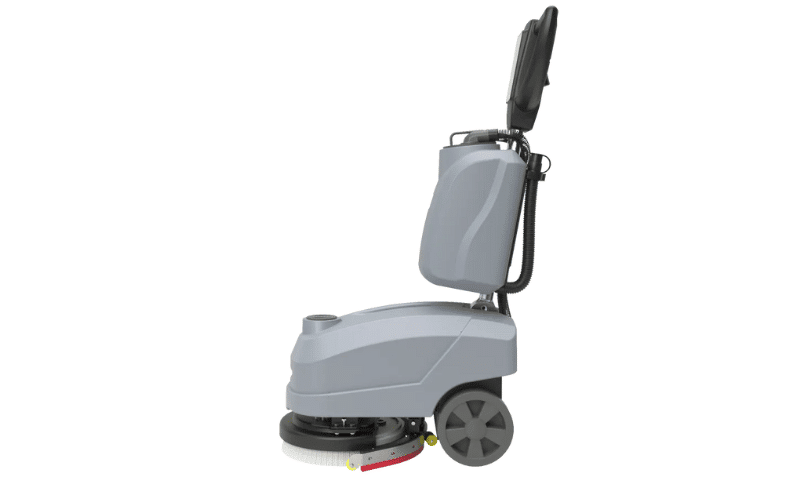

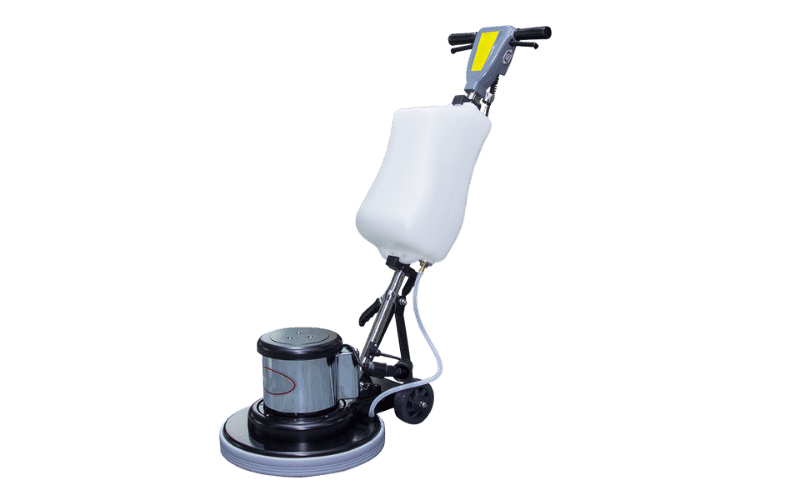
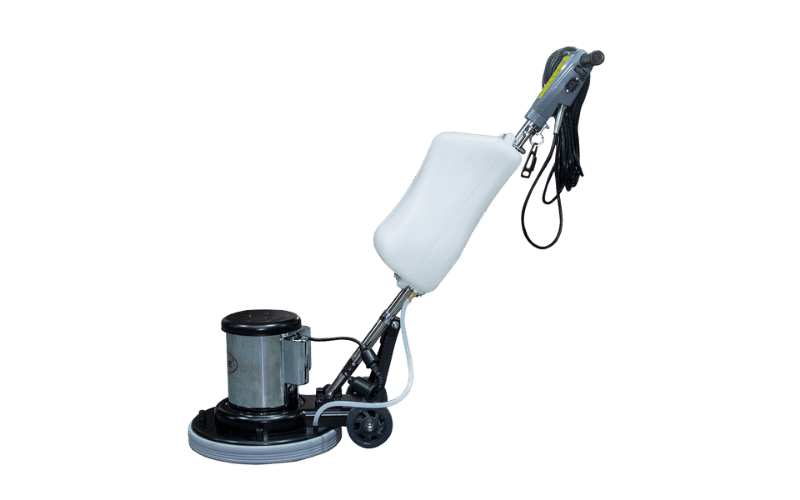
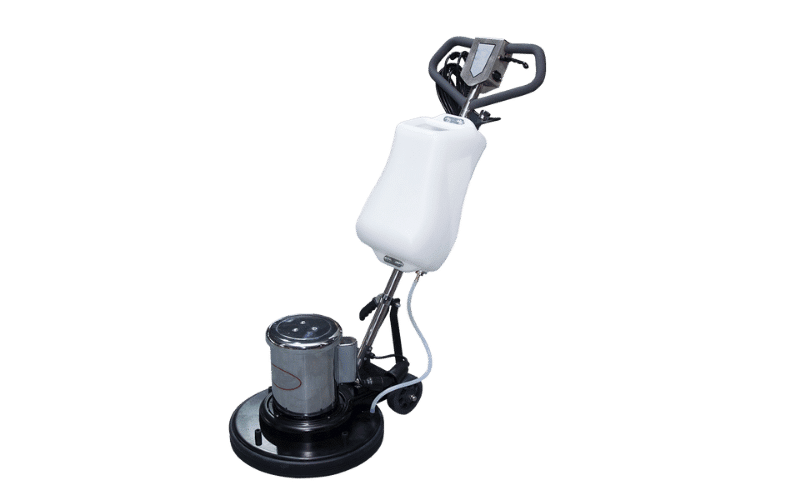
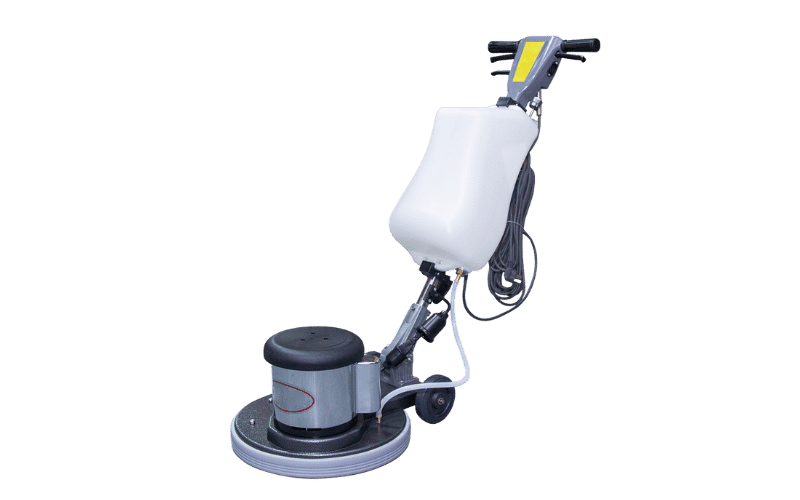



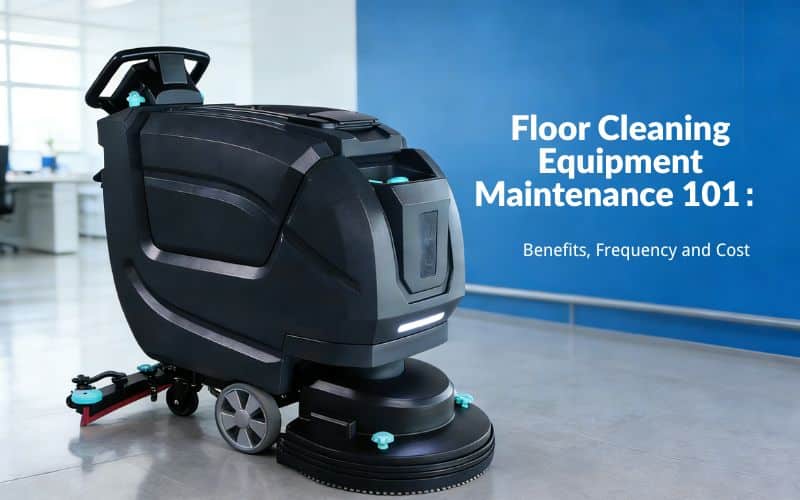
A neglected floor scrubber doesn’t just clean poorly—it costs significantly more to run and fails sooner. According to Tennant Company, every additional 30 minutes of unplanned cleaning caused by underperforming equipment adds $198 per month to labor costs, or $2,270 per year. Multiply that across a multi-machine fleet, and deferred maintenance becomes one of the largest hidden expenses a facility manager faces. This guide covers everything you need to know about floor-cleaning equipment maintenance: how often to maintain it, what it costs, what warning signs to watch for, and how to structure a program that protects both your machines and your budget.
Key Takeaways
- Service every 100 operating hours is the industry-standard benchmark for professional floor scrubber and sweeper maintenance
- Daily tasks take 10 minutes per shift and prevent the majority of premature component failures
- Planned maintenance customers spend approximately 30% less on parts and service over the lifetime of their machines compared to reactive repair models
- Battery systems, squeegee assemblies, and brush decks are the three highest-wear components and require attention before and after every shift
- Warning signs like streaking, reduced run time, and unusual noise are early indicators of specific mechanical failures—not signs that a machine “needs a clean”
Why Does Maintenance Determine the Lifespan of Floor Cleaning Equipment?
The single most controllable variable in floor scrubber and sweeper longevity is the frequency and quality of maintenance. A commercial floor scrubber, when operated in a high-traffic facility—such as a warehouse, hospital, or manufacturing plant—and properly maintained, can last 7 to 10 years. The same machine, run without a structured maintenance program, typically fails within 3 to 5 years.
The math is straightforward. Worn brushes force the motor to work harder. Residue left in recovery tanks accelerates corrosion. Clogged filters reduce suction, which puts strain on vacuum motors. Each skipped maintenance task adds incremental mechanical stress until a minor issue becomes a component failure.
Usage frequency accelerates this curve. Facilities running equipment multiple shifts per day need to service machines more aggressively than sites with a single cleaning cycle. The type of environment also matters—food processing facilities with high moisture, warehouses with debris-heavy floors, and cold storage operations all create conditions that wear components faster than a standard commercial setting.
Operator training is the most underestimated maintenance factor. Improper speed settings, incorrect chemical dilution, and failure to follow post-use cleaning procedures account for a significant proportion of avoidable breakdowns. A written operator checklist, reviewed during onboarding and refresher sessions, prevents this category of damage entirely.
How Often Should You Maintain Floor Cleaning Equipment?
Maintenance frequency is structured across four time horizons: daily, weekly, monthly, and annually. Each tier addresses a different category of wear and risk.
Daily Maintenance: 10 Minutes Per Shift
Daily maintenance should happen both before and after every cleaning cycle. Before use: check the battery charge level, inspect the terminals for corrosion, confirm the hose and drain connections are clear, and verify the debris tray is empty. Leaving debris in the tray from a previous shift causes blockages and accelerates bacterial growth.
After use: drain both the solution tank and recovery tank completely. This step is non-negotiable. Cleaning chemical left in the solution tank degrades and can gel, blocking solution flow. Dirty water left in the recovery tank settles and hardens, creating a sludge that is difficult to remove and generates persistent odors. Once drained, rinse both tanks and store them with lids open to prevent mold and mildew.
Squeegee assemblies need to be removed, rinsed, and dried after every shift. Metal components in the squeegee assembly corrode quickly when cleaning chemicals are left on them. The squeegee blade itself should be rotated when one edge shows wear—most blades offer four usable edges before replacement is required. Pads and brushes should be removed, washed, and stored off the machine floor.
Weekly Maintenance: 20–30 Minutes
Weekly tasks focus on filtration and fluid systems. Inspect and clean both the solution filter and the vacuum filter. Clogged filters are the most common cause of suction loss and reduced cleaning performance. In facilities with higher debris loads, filter inspection may need to happen every two to three days.
For wet-flooded lead-acid batteries, check electrolyte water levels weekly and top up with distilled water as needed. Check all visible hoses for early signs of cracking or leaking. Clean the exterior of the machine and inspect the brush deck for embedded debris or damaged bristles.
Monthly Maintenance: 45–60 Minutes
Monthly maintenance should include a full inspection of hoses, connections, and battery terminals. Look for swelling, cracking, or corrosion. Check caster wheels for wear and lubricate where specified. Inspect the squeegee blade condition across all edges and replace if wear is uneven or structural cracking is present.
On ride-on models and sweeper-scrubbers, check all fluid levels: hydraulic fluid, engine oil (where applicable), and coolant. Inspect brush skirts for tears that reduce containment effectiveness, and check that radiator and hydraulic cooler fins are free of dust and debris. Run the machine through a full cycle and observe performance—any change in cleaning pattern, suction, or noise is a signal worth logging.
Quarterly and Annual Maintenance: Professional Service
Quarterly and annual service intervals should be performed by a certified technician who can perform diagnostics, inspect electrical systems, test battery health, and assess motor performance. This is also the point at which worn components identified during daily and weekly checks are formally replaced rather than monitored.
Annual service is the right time to assess total operating costs across the fleet—by comparing repair frequency, part replacement history, and downtime patterns to determine whether machines are performing within their expected lifecycle or approaching end-of-serviceable-life.
What Is the Recommended Maintenance Interval by Operating Hours?
For equipment-based maintenance scheduling (as opposed to calendar-based), the industry standard is service every 100 operating hours. This approach is more accurate for facilities with variable usage—machines that run two shifts per day will reach 100 hours far faster than those running three days per week.
Track operating hours from the machine hour meter if available. For machines without meters, estimate based on cleaning cycle length and frequency. Once you’ve observed how long it takes to reach 100 hours under your normal operating conditions, you have a consistent trigger point for scheduling service.
Planned maintenance customers who service their machines consistently at this interval spend approximately 30% less on parts and service over the machine’s lifetime than operators who rely on reactive repair models, according to data from Factory Cleaning Equipment.
Maintenance Checklist by Equipment Type
Different machine types have distinct maintenance priorities. The table below summarizes key tasks by category.
|
Equipment Type |
Daily Priority |
Weekly Priority |
Monthly Priority |
|---|---|---|---|
|
Walk-behind floor scrubber |
Tank drain and rinse, squeegee clean, pad wash, battery check |
Filter inspection and clean, hose check |
Terminal inspection, caster lubrication, full-cycle performance check |
|
Ride-on floor scrubber |
Tank drain and rinse, squeegee clean, brush deck check, battery check |
Filter inspection, brush skirt check, fluid levels |
Hydraulic fluid, coolant, motor inspection, full diagnostic cycle |
|
Walk-behind floor sweeper |
Hopper empty and rinse, filter bag empty, side brush inspect |
Filter clean, bearing check, drive belt inspect |
Belt tension, brush height adjustment, full sweep-pattern check |
|
Ride-on floor sweeper |
Hopper empty and rinse, side and main brush check, filter empty |
Hydraulic fluid, filter clean, debris chute inspect |
Engine oil (propane/gas), spark plug check, cooling fin clean |
|
Battery-powered machines |
Charge after full cycle completion, terminal check |
Electrolyte levels (wet-flooded), connector inspect |
Battery capacity test, full-charge cycle performance review |
|
Propane/engine-powered machines |
Fuel level, exhaust check, oil level |
Oil and filter condition, belt check |
Full engine service, emissions check, fuel system inspection |
Floor Scrubbers: Walk-Behind and Ride-On
Both walk-behind and ride-on floor scrubbers share common high-wear components: squeegee blades, floor pads or brushes, vacuum filters, and batteries or engine systems. The major difference in maintenance between the two categories is scale and complexity.
Walk-behind units are more operator-dependent for daily care. Ride-on models carry additional mechanical systems—hydraulics, larger battery banks, cooling systems—that require technician-level inspection quarterly. For Leadv Clean’s ride-on scrubbers, which carry solution tanks from 75L to 180L, full tank drainage and thorough rinsing after each shift is particularly critical given the volume of chemical contact across the tank surface.
Floor Sweepers
Sweepers accumulate debris in hoppers and filter systems and require emptying and rinsing after every use. Side broom brushes wear unevenly and need height adjustment as they degrade—a side broom that no longer reaches the floor edge creates gaps in the cleaning path. Main brush patterns should be inspected weekly for embedded wire, string, or banding material that can wrap around the motor shaft.
Propane-powered ride-on sweepers require engine maintenance equivalent to a small vehicle: oil changes, filter replacements, spark plug checks, and fuel system inspections on a regular schedule. These should follow the manufacturer’s maintenance chart in the operator’s manual.
Battery-Powered Machines
Battery care is the highest-impact maintenance variable for electric floor scrubbers and sweepers. There are four common battery types: wet-flooded lead-acid, gel, AGM, and lithium-ion. Each has different maintenance requirements.
- Wet-flooded lead-acid: Requires weekly electrolyte level checks; top up with distilled water only. Sensitive to overcharging and opportunity charging (partial charging before the battery reaches its minimum threshold).
- Gel and AGM: Sealed maintenance-free designs. No water topping required, but sensitive to heat and incorrect charger settings.
- Lithium-ion: No water maintenance required. Tolerates partial charging without damage, faster charging cycles, and longer service life. Higher upfront cost, offset by lower ongoing maintenance.
For all battery types: charge only after completing a full cleaning cycle, or when charge drops below the manufacturer’s recommended minimum (typically 20%). Avoid opportunity charging with wet-flooded and gel batteries. Store batteries in a charged state if the machine is out of service for an extended period.
Common Warning Signs and What They Mean
Equipment warning signs are diagnostic signals, not random events. Each one points to a specific maintenance gap.
|
Warning Sign |
Most Likely Cause |
Immediate Action |
|---|---|---|
|
Streaking or water lines left behind |
Worn, torn, or contaminated squeegee blade |
Rotate to unused blade edge or replace; check for debris caught in squeegee assembly |
|
Reduced run time per charge |
Battery capacity degradation or sulfation (lead-acid) |
Test battery capacity; recondition or replace if below 80% of rated capacity |
|
Weak suction or poor water recovery |
Clogged vacuum filter or blocked hose |
Inspect and clean filter; backflush vacuum hose; check for cracks in hose assembly |
|
Uneven cleaning pattern or brush chatter |
Worn or unevenly loaded brush/pad |
Replace pad or brush; check brush pressure settings |
|
Unusual motor noise or grinding |
Debris wrapped around brush motor shaft or bearing wear |
Stop machine immediately; remove and clear debris; inspect bearings |
|
Solution flow stops or is intermittent |
Chemical residue blocking solution valve or jets |
Drain and rinse solution tank; inspect and clear solution jets |
|
Machine pulls to one side (sweepers) |
Side broom height imbalance or caster wear |
Adjust side broom height; inspect and replace worn casters |
|
Persistent odor from tanks |
Residue or mold buildup in recovery tank |
Deep-clean tank with appropriate cleaner; allow full dry-out with lid open |
|
Error codes or fault lights |
Sensor fault, electrical connection issue, or battery system alert |
Consult operator’s manual; contact certified technician if code persists |
Do not ignore error codes. Modern commercial floor scrubbers—including Leadv Clean’s ride-on models—include onboard diagnostics that flag system issues before they escalate. An error code on day one of a problem costs a service call; the same error ignored for three weeks often costs a major repair.
Floor Cleaning Equipment Maintenance Cost Breakdown
Understanding the real cost of maintenance helps facility managers build accurate budgets and make defensible procurement decisions. Total maintenance costs are broken down into five categories.
Consumables
Consumables are the highest-frequency cost in any maintenance program. Squeegee blades, floor pads, brushes, and filters all have predictable replacement cycles.
|
Consumable |
Typical Replacement Cycle |
Estimated Annual Cost |
|---|---|---|
|
Squeegee blade (walk-behind) |
Every 3–6 months |
$80–$200 |
|
Squeegee blade (ride-on) |
Every 3–6 months |
$150–$400 |
|
Floor pads (set) |
Every 1–3 months, depending on usage |
$300–$900 |
|
Scrub brushes |
Every 6–12 months |
$200–$600 |
|
Vacuum filters |
Every 3–6 months |
$100–$300 |
|
Side brooms (sweepers) |
Every 3–9 months |
$150–$450 |
Annual consumables spend for a single walk-behind scrubber typically ranges from $800 to $2,000. Ride-on models and sweepers have higher operating costs due to component size and volume. Facilities running multiple machines should track consumable spend per machine to identify outliers—unusually high consumable costs on a specific unit often signal a training gap for the operator or a misalignment between the machine type and the floor environment.
Battery-Related Costs
Battery systems represent the largest periodic capital expense within a maintenance program. Replacement costs vary significantly by battery type and machine size.
|
Battery Type |
Typical Lifespan |
Replacement Cost (per set) |
|---|---|---|
|
Wet-flooded lead-acid |
3–5 years (with correct maintenance) |
$500–$1,500 |
|
Gel / AGM |
4–6 years |
$700–$2,000 |
|
Lithium-ion |
6–10 years |
$1,500–$5,000+ |
|
Propane (ride-on sweepers) |
Ongoing fuel cost |
$1,000–$4,000/year in fuel |
Lithium-ion batteries have a higher initial cost, but the total cost of ownership over a machine’s lifecycle is often lower than that of lead-acid alternatives when accounting for replacement cycles, maintenance labor, and downtime.
Technician Labor
Technician rates for certified floor cleaning equipment service range from $75 to $150 per hour, depending on location and machine complexity. A standard 100-hour service visit typically takes one to two hours. More complex annual inspections on ride-on models can run three to four hours.
Facilities with in-house maintenance staff should ensure technicians have manufacturer-specific training. Modern commercial scrubbers contain sophisticated electronic systems—including onboard diagnostics and motor controls—that require qualified knowledge to diagnose accurately.
Planned Maintenance Contracts
A planned maintenance contract with a certified service provider removes scheduling friction and caps annual service costs at a predictable rate. Contract structures typically cover scheduled visits, labor for routine service, and discounts on parts.
|
Machine Type |
Typical Annual Contract Cost |
|---|---|
|
Walk-behind floor scrubber |
$500–$1,200 |
|
Ride-on floor scrubber |
$1,000–$2,500 |
|
Industrial ride-on sweeper-scrubber |
$1,500–$4,000 |
The ROI case for maintenance contracts is clear: operators using planned maintenance programs spend approximately 30% less on parts and service over the machine’s lifecycle than those managing maintenance reactively.
Maintenance Cost by Machine Tier
Total annual maintenance cost—consumables, battery amortization, and service labor—varies significantly by machine class.
|
Machine Tier |
Example Machine Type |
Estimated Annual Maintenance Cost |
|---|---|---|
|
Entry-level |
Small walk-behind scrubber (5–15L tank) |
$600–$1,500 |
|
Mid-range |
Standard walk-behind scrubber (30–60L tank) |
$1,200–$3,000 |
|
Industrial / Ride-on |
Ride-on scrubber (75L–180L tank) |
$2,500–$6,000+ |
|
Heavy-duty sweeper |
Propane ride-on sweeper |
$3,000–$8,000+ |
These figures assume a structured maintenance program. Reactive maintenance—replacing components only after failure—routinely runs 40 to 60% higher annually, compounded by downtime costs and shortened equipment lifespan.
General Floor Cleaning Equipment Maintenance Best Practices
- Establish a written maintenance log per machine. Record daily checks, filter changes, brush replacements, and any performance observations. A log creates accountability and builds a service history that supports warranty claims and resale value.
- Match the machine to the environment. A walk-behind scrubber running in a large warehouse with heavy debris loads will wear components significantly faster than the same machine used in a retail setting. If maintenance frequency is unusually high, the machine specification may be wrong for the application.
- Train operators properly—and retrain annually. Improper handling—wrong speed settings, chemical overdosing, skipped post-use procedures—causes more avoidable damage than any other single factor. Operator training should be a scheduled event, not a one-time orientation.
- Stock critical wear items on-site. Squeegee blades, floor pads, and filters are predictable consumables. Keeping a small inventory eliminates the gap between identifying wear and completing the replacement. A machine running on a degraded squeegee blade is not cleaning effectively—and may be creating a slip hazard.
- Use the correct cleaning chemistry. Wrong chemical dilution rates damage pump systems, degrade tank seals, and accelerate brush wear. Consult the machine manufacturer’s approved chemical list, not just the label on the cleaning product.
- Store machines correctly between shifts. Tanks should be drained and stored open. Squeegees should be raised off the floor. Machines stored in environments with extreme temperatures—particularly cold storage facilities—require additional attention to battery management and seal condition.
Start Protecting Your Equipment Investment Today
Maintenance is not a cost center—it’s how you protect a capital investment that enables daily operations. A structured program combining daily operator tasks, 100-hour service intervals, and annual technician inspections is the most reliable path to full equipment lifespan and the lowest total cost of ownership.
Leadv Clean’s commercial floor scrubbers and sweepers are engineered for high-demand facility environments, from compact walk-behind models for mid-size commercial spaces to ride-on scrubbers handling up to 5,500 m²/h in large industrial operations. Every machine is built with durability and serviceability in mind—including ECO mode that extends battery life by 20%, low-noise motors at 60 dB(A), and warranties up to 2 years or 2,000 hours on ride-on models.
Explore Leadv Clean’s full range of commercial floor scrubbers and sweepers, or contact the Leadv Clean team for tailored guidance on the total cost of ownership for your facility.
Frequently Asked Questions
How often should a commercial floor scrubber be serviced?
The standard service interval is every 100 operating hours. For calendar-based scheduling, most facilities running one shift per day will reach this point every 2 to 4 months. Facilities with multi-shift operations or high debris loads may need service every 4 to 8 weeks. Daily operator maintenance—tank draining, squeegee cleaning, filter checks—should occur every shift regardless of the technician service schedule.
What are the most common causes of floor scrubber breakdowns?
The four most frequent causes of avoidable floor scrubber failure are: (1) failure to drain and rinse recovery tanks after each use, leading to corrosion and sludge buildup; (2) battery mismanagement, including opportunity charging and incorrect charge cycles; (3) clogged vacuum filters reducing suction until motor strain causes failure; and (4) worn squeegee blades running past usable life, creating water recovery failures and floor hazards.
How much does it cost to maintain a commercial floor scrubber per year?
Annual maintenance costs range from approximately $600 to $1,500 for entry-level walk-behind scrubbers, $1,200 to $3,000 for mid-range units, and $2,500 to $6,000 or more for industrial ride-on models. These figures include consumables, battery amortization, and service labor under a planned maintenance model. Reactive maintenance (repairing only after failure) typically adds 40 to 60% to these costs.
How long do commercial floor scrubbers last with proper maintenance?
A well-maintained commercial floor scrubber, when operated under appropriate conditions, can last 7 to 10 years. Without a structured maintenance program, the same machine typically reaches the end of serviceable life in 3 to 5 years. Leadv Clean’s ride-on scrubbers carry a warranty of up to 2 years or 2,000 operating hours, reflecting the durability built into the machine design when maintained correctly.
What is the difference between planned and reactive maintenance for floor-cleaning equipment?
Planned maintenance is a scheduled, proactive program—daily operator tasks, 100-hour technician service, and annual diagnostics—designed to prevent failures before they occur. Reactive maintenance is responding to breakdowns after the fact. Facilities using planned maintenance programs spend approximately 30% less on parts and service over the machine’s lifetime, while also reducing unplanned downtime, extending equipment lifespan, and maintaining consistent cleaning performance.
What does it mean when a floor scrubber leaves streaks on the floor?
Streaking is almost always a squeegee blade issue. The most common causes are: a worn blade edge (flip to a fresh edge or replace the blade), debris trapped in the squeegee channel, or a squeegee assembly that is out of alignment with the floor. If the blade is new and aligned correctly but streaking persists, check whether the vacuum motor is generating sufficient suction—weak recovery can cause water to spread rather than be lifted from the floor.
Should facility managers choose lithium-ion or lead-acid batteries for floor scrubbers?
Lithium-ion batteries offer longer service life (6–10 years versus 3–5 for lead-acid), faster charging, and no water maintenance requirements. They tolerate partial charging without cycle damage, which suits facilities with interrupted cleaning schedules. Lead-acid batteries (wet-flooded, gel, or AGM) carry a lower upfront cost and are appropriate for facilities with consistent full-cycle charging routines and structured battery maintenance programs. For facilities evaluating total cost of ownership over 5 or more years, lithium-ion typically becomes the more cost-effective choice. Leadv Clean’s floor scrubber range supports both battery types to fit different facility budgets and operational profiles.
Can operator error cause damage to a floor scrubber?
Yes—operator misuse is one of the leading causes of avoidable mechanical failure. Common errors include running the machine at incorrect speed settings for the floor type, using chemical concentrations outside the manufacturer’s specifications, skipping post-shift tank draining and squeegee cleaning, and overcharging batteries beyond their design parameters. Regular operator training, written shift checklists, and supervisory audits of daily maintenance logs significantly reduce this category of damage.