







Standing in front of a wall of cleaning equipment — or scrolling through a catalog of scrubbers, sweepers, and vacuums — it’s easy to feel lost. The names overlap, every manufacturer uses different labels, and the specs blur together. Pick the wrong machine, and you waste money, waste labor, and sometimes damage the floor you were trying to protect.
This guide sorts cleaning equipment into the categories that actually matter for commercial and industrial facilities. We’ll focus on the workhorses — powered floor equipment, specialty machines, and manual tools that still anchor every routine — and show you how to match each to your surface, square footage, and workload. The goal isn’t to name every tool ever made. It’s to help you assess your building’s needs and choose with confidence.
How to Think About Cleaning Equipment Categories
Before the specific machines, it helps to have a mental filter. Nearly every buying decision comes down to four questions:
- What surface am I cleaning? Hard floors, carpet, glass, and exterior concrete each call for different equipment.
- How much area, how often? A 500-square-foot clinic and a 200,000-square-foot warehouse are entirely different problems.
- What kind of soiling? Loose debris, ground-in grime, grease, and stains each need a different approach.
- Who’s operating it, and how much can they handle? Training time and physical strain are real costs.
Keep those four in mind as you read. They turn “which machine looks good” into “which machine fits my situation” — and that’s the difference between equipment that pays for itself and equipment that gathers dust in a closet.
Powered Floor Cleaning Equipment
This is the backbone of any serious cleaning operation. Powered machines cover ground faster, clean more consistently, and spare your staff the strain of manual work. Within this category, four sub-groups do most of the heavy lifting.
Floor Scrubbers: The Core Machine for Hard Floors
If you clean hard floors daily, a scrubber is the single most valuable machine you can own. It dispenses solution, agitates the surface with brushes or pads, and vacuums the dirty water back up — all in one pass. Where a mop just relocates grime, a scrubber lifts it off the floor and out of the building.

Scrubbers split into two main types by size and layout:
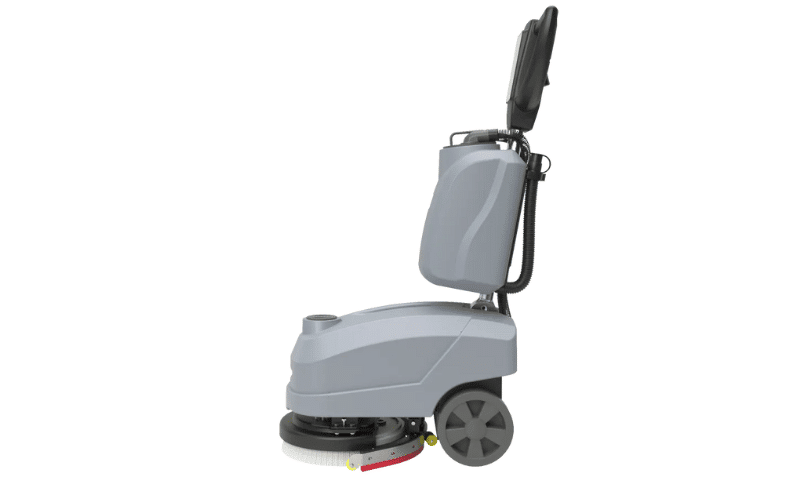
- Walk-behind scrubbers suit small- to mid-size spaces: retail stores, clinics, restaurants, schools, and warehouses with tight aisles. They’re maneuverable, affordable, and get into corners a rider can’t. A walk-behind floor scrubber with a 20–26-inch cleaning path covers open floors efficiently while still fitting through standard doorways and aisles.
- Ride-on scrubbers earn their place in large, open facilities — distribution centers, big-box retail, parking structures, and manufacturing plants. One seated operator covers far more ground per hour, which is exactly what you need when you’re scrubbing tens of thousands of square feet on a tight schedule.

There’s also a brush-type decision worth knowing. Disc brushes work best on smooth, even floors and handle general grime well. Cylindrical brushes are the better choice for uneven surfaces like textured concrete or tile with grout lines, since they scrub into low spots and can sweep up small debris at the same time.
To see how machine size maps to different spaces, the full range of floor scrubbers shows where compact, walk-behind, and ride-on models each fit.
Sweepers: Debris Before Water
Sweepers handle what scrubbers shouldn’t — loose dirt, dust, and debris. Running a scrubber over a floor covered in grit just clogs the recovery system and drags debris across the surface. On dusty or debris-heavy floors, you sweep first, then scrub.
Sweepers come in walk-behind and ride-on styles, and unlike scrubbers, many work both indoors and outdoors — including pavements, loading yards, and parking lots. For facilities with heavy debris and large open areas, a sweeper-scrubber combo handles both jobs in a single pass, saving time when the floor needs both services daily.
Buffers and Burnishers: Finish and Shine
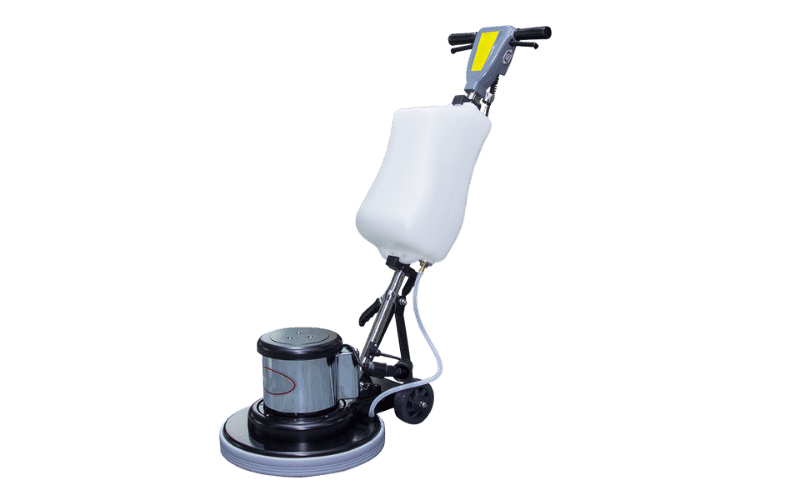
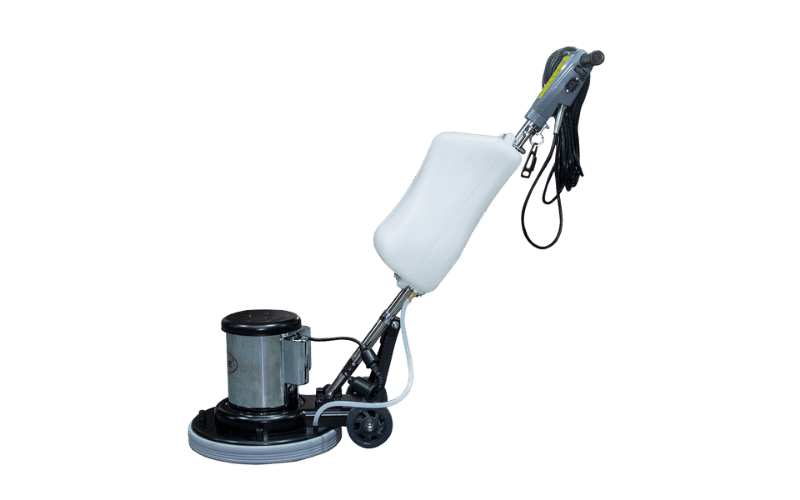
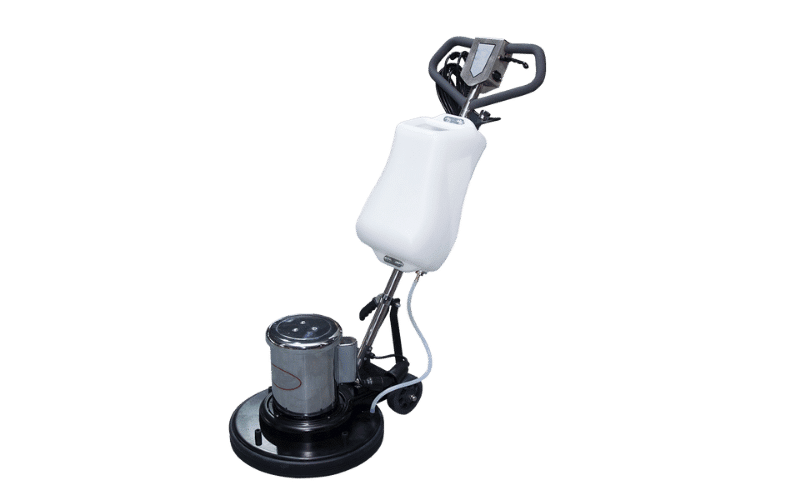
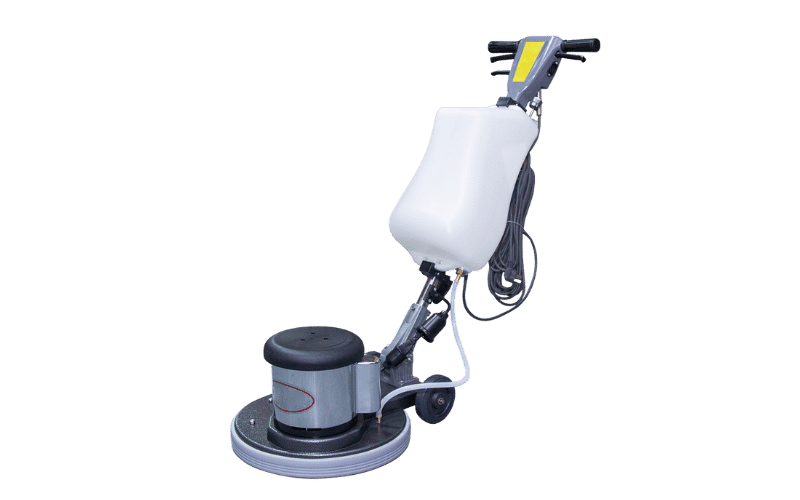
These two get confused constantly, so here’s the clean line between them. A buffer (also called a polisher) runs at low-to-mid speed and handles finish work — spray buffing, light scrubbing, stripping old wax, and applying new coats. A burnisher runs at high speed and uses friction heat to fuse an existing finish into a deep, wet-look gloss.
The practical takeaway: a buffer preps and maintains; a burnisher polishes. Pad choice and speed control the outcome on tile, concrete, and vinyl — a soft pad restores shine, a stiff pad strips finish. Burnishers only work on floors that already hold a healthy finish; run one over bare or worn flooring, and you’ll scorch it.

Vacuums: Not Just for Carpet
Vacuums are the most familiar category and still one of the most important. The right type depends on what and where you’re cleaning:
- Upright vacuums handle carpeted areas and quick daily passes.
- Canister vacuums reach stairs, upholstery, and above-floor surfaces where an upright can’t go.
- Backpack vacuums shine in large facilities — offices, theaters, hotels — where an operator needs to move fast and cover long corridors without dragging a heavy unit behind them.
- Wet/dry vacuums deal with spills, construction debris, and workshop floors that would ruin a standard vacuum.
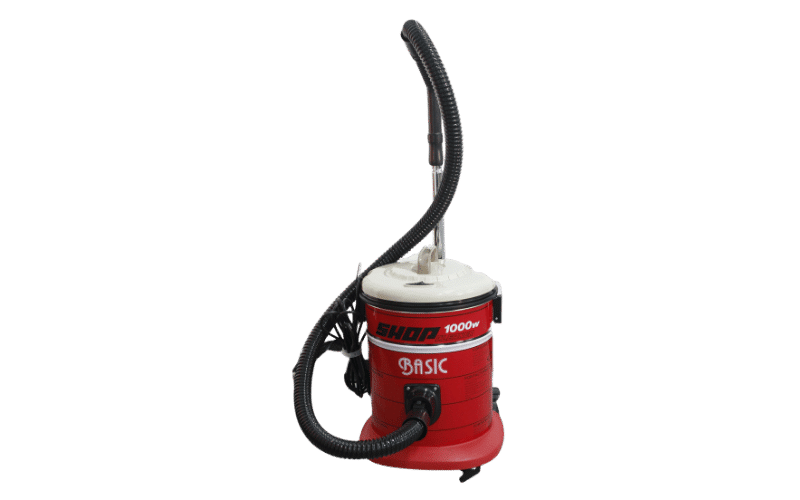
For commercial settings, mobility and capacity usually matter more than raw suction. A vacuum cleaner built for facility use — whether a canister for detail work or a backpack for large open spaces — cuts cleaning time significantly compared to a residential model pressed into commercial duty.
Specialty Equipment for Targeted Jobs
General-purpose machines can’t solve every problem. When you hit a specific surface or stubborn soiling, specialty equipment does what a scrubber or vacuum can’t.
Pressure Washers
Pressure washers blast away grime that no floor machine will touch — exterior concrete, loading docks, equipment, building facades, and dumpster pads. The two things that matter most are PSI (pressure) and the nozzle tip.
- Electric units suit lighter jobs: patios, siding, and light indoor washdowns.
- Gas-powered units deliver the higher pressure needed for driveways, heavy equipment, and stubborn exterior grime.

Match the nozzle to the surface. A narrow, high-pressure tip cuts through caked-on dirt but can gouge softer surfaces, so start wider and step down only if you need more force. More PSI isn’t always better — it’s about matching the machine to what you’re cleaning.
Steam Cleaners
Steam machines clean and sanitize with heat rather than chemicals, making them valuable in food service, healthcare, and any setting where chemical residue is a concern. Steam mops handle sealed hard floors, handheld units tackle grout, ovens, and fixtures, and commercial vapor systems sanitize high-touch areas. The trade-off is speed — steam cleaning is thorough but slower than a scrubber, so it’s a targeted tool, not a whole-floor solution.
Carpet Extractors
Carpet needs its own equipment. Extractors inject a cleaning solution deep into the fibers and pull it back out along with embedded dirt. Portable extractors handle spot cleaning and small areas, while larger walk-behind or truck-mounted systems deep-clean big carpeted zones. Hot water extraction (steam cleaning) reaches deepest; dry or low-moisture methods trade some cleaning depth for much faster drying, which matters in spaces that can’t close for hours.
Manual Tools Still Matter
Even the most machine-heavy operation relies on manual tools for detail work — and skipping them leaves gaps no scrubber can fill.
- Brooms and brushes: push brooms for large, flat areas; angle brooms for corners; and detail brushes for grout lines, edges, and fixtures. Bristle stiffness matters — soft for delicate surfaces, stiff for concrete.
- Mops and flat-mop systems: flat mops with microfiber pads give better control over chemical use than old string mops and are the right tool for touch-ups and tight spaces a machine can’t reach.
- Microfiber cloths and dusters: microfiber traps dust without chemicals, and extendable dusters reach vents, high shelves, and light fixtures.
- Squeegees: the fastest way to clean glass and clear water off smooth tile.
The rule here is simple: machines cover the open ground, manual tools handle the edges, corners, and high-touch detail.
How to Choose the Right Equipment for Your Facility
Match your equipment to three variables — surface type, square footage, and cleaning frequency. Here’s how that plays out across common facility types.
Small Retail, Clinics, and Offices
Keep it lean. A compact walk-behind scrubber for the hard floors, a good commercial vacuum for carpet and detail work, and a set of manual tools cover nearly everything. Storage is often tight in these spaces, so a short, versatile equipment list beats a crowded closet of single-use gear.
Large Commercial Facilities
Prioritize coverage and speed. Ride-on scrubbers for open floors, backpack vacuums for corridors and carpeted zones, and a buffer or burnisher if your floors carry a finish you need to maintain. At this scale, budget for replacement parts — pads, brushes, squeegee blades — and build a maintenance routine so machines don’t die early from neglect.
Industrial and Heavy-Duty Environments
Build for abuse. Sweepers rated for abrasive debris, wet/dry vacuums for spills and workshop messes, and gas pressure washers for exterior and equipment cleaning. Two things become non-negotiable here: chemical compatibility with your surfaces and proper operator training, since bigger machines and harsher jobs carry real safety stakes.
Buy, Lease, or Rent?
Look past the sticker price to total cost of ownership — batteries, pads, filters, and repairs all add up over a machine’s life.
- Buy when a machine sees daily use and the labor savings justify the price.
- Lease to keep monthly costs predictable and leave room to upgrade.
- Rent for occasional deep cleans, seasonal projects, or to test a model on your own floor before committing.
Frequently Asked Questions
Do I need both a vacuum and a floor scrubber, or will one machine do everything?
For most facilities, you need both. Vacuums handle carpet and above-floor detail; scrubbers clean hard floors. If your building is nearly all hard flooring, a scrubber plus a small vacuum for detail work usually covers it.
What’s the difference between a steam cleaner and a pressure washer?
A steam cleaner uses heat to sanitize surfaces, often chemical-free, and works indoors on floors, grout, and fixtures. A pressure washer uses high-pressure water to blast grime off tough exterior surfaces like concrete and equipment. They solve different problems.
When should I use a sweeper instead of a scrubber?
Use a sweeper for loose dirt, dust, and debris — indoors or outdoors. Use a scrubber for washing embedded grime off hard floors. On debris-heavy floors, sweep first, then scrub. A sweeper-scrubber combo does both in one pass.
Are battery-powered scrubbers as strong as corded models?
Modern battery scrubbers handle the vast majority of commercial jobs and offer huge freedom of movement — no cords, no outlet hunting. For most facilities, the mobility gain outweighs any difference, and battery run times comfortably cover a shift’s work.
Which brush should I choose — disc or cylindrical?
Disc brushes suit smooth, even floors and general grime. Cylindrical brushes work better on uneven or textured surfaces and can sweep small debris while scrubbing. Match the brush to your floor’s texture, not just the machine.
How do I choose the right pad for a floor buffer?
Pad color signals aggressiveness — softer, lighter pads polish and restore shine, while darker, stiffer pads strip old finish. Start with the gentlest pad that gets results, especially on coated floors you don’t want to damage.
The Bottom Line
Cleaning equipment sorts into a handful of practical categories: powered floor machines cover open ground, specialty gear solves specific soiling problems, and manual tools handle the edges and detail. Get the categories right, and the individual purchase decisions fall into place.
Your next step is a quick audit of your own space. List your surface types, measure your square footage, and note how often each area needs cleaning. Then match each task to the equipment category above. When you’re ready to compare machines, ask a supplier for a trial unit and time it on your actual floor — real minutes on your real surface tell you more than any spec sheet. Buy the simplest tool that does the job right, pair it with the correct pads and chemicals, and it will earn its keep every shift.