







The wrong detergent can ruin a floor scrubber’s vacuum motor, leave streaky residue, or turn a clean surface into a slip hazard. Choosing the right one isn’t complicated, but it does require knowing what matters most — and why.
This guide gives you a clear decision path: what type of detergent to use, why low-foam is non-negotiable, which products to keep out of your solution tank, and how to match your cleaner to your specific floor and soil. Whether you’re managing cleaning operations in a warehouse, a hospital, a school, or a retail store, the same principles apply.
What Type of Detergent Should You Use in a Floor Scrubber?
Use a low-foam, machine-safe detergent. For daily cleaning, a neutral pH cleaner (pH 7–9) handles most surfaces without harming floors or equipment. For oily or heavily soiled areas, switch to a low-foam degreaser rated for automatic scrubbers.
Three rules apply in nearly every situation:
- Low-foam is required — not optional. High-suds cleaners flood the recovery tank and threaten the vacuum motor.
- Match the cleaner to your floor type and soil level. A dusty concrete warehouse and a greasy loading dock call for completely different products.
- Follow the dilution ratio on the label. More chemical does not mean a cleaner floor. Overconcentration leaves residue and wears out machine components.
These three rules solve most problems before they start. The rest of this guide explains how to apply them to your specific situation.
Why Low-Foam Detergent Is Non-Negotiable
This is the most critical concept in floor scrubber chemistry, and it’s worth understanding fully.
An automatic scrubber doesn’t just apply cleaning solution — it also vacuums the dirty water back off the floor and into a recovery tank. That recovery tank is directly connected to the vacuum motor. If your detergent creates foam, that foam accumulates inside the tank with every pass.
When foam rises high enough, it gets drawn into the vacuum motor. Vacuum motors are designed to handle air and water — not suds. Foam coats internal components, reduces suction, and eventually causes motor failure. A new vacuum motor costs far more than a jug of the right detergent.
Foam causes performance problems even before it reaches the motor. It reduces water pickup, so your floors stay wet behind the machine. It also trips the float shutoff switch, making the machine think the recovery tank is full when it isn’t, which cuts suction mid-job.
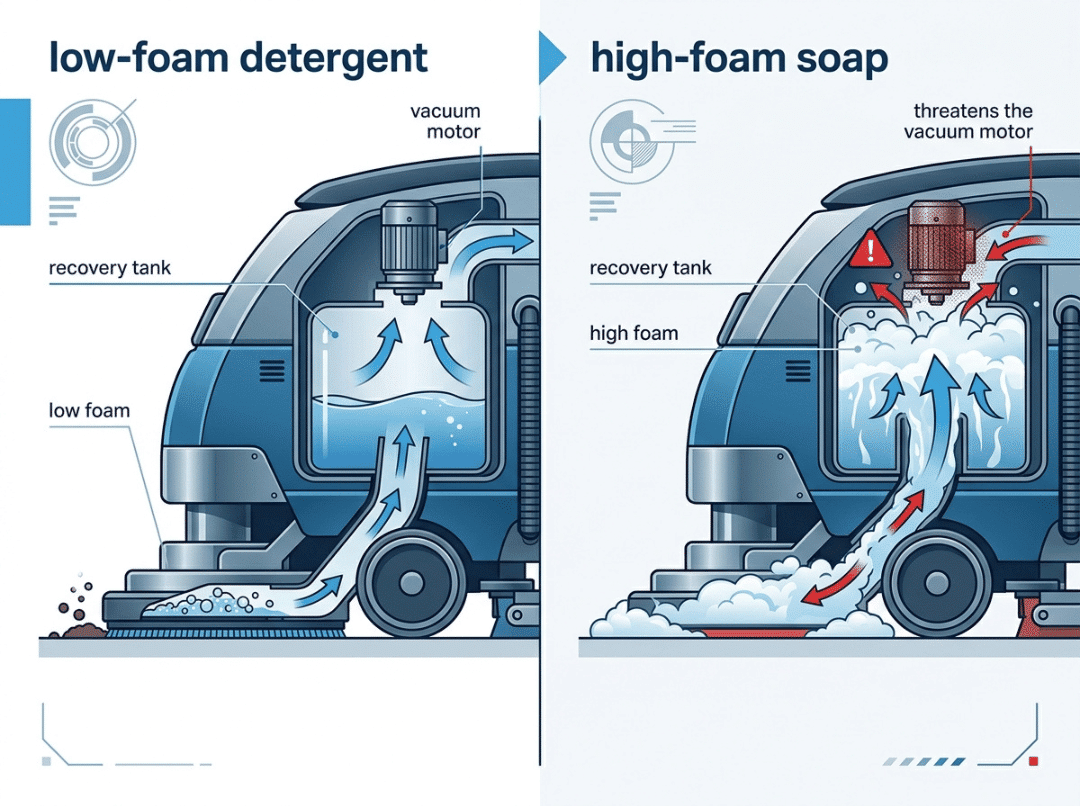
The bottom line: if a product foams in a bucket, it does not belong in a floor scrubber.
If you’re already dealing with foam buildup — often caused by residue from a previous incorrect cleaner — add a defoamer directly to the recovery tank to knock it down. But defoamer treats the symptom. Fix the root cause by switching to the right low-foam product.
What Cleaners Are Safe to Use
Each of the following works in an automatic scrubber, provided it is low-foam and compatible with your floor type:
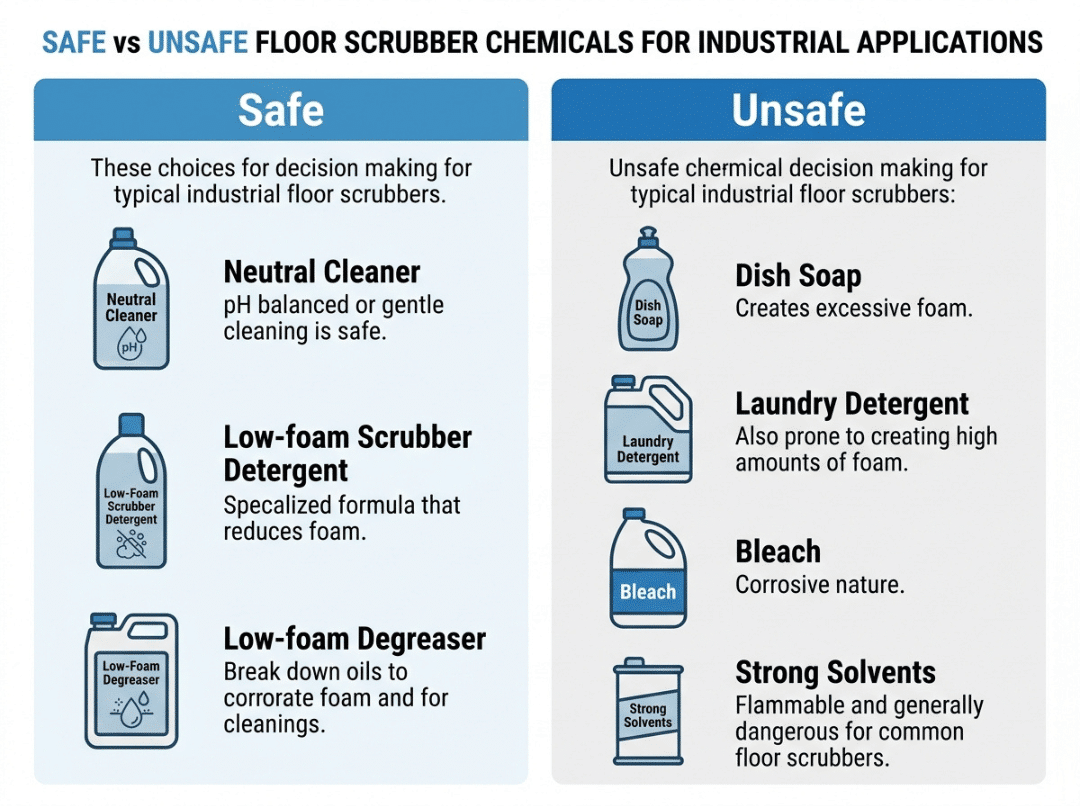
- Neutral floor cleaner (pH 7–9): The right choice for routine daily cleaning on sealed concrete, tile, epoxy, polished vinyl, and most commercial hard floors. Gentle enough for everyday use without stripping floor finish.
- Dedicated automatic scrubber detergent: Purpose-built for these machines. If you’re cleaning large areas on a daily schedule, this is the safest and most consistent option. Labels will confirm it’s low-foam and machine-rated.
- Low-foam degreaser: For oily floors — loading docks, mechanical shops, food production areas, and commercial kitchens. Effective where neutral cleaners simply don’t cut through grease films. Always confirm the product is rated for scrubber use.
- Machine-safe disinfectant cleaner: Required in hospitals, schools, long-term care facilities, and food-service environments. Only use products that are both low-foam and explicitly approved for automatic scrubbers — many disinfectants produce heavy suds.
- Manufacturer-approved chemicals: When your machine’s documentation recommends specific products, follow it. Approval protects your warranty and removes the guesswork.
If a label doesn’t clearly state it’s safe for automatic scrubbers, or doesn’t address foam level, treat that as a reason to look for something else.
What You Should Never Put in a Floor Scrubber
These products are responsible for the majority of avoidable vacuum motor failures and floor damage in commercial cleaning operations:
- Dish soap: Engineered to foam. Even a small amount creates suds that rapidly fill the recovery tank and endanger the motor.
- Laundry detergent: Same foam problem as dish soap, with the added risk of leaving a slippery film on the floor surface.
- Any high-foam household cleaner: The suds level that makes a product feel effective for hand cleaning makes it actively harmful in a scrubber.
- Bleach (unless your machine and cleaner are rated for it): Corrodes seals, hoses, tanks, and metal fittings. Only use bleach-based cleaners when both your machine and the specific product are explicitly approved.
- Strong solvents: Acetone, mineral spirits, and similar products dissolve gaskets, hoses, and plastic components.
- Overly concentrated solutions: Even the right cleaner causes problems when mixed too strong. Residue builds on the floor, components degrade faster, and chemical costs climb for zero extra benefit.
- Incompatible acids or caustic cleaners: Strong acids and heavy alkalis can etch floor finishes and attack internal machine surfaces.
If you’re unsure whether a product is safe, contact the manufacturer before running it through the machine. One phone call is far easier than a motor replacement.
Quick Selection Guide: Detergent by Situation
Use this table to identify the right cleaner for your facility at a glance.
|
Facility / Situation |
Recommended Cleaner |
Avoid |
|---|---|---|
|
Daily cleaning, sealed floors |
Neutral low-foam cleaner |
Dish soap, laundry detergent |
|
Warehouse — dust and light grime |
Neutral low-foam cleaner |
High-foam household cleaners |
|
Loading dock — grease and oil |
Low-foam degreaser |
Neutral cleaner (won’t cut grease) |
|
Epoxy floors |
Neutral pH scrubber detergent |
Acids, strong alkalis, solvents |
|
Polished concrete |
Neutral low-foam cleaner |
Caustic cleaners, high-foam soap |
|
Hospital or long-term care |
Low-foam, machine-safe disinfectant |
Bleach (unless machine-rated) |
|
School or food-service facility |
Low-foam neutral or disinfectant |
Strong fragranced household cleaners |
|
Mechanical shop or kitchen |
Low-foam degreaser |
High-foam soap, solvents |
How to Choose Detergent by Floor Type
Your floor surface sets the limit on how aggressive your chemistry can be. Going beyond that limit damages the finish and costs you in repairs or refinishing.
- Sealed or polished concrete: Neutral cleaner for daily maintenance. For unsealed industrial concrete with grease or oil buildup, a low-foam degreaser is appropriate.
- Epoxy floors: Neutral pH cleaner only. Acidic or caustic products dull and etch epoxy coatings over time, which can be expensive to restore.
- Tile and grout: Neutral cleaner for routine passes. For deep grout cleaning, a low-foam alkaline cleaner lifts embedded soil more effectively — but verify it’s safe for your specific grout type before using.
- Polished vinyl and VCT: Neutral cleaner designed to preserve floor finish. Avoid anything that strips protective coatings.
- Retail and hospital floors: Neutral or machine-safe disinfectant cleaner. These environments demand both appearance and safety — no slippery residue, no overpowering chemical smell.
The general rule: the more specialized or delicate the floor, the more you should lean toward a neutral cleaner and away from aggressive chemistry.
How to Choose Cleaner by Soil Type
Floor type tells you what’s safe. Soil type tells you what actually works.
- Light dust and everyday foot traffic: A diluted neutral cleaner is sufficient. The machine’s brush pressure and mechanical scrubbing action carry most of the load. You don’t need strong chemistry for light soil.
- Grease and oil: A neutral cleaner won’t break down oily films. Use a low-foam degreaser. This is non-negotiable on loading docks, in kitchens, and in mechanical areas.
- Food residue: Use a neutral or mild alkaline cleaner. Add a machine-safe disinfectant where sanitation requirements apply.
- Heavy industrial grime: Built-up grease in manufacturing plants and mechanical shops calls for a heavy-duty low-foam degreaser, often combined with double scrubbing (see below).
- Neglected or first-time floors: Floors that have only been hand-mopped for months or years carry significant wax buildup and embedded grime. Double scrubbing with a stronger dilution on the first pass is usually necessary.
When in doubt, start with a neutral cleaner at standard dilution, assess the result, and step up to a degreaser only where needed. Graduated approach saves chemical and protects floors.
How Much Detergent to Use
Follow the dilution ratio on the product label. Then consider diluting slightly further for lightly soiled floors.
More chemical is one of the most expensive and counterproductive habits in floor care. When you overconcentrate:
- The cleaner leaves a sticky film that attracts dirt, making floors look dull sooner.
- Residue builds on the floor finish and on internal machine components.
- You burn through product and money for no measurable gain in cleaning results.
For routine maintenance cleaning — daily passes in a warehouse, school, or retail space — you can typically work at the lower end of the recommended dilution range. The scrubber’s brush action and vacuum recovery do the work. Reserve full-strength dilution for genuinely heavy soil jobs.
Measure every time. A measuring cup or dispenser prevents guesswork and keeps your chemical costs predictable.
When to Double Scrub Instead of Adding More Detergent
When a floor is badly soiled, more chemical rarely solves the problem. More dwell time does.
Double scrubbing is the right technique for heavy jobs:
- Make the first pass with the vacuum off and squeegee raised, laying down plenty of solution.
- Allow the solution to sit on the floor for 2–5 minutes — this dwell time breaks down grease and embedded grime.
- Return with the vacuum on and squeegee lowered to pick up the dirty solution.
When double scrubbing is the right call:
- Loading docks and greasy zones where oil has built up over multiple shifts
- Floors that have been mopped only (no machine scrubbing) for an extended period
- The initial deep clean in a new facility or after a long maintenance gap
- Heavy industrial soil in manufacturing or processing areas
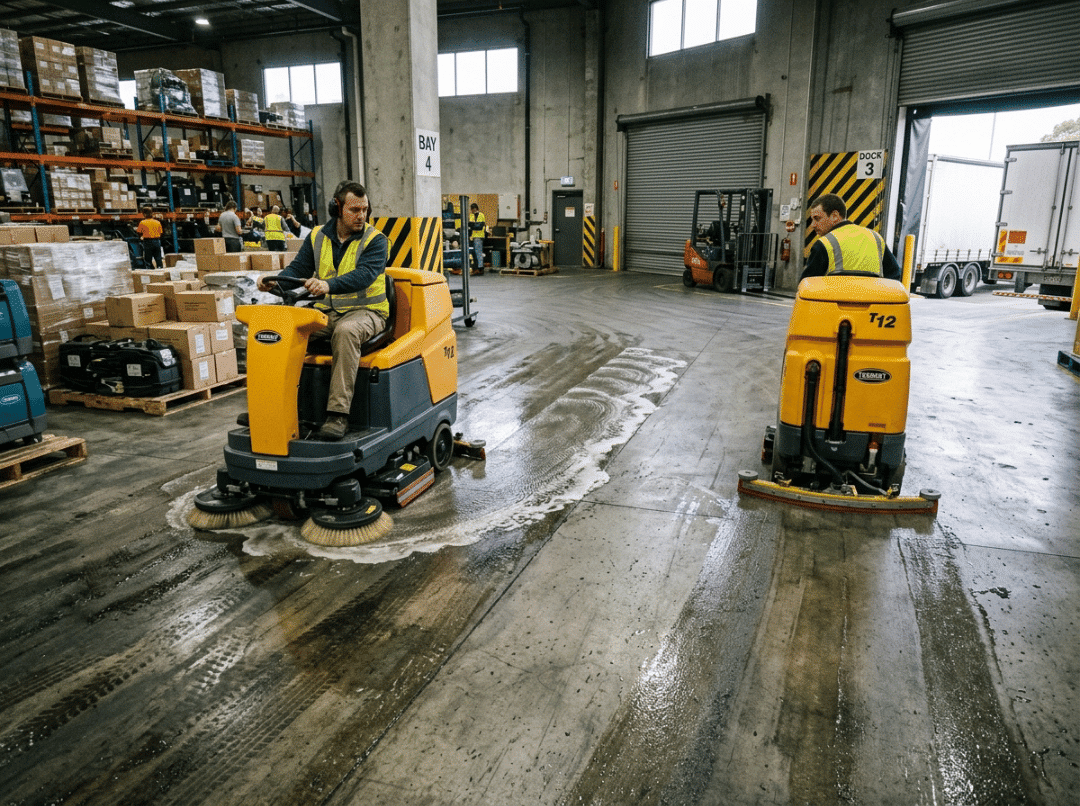
Dwell time accomplishes what additional detergent concentration cannot. It’s cheaper, easier on your machine, and more effective on caked-on soil.
Do You Need Defoamer?
Not if you’re using the right low-foam detergent at the correct dilution.
Defoamer is a corrective tool — most useful when switching from a foamy product that left residue in the tank and lines, or when foam unexpectedly builds despite using a labeled low-foam cleaner. Add it to the recovery tank, where foam actually accumulates. Do not add it to the solution tank.
If you find yourself reaching for defoamer after every job, that’s a signal to examine your detergent choice or dilution ratio. Correct the underlying cause, and the need for defoamer goes away.
Do This, Not That
|
Do This |
Not That |
|---|---|
|
Use a dedicated low-foam scrubber detergent |
Use dish soap or laundry detergent |
|
Measure dilution with a cup or dispenser |
Eyeball the chemical by feel |
|
Double scrub greasy areas with dwell time |
Keep adding more chemical to solve heavy soil |
|
Add defoamer to the recovery tank |
Add defoamer to the solution tank |
|
Match your cleaner to your soil and floor type |
Use the same cleaner for every situation |
|
Flush the tank after using harsh chemicals |
Leave degreaser or disinfectant residue in the system |
Common Mistakes to Avoid
Even experienced operators repeat these errors. Knowing them in advance saves downtime and repair costs.
- Using household soap. Dish soap and laundry detergent top the list of reasons vacuum motors fail early. They foam heavily and have no place in a scrubber.
- Overconcentrating the chemical. Floors look worse faster, and machine components wear sooner. More is not better.
- Choosing by scent. A product that smells clean tells you nothing about its foam level or machine compatibility.
- Ignoring foam buildup. If suds are rising in the recovery tank, stop the job and address it before the foam reaches the motor.
- Skipping the flush after harsh chemicals. After using a degreaser, a disinfectant, or any approved bleach-based product, run clean water through the solution system to protect seals and hoses.
- Using one cleaner for everything. Light dust and heavy grease require different products. Matching chemical to soil protects both your floors and your budget.
Frequently Asked Questions
Can you use dish soap in a floor scrubber?
No. Dish soap creates heavy suds that flood the recovery tank and can reach the vacuum motor. Even a small amount is enough to cause problems. Always use a low-foam detergent rated for automatic scrubbers.
Can you use regular floor cleaner in a floor scrubber?
Only if it’s explicitly low-foam and compatible with your floor type. Many household floor cleaners produce too much foam. A neutral, low-foam scrubber detergent is a safer and more consistent choice.
Can you use a degreaser in a floor scrubber?
Yes — as long as it’s a low-foam degreaser rated for scrubber use. It’s the right product for loading docks, commercial kitchens, and mechanical shops where grease buildup is the primary problem.
How much soap do you put in a floor scrubber?
Follow the dilution ratio on the label. For lightly soiled floors, you can often work at the lower end of the range. Measure rather than estimate — overconcentration causes residue buildup and machine wear.
What happens if the detergent foams too much?
Foam fills the recovery tank, reduces water pickup, triggers the float shutoff prematurely, and can be drawn into the vacuum motor. Stop the job, switch to a low-foam cleaner, and add defoamer to the recovery tank if foam is already present.
Do all floor scrubbers require low-foam detergent?
Yes. Every automatic scrubber vacuums water into a recovery tank connected to the vacuum motor. That makes foam a risk regardless of brand, size, or model. Low-foam detergent is the correct standard for all machines.
What’s the best detergent for a warehouse floor scrubber?
For routine dust and light grime, a neutral low-foam cleaner is the right daily choice. For zones with grease or tire marks — loading docks, vehicle entry points, mechanical bays — step up to a low-foam degreaser. Use double scrubbing on heavily soiled areas rather than increasing chemical concentration.
Conclusion
The right detergent choice comes down to three decisions made before you fill the tank: Is it low-foam? Does it match my floor surface? Does it match my soil level? Get those three right, follow the dilution instructions, and use double scrubbing on tough jobs instead of stronger chemistry. Those habits prevent the two most common failures — damaged vacuum motors and streaky, residue-covered floors.
A well-chosen cleaner works with your machine, not against it. If your current setup isn’t delivering clean results, the answer is usually the right product at the right dilution — not more of the wrong one. Browse our range of commercial floor scrubbers, cleaning solutions, replacement squeegee blades, and maintenance parts to keep your operation running at full performance.