




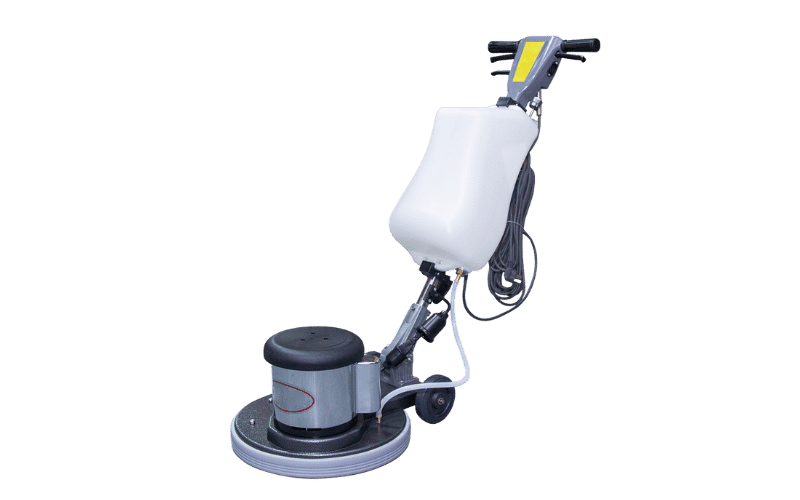



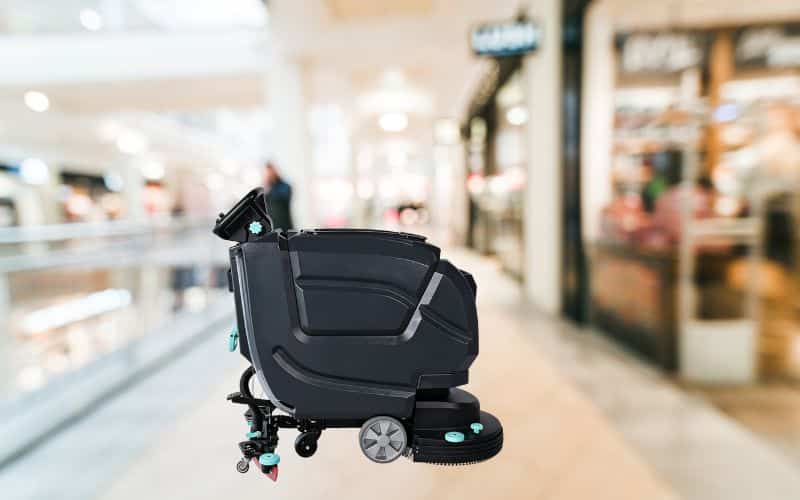
Floor scrubbers are one of the most versatile pieces of cleaning equipment in commercial and industrial facility management—yet many facilities still use them for only a fraction of what they’re capable of. This guide covers the seven most common uses of floor scrubbers, explains how each application works in practice, and helps facility managers across warehousing, healthcare, food processing, retail, education, manufacturing, and airports choose the right machine for their needs.
Key Takeaways
- Floor scrubbers clean, scrub, and dry hard floors in a single pass—eliminating the cross-contamination risk associated with mop-and-bucket systems.
- A 20-inch walk-behind scrubber can clean up to 16,000 sq ft per hour, compared to approximately 1,700 sq ft per hour with a standard mop (according to the ISSA 612 cleaning times study).
- The seven primary use cases span routine maintenance, deep cleaning, grease removal, textured floor cleaning, large-area coverage, hygiene-critical sanitization, and post-shift cleanup.
- Machine selection—walk-behind, ride-on, or robotic—depends on facility size, floor type, and soiling level.
- ROI on commercial floor scrubbers is typically achieved within one to two years, driven by labor savings and reduced chemical and water usage.
How Do Floor Scrubbers Work?
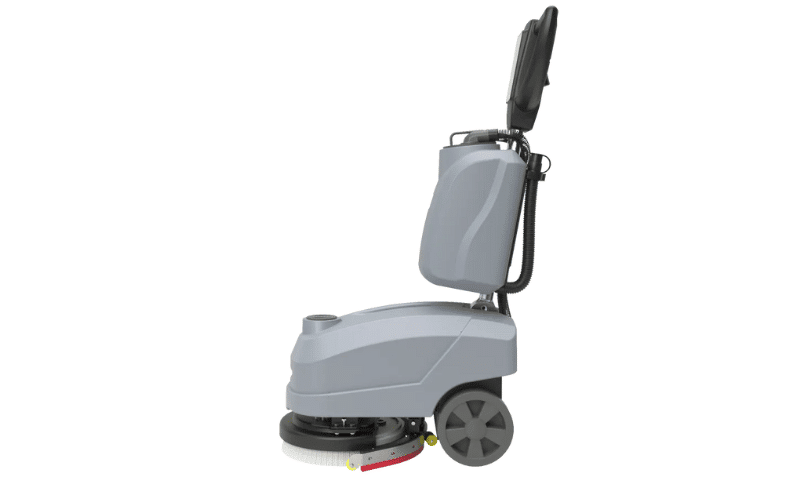
A floor scrubber applies a metered cleaning solution to the floor surface, agitates it with rotating brushes or pads, and immediately vacuums the resulting dirty water into a separate recovery tank. This three-stage process—apply, scrub, recover—means the machine never redistributes contaminated water across the floor the way a traditional mop does.
The separation of clean and dirty water tanks is one of the most important design features. It prevents cross-contamination, leaves floors dry almost immediately, and reduces slip hazards. Most commercial models also allow operators to adjust brush pressure, water flow, and cleaning speed to match the floor type and soil level.
What Industries Commonly Use Floor Scrubbers?
Floor scrubbers are standard equipment across a wide range of facility types:
- Warehousing and logistics — concrete and epoxy floors with heavy forklift and foot traffic
- Manufacturing and industrial plants — floors subject to oil, coolant, and production debris
- Healthcare facilities — strict hygiene requirements and infection control protocols
- Food processing and food service — grease, organic residue, and regulatory compliance
- Retail and shopping centers — high-visibility floors with continuous foot traffic
- Education (schools and universities) — large floor areas with daily use across multiple surfaces
- Airports and transit hubs — 24/7 operations requiring quiet, efficient, low-disruption cleaning
Each of these environments has distinct cleaning demands. The seven use cases below map directly to those demands.
7 Common Uses of Floor Scrubbers
1. Routine Daily Maintenance
The most common use for a floor scrubber is straightforward: keeping hard floors clean during normal operations. Facilities that previously relied on mops for daily cleaning consistently report faster turnaround times, better hygiene outcomes, and reduced staff fatigue after switching to automated scrubbing.
According to the ISSA 612 cleaning times study, a standard 16-ounce mop head covers approximately 1,700 sq ft per hour. A 20-inch walk-behind scrubber covers up to 16,000 sq ft per hour—roughly nine times the area. For a facility manager running daily cleaning across a 50,000 sq ft floor, that difference is measured in labor hours, not minutes.
How to get the most from it: Use a low-foam, neutral-pH detergent appropriate for your floor type. Set the brush pressure to match the surface—lighter for vinyl or sealed hardwood, heavier for textured concrete or tile grout. Run the machine before peak foot traffic hours to minimize disruption.
Leadv Clean’s walk-behind floor scrubbers (with 45L–60L solution tank capacity) are well-suited to this application in medium-to-large facilities. For tighter spaces such as restrooms or server corridors, Leadv Clean’s small floor scrubbers (5L–45L) offer the maneuverability needed without sacrificing cleaning performance.
2. Heavy-Duty Deep Cleaning
Periodic deep cleaning removes embedded grime, stubborn staining, and buildup that routine maintenance misses. This typically involves higher brush pressure, slower machine passes, and a more concentrated cleaning solution. Some facilities schedule deep cleans weekly; others do so monthly, depending on traffic levels and floor type.
Deep cleaning is where the mechanical advantage of a scrubber really shows. Rotating brushes can reach into grout lines, textured surfaces, and surface irregularities that a flat mop head simply cannot access. Crescent Industrial notes that industrial scrubbers remove more bacteria, grease, debris, and allergens than traditional cleaning tools—a benefit that compounds over time as residue buildup is prevented rather than managed.
How to get the most from it: Reduce machine travel speed during deep cleans to allow longer brush contact time. Increase solution flow slightly to ensure the detergent has time to emulsify soiling before the scrub head passes. Always sweep or vacuum the floor before deep cleaning to prevent large debris from clogging the recovery system.
3. Grease and Oil Removal
Grease and oil represent one of the most demanding cleaning challenges in manufacturing plants, commercial kitchens, food processing facilities, and automotive workshops. Left unaddressed, oil-contaminated floors create serious slip hazards and can compromise floor coatings over time.
Floor scrubbers equipped with stiff-bristle brushes and degreaseant-compatible solution systems are the right tool for this job. The mechanical scrubbing action breaks up the bond between grease and the floor surface, while the recovery system removes the emulsified residue immediately, rather than spreading it across a wider area as a mop would.
How to get the most from it: Use a degreasing detergent rated for your floor type and compatible with the scrubber’s seals and components. For heavy accumulations, consider a pre-treatment application before the scrubber pass. In food processing environments, ensure the cleaning solution is food-safe and compliant with applicable local regulations. Leadv Clean machines support compatibility with specialized cleaning solutions and can be configured with appropriate brush types for high-soil applications.
4. Non-Slip and Textured Floor Cleaning
Non-slip and textured surfaces—anti-slip tiles, rough concrete, quarry tile, and diamond-plate flooring—are designed to grip underfoot. That same texture traps dirt, grease, and bacteria in ways that flat surfaces don’t. A flat mop pad rides over the surface profile and misses most of what’s embedded in the texture.
A scrubber with cylindrical or stiff disc brushes reaches into the surface profile and dislodges what’s trapped there. This is particularly important in wet environments like food processing areas, commercial kitchens, and pool surrounds, where floor hygiene directly affects safety compliance.
How to get the most from it: Select brushes specifically designed for textured or profiled floors. Cylindrical brush systems generally outperform disc systems on heavily textured surfaces. Increase brush pressure slightly above the setting used for smooth floors. Reduce travel speed to allow full brush engagement across the surface profile.
5. Large-Area Coverage
Airports, distribution centers, manufacturing halls, and large retail or exhibition spaces present a coverage challenge that walk-behind equipment cannot efficiently address. A ride-on floor scrubber changes that equation entirely.
Leadv Clean’s ride-on floor scrubbers achieve cleaning efficiencies of up to 5,500m²/h—covering large industrial spaces in a fraction of the time required by walk-behind units. According to figures cited by Imperial Brady, ride-on scrubbers deliver up to 40% more productivity than walk-behind models, making them the logical choice wherever square footage is the primary constraint.
How to get the most from it: Plan cleaning routes in advance to minimize overlap and dead turns. Use overlapping passes by 10–15% at the machine’s edge to ensure consistent coverage. Where facilities operate continuously, schedule cleaning during low-traffic windows or use robotic scrubbers programmed to run on defined routes during off-peak hours. Leadv Clean’s robotic floor scrubber range is specifically designed for these high-frequency, large-area applications.
|
Scrubber Type |
Coverage Rate |
Best For |
|---|---|---|
|
Small walk-behind |
Up to ~1,000m²/h |
Restrooms, corridors, and small retail |
|
Standard walk-behind |
Up to 3,000m²/h |
Medium facilities, schools, offices |
|
Ride-on |
Up to 5,500m²/h |
Warehouses, airports, industrial halls |
6. Hygiene-Critical Sanitization Protocol Support
Healthcare facilities, pharmaceutical manufacturing plants, and food processing operations operate under strict hygiene standards. In these environments, floor scrubbers don’t just clean—they form part of an infection control or contamination prevention protocol.
The case for scrubbers over mops is especially strong here. Mop water becomes contaminated rapidly and, when reapplied to the floor, spreads pathogens rather than removing them. Research cited by Minuteman International notes that Clostridium difficile, a highly resilient pathogen, can survive on floor surfaces for up to five months. The UK Department of Health has reported that organizations failing to adequately sterilize floors to prevent healthcare-associated infections (HCIs) can face costs approaching $1 billion from related incidents and legal liability.
A floor scrubber’s closed-loop water system—where clean and dirty water never mix—eliminates this risk of recontamination. When combined with appropriate disinfectant detergents, it supports infection control standards in ways that manual mopping cannot reliably replicate.
How to get the most from it: Work with your infection control or quality assurance team to select a detergent that meets both the scrubber manufacturer’s specifications and applicable hygiene standards (such as EPA-registered disinfectants in the US, or COSHH-compliant products in other markets). Clean recovery tanks after every use in healthcare settings. Leadv Clean machines hold international certifications, including ISSA and CE, supporting compliance requirements across multiple markets.
7. Post-Shift or Post-Event Cleanup
Shift changeovers in manufacturing and food processing, end-of-day cleanup in retail, and post-event cleaning in airports and public venues share a common requirement: large areas must be cleaned quickly, thoroughly, and safely before the next operational period begins.
Speed is the critical factor here. A ride-on or robotic scrubber covers ground fast enough to complete the full floor area within the available window, without requiring a large cleaning crew. Floors are left dry immediately, so the area can be reopened as soon as the machine clears it—no waiting for wet floors to dry, no additional slip hazard management.
How to get the most from it: Develop a consistent cleaning route map so operators can complete the floor area efficiently without backtracking. For facilities with regular, predictable cleanup windows, robotic scrubbers programmed with defined routes offer the most consistent results with minimal staffing. Pre-position the machine and check the solution and battery levels before the shift ends so the equipment is ready immediately when cleaning begins.
Floor Scrubber vs. Traditional Mop: What Actually Changes?
The operational difference between a mop and a floor scrubber is larger than most facility managers expect until they compare the numbers directly.
|
Factor |
Mop and Bucket |
Floor Scrubber |
|---|---|---|
|
Coverage per hour |
~1,700 sq ft |
Up to 16,000+ sq ft |
|
Water cross-contamination |
High (shared bucket) |
None (separate tanks) |
|
Floor dry time |
20–40 minutes |
Near-immediate |
|
Slip hazard during cleaning |
High |
Low |
|
Labor intensity |
High |
Low |
|
Long-term cost |
Lower upfront, higher labor costs |
Higher upfront, lower total cost |
The switch from mop to scrubber typically pays for itself within one to two years, driven by labor reduction, lower water and chemical consumption, and reduced liability exposure from slip-and-fall incidents.
Walk-Behind vs. Ride-On Scrubbers: Which Is Right for Your Facility?
The right machine type depends primarily on the size and layout of the area being cleaned, as well as the required frequency and intensity of cleaning.
Choose a walk-behind floor scrubber if:
- Your facility is under approximately 30,000 sq ft of hard floor
- The layout includes tight corners, narrow aisles, or frequent obstacles
- You need flexibility across multiple zones with varied floor types
- Budget constraints make a ride-on impractical at this stage
Choose a ride-on floor scrubber if:
- You manage large, open-plan floor areas in warehouses, manufacturing halls, or airports
- Cleaning speed and coverage are the primary operational constraints
- You want to reduce the number of operators required per shift
- Your facility operates continuous shifts with limited cleaning windows
Choose a robotic floor scrubber if:
- Consistent, unsupervised cleaning is required during off-hours
- You want to free staff for higher-value tasks
- The floor layout is regular and predictable enough for programmed routes
- You’re managing multiple facilities and want centralized cleaning management
Leadv Clean offers all three categories: ride-on models capable of up to 5,500 m²/h, walk-behind models covering up to 3,000 m²/h, and compact scrubbers for confined spaces. All machines are available at factory-direct pricing and are backed by a two-year/2,000-hour warranty on larger units.
When Not to Use a Floor Scrubber
Floor scrubbers are not the right tool in every situation. Understanding the limitations protects both the machine and the floor surface.
- Carpeted or soft surfaces — scrubbers are designed for hard floors only
- Heavily damaged or uneven floors — deep cracks, lifting tiles, or severely pitted surfaces can damage brush heads and leave sections uncleaned
- Floors with large loose debris — always sweep or vacuum first; large debris can block the recovery system
- Unsealed natural wood or highly porous materials — excess moisture can cause warping or surface damage
- Very confined spaces — areas too narrow for the machine’s scrubbing head require micro scrubbers or manual cleaning tools
How to Choose the Right Floor Scrubber for Your Facility
When evaluating floor scrubbers, work through these criteria systematically:
- Total floor area — determines whether a walk-behind, ride-on, or robotic unit is appropriate
- Floor type — concrete, tile, epoxy, vinyl, and marble each require different brush types and pressure settings
- Soiling level — light daily traffic needs different specifications than a food processing plant or automotive workshop
- Operating hours — facilities with limited cleaning windows benefit from higher-coverage machines; those needing 24/7 cleaning should consider robotic options
- Power supply — battery-powered machines offer the most flexibility indoors; corded models are suited to smaller areas with nearby power access
- Regulatory requirements — healthcare, food processing, and pharmaceutical facilities may require machines with specific certifications (Leadv Clean machines carry ISSA and CE certifications)
- Budget and total cost of ownership — factor in machine cost, consumables, maintenance, and labor savings over a two-to-five-year period
The Right Machine Changes Everything
Selecting the correct floor scrubber—and using it correctly across the right applications—is one of the highest-impact decisions a facility manager can make. The productivity gains, hygiene improvements, and cost reductions are measurable and typically visible within the first few months of operation.
Leadv Clean manufactures a full range of commercial and industrial floor scrubbers, including walk-behind, ride-on, and robotic models, supplied factory-direct to facilities worldwide. Whether you’re equipping a new warehouse, upgrading an existing cleaning program, or evaluating options for a healthcare or food processing environment, the Leadv Clean team can help you identify the right specification for your floor type, area, and budget.
Contact Leadv Clean at sales@leadvclean.com or visit leadvclean.com to request factory-direct pricing and technical guidance for your facility.
Frequently Asked Questions
What are the most common uses of a floor scrubber?
Floor scrubbers are most commonly used for routine daily floor maintenance, heavy-duty deep cleaning, grease and oil removal, large-area coverage in warehouses and airports, hygiene-critical sanitization in healthcare and food processing facilities, non-slip surface cleaning, and post-shift or post-event cleanup. Each use case benefits from a different machine configuration and cleaning approach.
Can floor scrubbers be used in food processing facilities?
Yes. Floor scrubbers are widely used in food processing environments because they remove grease and organic residue more effectively than mops and eliminate the risk of cross-contamination from shared mop water. Food processing applications require food-safe detergents and, in some cases, machines with stainless-steel components or explosion-proof configurations for environments containing flammable substances.
How much faster is a floor scrubber compared to a mop?
According to the ISSA 612 cleaning times study, a 20-inch walk-behind floor scrubber covers up to 16,000 sq ft per hour, compared to approximately 1,700 sq ft per hour with a standard 16-ounce mop head. That represents roughly nine times the coverage rate. Ride-on scrubbers further increase that advantage, cleaning up to 5,500 m²/h in large open facilities.
What type of floor scrubber is best for a large warehouse?
Ride-on floor scrubbers are the preferred choice for large warehouses, as they cover the most ground per hour and reduce operator fatigue over long cleaning shifts. Robotic floor scrubbers are increasingly used in warehouses where consistent off-hours cleaning is a priority. For warehouses with narrow racking aisles, compact walk-behind models may be needed alongside a ride-on for open areas.
Are floor scrubbers suitable for healthcare environments?
Floor scrubbers are strongly recommended for healthcare environments. Mops recontaminate floors by spreading pathogens through shared bucket water, while floor scrubbers use separate clean and dirty water tanks to prevent cross-contamination. Research indicates that pathogens such as Clostridium difficile can survive on floors for up to five months, making mechanical scrubbing with appropriate disinfectants essential in hospitals and clinics.
How long does it take to see a return on investment from a floor scrubber?
Most organizations report recovering their floor-scrubber investment within 1 to 2 years. The primary savings drivers are labor cost reduction (one operator can replace multiple manual cleaners), lower water and chemical consumption due to metered dispensing systems, and reduced liability exposure from fewer slip-and-fall incidents.
What floors should not be cleaned with a floor scrubber?
Floor scrubbers should not be used on carpeted surfaces, heavily damaged or structurally compromised floors, unsealed natural wood, or floors with significant loose debris that has not been swept first. Always verify that the brush type and pressure settings are appropriate for the specific floor material before operating the machine.